Part 2: Dollars, Cents & Broken Pipes
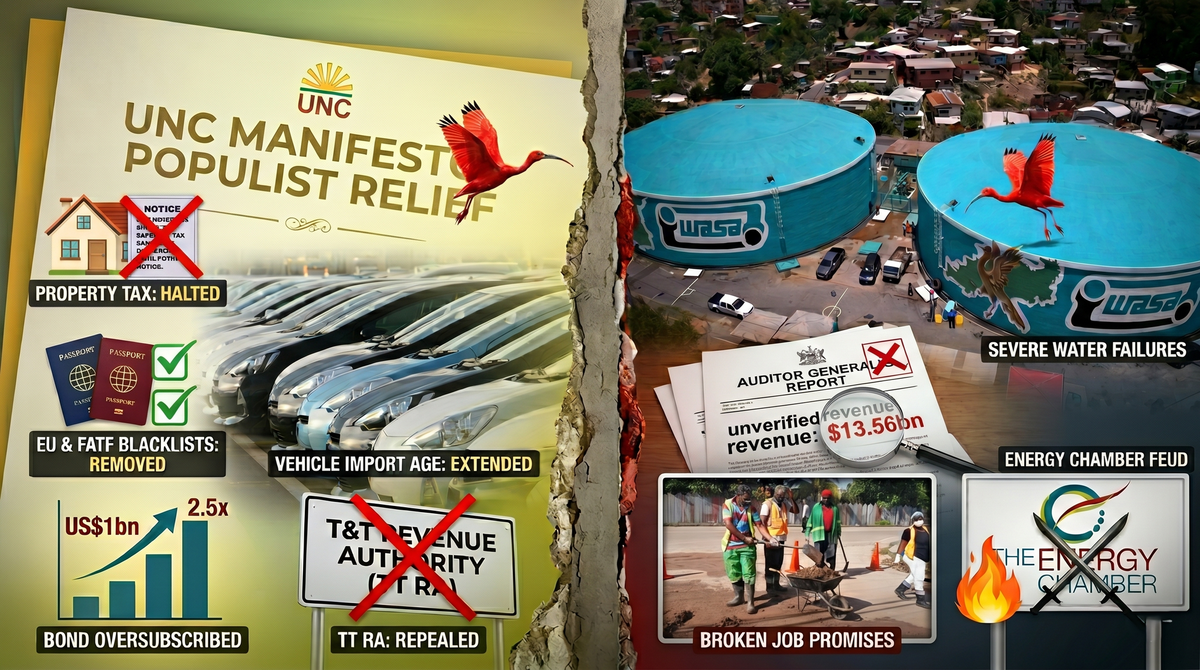
The UNC offered immediate populist relief by halting property taxes and repealing the TTRA. But broken job promises, the Auditor General's qualified opinion on $36.56bn in unverified revenue, severe water failures and an open feud with the Energy Chamber expose the gap between manifesto and reality.
The Brief
- The 2025/2026 budget set out a deficit of $8.7bn against revenue of $50.6bn.
- Genuine wins: TTRA repeal, property tax halt, $1 cut on super gasoline, vehicle import age extended, removal from EU and FATF blacklists, a US$1bn bond oversubscribed 2.5 times.
- The Auditor General's report on the 2025 Public Accounts flagged $36.56bn in unverified tax revenue, $1.59bn in unsupported expenditure, and a $5.4bn off-budget Waterfront sublease arrangement.
- Around 15,000 jobs delivered against the manifesto promise of 50,000. CEPEP and URP audits left thousands of vulnerable households without income.
- WASA's El Socorro Booster Station crisis left over 200,000 residents without reliable water. School maxi taxi payment crisis stretching back to mid-2025 culminated in disrupted service into 2026.
- The PM's January 2026 attack on the Energy Chamber as "self-serving, greedy" and a "farce", combined with proposed gas price hikes for non-energy manufacturers, has unsettled both pillars of the productive economy.
- Petrotrin restart talks now active with Indian Oil Corporation, Chevron, Reliance, and Oando. Late 2026 partial restart targeted.
To understand the policy trajectory and the administrative challenges of the past twelve months, we have to look at the fiscal realities the country was handed. When Finance Minister Davendranath Tancoo presented the State's ledgers on October 13, 2025, delivering his maiden 2025/2026 National Budget Statement – titled "T&T First: Building Economic Fairness through Accountable Fiscal Policies" – he had to give the nation a sobering diagnosis.
The preliminary outturn for Fiscal 2025 showed a deficit of $8.7 billion, with revenue of $50.6 billion against expenditure of $59.3 billion. The 2026 budget was anchored on an oil price assumption of US$73.25 per barrel. Tancoo structured his fiscal approach around five strategic pillars: restoring financial stability, unlocking productive investment, commercialising public assets, modernising infrastructure, and protecting the vulnerable through enhanced safety nets. It was a declaration of intent designed to assure an anxious populace that the bleeding had stopped and the rebuilding had begun.
The government's response has been a fascinating, if often chaotic, tightrope walk between necessary fiscal prudence and desperately needed populist relief. We saw the immediate fulfilment of a major campaign promise with the rapid repeal of the controversial Trinidad and Tobago Revenue Authority (TTRA) Act. The dismantling of this entity was widely celebrated by public sector unions, who had argued for years that the TTRA was a punitive, overreaching institution that threatened worker security and civil service independence. Simultaneously, the administration halted the implementation of the highly unpopular residential property tax. For years, the impending tax had hung over working and middle-class households, generating anxiety for citizens already struggling with inflation and stagnant wages. Pausing it indefinitely was a clear choice to prioritise domestic relief over revenue collection. The administration also instituted a $1 reduction in the price of super gasoline and extended the permissible age of importation for private vehicles from three years to six, providing immediate relief on the cost of living.
Looking outward, the government has racked up some genuine wins on international credibility. T&T was removed from both the European Union tax blacklist and the FATF blacklist, and a US$1 billion bond was oversubscribed 2.5 times with participation from 140 global investors. These are not small things – they restore the country's standing with international financial institutions, which translates directly into cheaper borrowing and easier trade.
Then came the Auditor General's report, tabled in Parliament on April 25, 2026. Auditor General Jaiwantie Ramdass issued a qualified opinion on the 2025 Public Accounts, citing $36.56 billion in tax revenue that could not be verified because of unreconciled differences across Treasury records and Inland Revenue Division reports. She also found $1.59 billion in expenditure – about 2.43% of total government spending – that lacked supporting documentation. Public debt stood at $117.46 billion as at September 30, 2025, an increase of $7.32 billion or 6.65% from the previous year, with total debt amounting to 191% of total revenue. The HDC was found to have used $78.07 million approved for housing construction to instead fund grass cutting, garbage collection and drain cleaning. Government rent expenditure surged 35% to $665.7 million. And a $5.4 billion off-budget financing arrangement built on a 30-year Waterfront sublease – not formally classified as government debt – was flagged as obscuring the true level of public liabilities.
This is the messy reality of inherited fiscal architecture. A lot of it predates the UNC. But once you take office, you own the books. The administration's response has been muted, and the Opposition has seized on the report as evidence that the "promise made, promise kept" rhetoric of the budget needs to be tested against what the auditors actually find.
The harsh reality on the ground tells a different story of severe infrastructural decay, utility failures, and unmet promises. During the slick, well-funded campaign, the UNC promised the rapid creation of 50,000 new jobs to revitalise the working class. A year on, the Prime Minister has accounted for around 15,000 jobs – about 30% of the headline pledge – across various ministries (3,185 in Rural Development and Local Government, 2,647 in Education, 1,800 in Works and Transport, and so on). Whether you accept the tally is one question. Whether the pace will get us anywhere near 50,000 by 2030 is another. Citizens who depended on state-funded relief programmes like CEPEP and URP found themselves out of work as the government halted the initiatives pending audits, leaving thousands struggling for stable income. For people like "Josanne", a single mother in Sangre Grande who lost her State job shortly after the election, macroeconomic pivots toward artificial intelligence and fintech mean nothing when she cannot put food on the table today.
Our basic utilities remain in a state of perpetual crisis. This was glaringly evident between April 14 and April 17 this year, when mechanical failures at the El Socorro Booster Station left huge swathes of Port of Spain, Laventille, Cascade, St James, and Woodbrook entirely without a reliable water supply. On April 14, WASA confirmed that an electrical fault linked to a starter mechanism caused a booster unit to trip. While Public Utilities Minister Barry Padarath blamed the crisis on a "decade of neglect" by the PNM, admitting in Parliament on April 17 that the booster station was operating at 50% capacity, exhausted citizens are growing weary of the political blame game. By April 16, WASA had to announce that a further "small but critical repair" to the Booster #3 motor was required, extending the suffering of over 200,000 residents. Citizens cannot bathe with political excuses. To the government's credit, it allocated $298.9 million for coastal protection to save communities like Granville and Otaheite from erosion, but daily utility functionality remains poor.
The transport and education sectors haven't fared much better. The school maxi taxi payment crisis, which simmered through the second half of 2025, escalated when over 100 drivers complained that for eight months they had received no payments. Education Minister Dr Michael Dowlath confirmed in Parliament that $11.97 million had been paid since May 2025 with $10.79 million still outstanding. The Tobago school transport service was disrupted again in March 2026, with drivers saying they had not been paid for the year. For pupils in rural Trinidad and across the sister isle, this isn't just a bureaucratic inconvenience – it is missed school. Adding insult, Trade, Industry and Tourism Minister Satyakama Maharaj championed a proposal to remove the airbridge subsidy for peak morning and evening flights, which could see Caribbean Airlines tickets between Trinidad and Tobago rise to $1,000. For a government that ran on "Trinidad and Tobago First", pricing its own citizens out of inter-island travel is a contradiction the PM has since had to back away from, confirming at the anniversary congress that no Cabinet decision has yet been taken on adding two unsubsidised flights.
Then there is the government's open feud with the productive sector. In January 2026, ahead of the T&T Energy Conference at the Hyatt, the Prime Minister described the Energy Chamber and its conference as a "farce" and its members as "self-serving, greedy and have acted in a detrimental manner towards citizens and the country". She ordered all state energy companies to remove STOW certification as a prerequisite for qualifying for work – a position a Trinidad Express editorial called "rather odd" given that the Paria diving disaster, which took the lives of four men, is still working its way through the courts. If any event highlights the need for better safety protocols, especially at state-owned companies, it is that tragedy.
Almost simultaneously, the country learned of a proposed 76% increase in the price of natural gas to non-energy manufacturers – a move that would hammer manufacturing competitiveness. The Newsday editorial page noted dryly that "in the space of a couple days, the UNC government has managed to unsettle the two most critical pillars of the TT economy". You can disagree with a chamber. You can refuse to attend its conference. But describing the body that represents 400 companies in your largest export sector as "greedy" in a public WhatsApp message is not a strategy. It is a tantrum.
Yet there are glimmers of hope on the industrial front. On January 30, 2026, Energy Minister Dr Roodal Moonilal confirmed the government was in active talks with the Indian Oil Corporation (IOC), Chevron, and Nigeria-based Oando regarding the potential restart of the Pointe-à-Pierre refinery, mothballed by the PNM in 2018. Moonilal told Reuters that "by the end of this year or so, end-2026, we may be on target to start back some level of production". A four-phase restart strategy is in place, following the Refinery Restart Committee's interim report submitted by former Energy Minister Kevin Ramnarine in December 2025. While this has sparked excitement and cautious optimism in communities like Marabella and San Fernando, where hundreds were thrown on the breadline, residents and energy experts are watching closely. Will negotiations translate into concrete revival, or remain political theatre? To keep the populace pacified, the Prime Minister has assured the nation that "brighter days are ahead". They had better come quickly.
Next:
Part 3: The Working Class, Social Welfare & Nursing Crisis →