Part 4: The National Security Dilemma
Despite a 42% drop in murders heavily reliant on emergency powers, national security remains the government's most urgent open wound. The collapse of the ZOSO Bill, the police killing of Joshua Samaroo, and the murder of Corporal Anuska Eversley inside her own station expose a state losing its grip.
The Brief
- 2025 closed with 369 murders – a 42% reduction on 2024's 626 – but driven heavily by State of Emergency declarations.
- Zones of Special Operations Bill collapsed in the Senate after eight Independent Senators and six Opposition Senators voted against it.
- The Home Invasion (Self-Defence and Defence of Property) Act 2025 enacts "Stand Your Ground" principles into law.
- Police killing of Joshua Samaroo and paralysing of Kaia Sealy ignited national protests and demands for the resignations of Police Commissioner and Homeland Security Minister.
- The murder of Acting Corporal Anuska Eversley, and the theft of more than 100 firearms and 4,000 rounds of ammunition from the armoury, exposed institutional rot.
- The Brent Thomas apology – the AG's discontinuance of the State's appeal – and the Roger Alexander prison-visits investigation are warning signs about the state of our security institutions.
- Over $4 million ordered in compensation to the families of five men unlawfully killed by police during a 2018 Laventille operation.
If the economy presents a structural challenge, national security remains this administration's most urgent, continually bleeding wound.
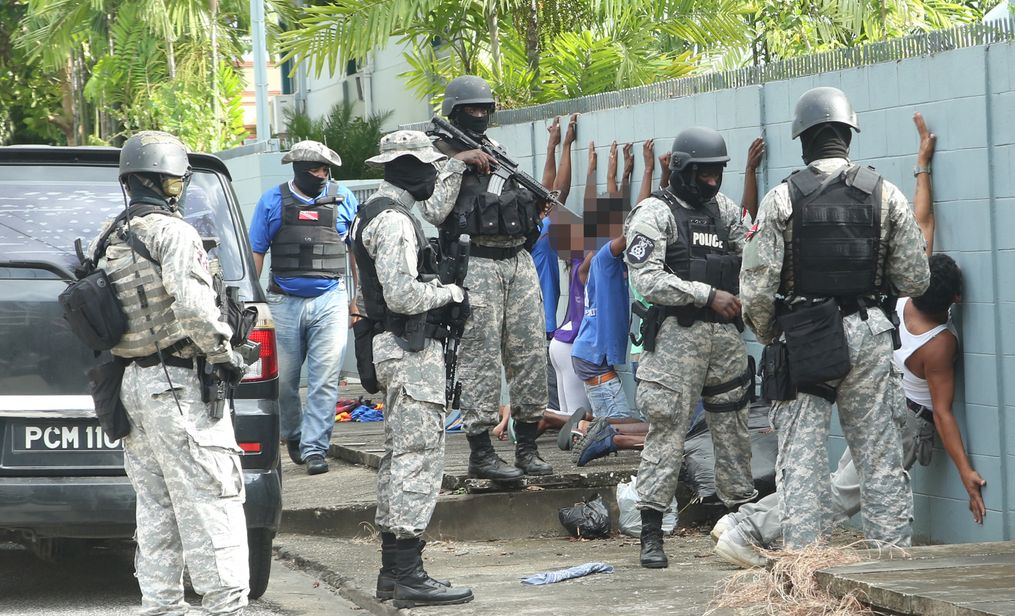
The government has rightfully heralded a 42% reduction in homicides – 369 murders in 2025, against 626 in 2024 – the lowest annual figure since 2014. The streets, however, do not feel any safer to the average citizen. The reduction has rested heavily on emergency executive powers. The first State of Emergency was declared by the previous Rowley government in December 2024 and extended by Persad-Bissessar after taking office. A second SoE was declared on July 18, 2025, after police uncovered a "coordinated and highly dangerous criminal network" operating within the prison system. That SoE ran until January 31, 2026. A third nationwide SoE was declared on March 2-3, 2026, following another spike in violent activity, and was extended for a further three months in mid-March 2026. By the PM's own admission, T&T has been under a State of Emergency for about 10 of the last 14 months. I am deeply uncomfortable with a government that casually relies on suspending the constitution, instituting Preventive Detention Orders (PDOs), and stripping basic civil liberties to artificially suppress crime rates – and I do not think the comfort the figures provide outweighs the long-term risk of treating emergency powers as the new normal.
Recognising the unsustainability and unpopularity of perpetual emergencies, the administration aggressively attempted to alter the security landscape with the Zones of Special Operations Bill 2026. This legislation aimed to grant the Prime Minister, in consultation with the Police Commissioner and Chief of Defence Staff, the authority to designate specific high-crime areas as "Zones of Special Operations" – areas subject to military cordons for 24 hours, curfews of up to 72 hours, warrantless searches under specific conditions, and detentions under limited court oversight. A zone could remain in effect for up to 180 days. Defence Minister Wayne Sturge defended the bill, explaining it contained judicial safeguards.
The legislation collapsed in the Senate on January 27, 2026. The 15 Government Senators voted in favour; eight of nine Independent Senators and six Opposition Senators voted against, with one abstention from Independent Senator Courtney McNish. The bill required a three-fifths majority because it would have contravened the rights enshrined in sections 4 and 5 of the Constitution. Independent senators argued on the content of the legislation and societal concerns, not on partisan grounds. Rather than accepting the democratic process, the Prime Minister launched a publicised attack on the Independent Senators and the Law Association of Trinidad and Tobago, which the LATT condemned as an authoritarian attempt to undermine the independence of the upper house.
This legislative failure has been paired with the normalisation of extreme violence, championed from the very top of government. On the campaign trail in 2023, and again at the closing UNC rally at Aranguez Savannah on April 26, 2025, two days before the election, Persad-Bissessar urged citizens to deal with home invaders by declaring, "Load up your 'matic. Light them up. Empty the clip!" Quoting from a Trinibad song popularised by Prince Swanny, she added, "When you're done, knock it on them, knock it again." This rhetoric was condemned by human rights groups, the Council for Responsible Political Behaviour, and moderate liberals, who rightly argued that the head of government was tacitly endorsing extrajudicial killings and vigilantism. The Prime Minister doubled down, refused to apologise, and insisted the public needed to defend themselves.
This vigilante sentiment has been codified into law with the passage of the Home Invasion (Self-Defence and Defence of Property) Act, 2025. Officially proclaimed into law on January 20, 2026, the legislation removes the "duty to retreat" and legally affirms the use of deadly force to protect property. Defence Minister Wayne Sturge defended the law during debates by asking, "If you come into my house at 2 am and you are armed and I am outnumbered... what should I do? Wait for him to turn back around? Figure out if he's a douen? That's my opportunity." The legislation is popular among a terrified electorate desperate for protection. It also represents a dark shift in our social fabric, importing American-style "Stand Your Ground" philosophies into an already fractured society.
The State security apparatus is visibly imploding under the weight of relentless scandals. Public trust was shattered following the fatal police-involved shooting of 31-year-old Joshua Samaroo and the catastrophic injury of his common-law wife Kaia Sealy in St Augustine on January 20, 2026. CCTV footage appeared to show Samaroo actively surrendering – rolling down his window and sticking his hands out – before officers fired at least 17 rounds into the vehicle. Samaroo was killed; Sealy, the mother of their five-year-old daughter, was left paralysed. Furious protests gathered outside Woodford Square on February 2 demanding the resignations of Commissioner Allister Guevarro and Homeland Security Minister Roger Alexander. Rather than ensuring transparency, Alexander stated on television that "Something needs to be done with those who do that in terms of the law", proposing to introduce legislation to criminalise the public sharing of CCTV videos that expose police abuses. Forensic reports remain outstanding; no officer has been suspended.
Alexander himself has become a lightning rod for parliamentary friction. Known for his abrasive persona on Beyond the Tape, he has drawn fire for invoking "national security interests" as a blanket excuse to avoid answering basic questions about public expenditure, refusing even to detail the leasing of police vehicles. At a seminar on vulnerable youth, he claimed the core issue driving young men to crime was the "Three Gs: Guns, Girls and Gold", drawing a sharp rebuke from the Association of Psychologists, who pointed out that criminality is the result of cumulative societal failures, not catchphrases. More serious is the October 2025 investigation into Alexander's pre-election prison visits to Maximum Security inmates, including a January 17, 2025 visit to alleged gang figure Sheldon "Stiff" Ali – a visit then approved through the TTPS chain of command while Alexander was still a serving officer. Attorney Krystal Primus has alleged that the visits may have included political support and contract promises. Alexander denies the allegations and has threatened legal action. Whichever side of the truth this lands on, it is not the kind of cloud you want hanging over your Homeland Security Minister.
The security crisis reached its nadir with the murder of Acting Corporal Anuska Eversley inside the San Fernando Municipal Police Station on April 19, 2026. Eversley, a 42-year-old mother of three with over 19 years' service, was found dead at around 4.40 a.m. The autopsy confirmed she was beaten, strangled and stabbed. Following her murder, more than 100 firearms – 114 pistols, one revolver, six shotguns, two MPX submachine guns – along with 173 firearm magazines and over 4,400 rounds of ammunition, were discovered missing from the station's armoury. By April 24, three men had been charged: serving Municipal Police Constable Jivan "Bigs" Cooper, 28, alongside scrap iron dealer Nicholas "Nico" Ramdass, 24, and construction worker Kwame Arnold, 20, all of Claxton Bay. Forty-four firearms have since been recovered. The head of the T&T Municipal Police Service, ACP Surrendra Sagramsingh, was sent on administrative leave and replaced by ACP Wayne Mystar. Five other officers attached to the station have been suspended. Senior sources told the Trinidad Express that preliminary investigations point to a group of municipal officers allegedly involved in the sale of firearms and ammunition to the criminal underworld for the past six to eight months.
Two other matters underline how deep the rot runs. In September 2025, Attorney General John Jeremie issued a public apology to firearms dealer Brent Thomas, acknowledging the "gross abuse of power" Thomas endured when he was unlawfully detained in Barbados in October 2022 and forcibly returned to T&T without extradition proceedings. The State withdrew its appeal of the 2023 High Court ruling that had found the actions unconstitutional and is now in good faith negotiations on damages. And on the night of April 19, 2026, before Eversley's body was even recovered, the High Court delivered another ruling: five men killed by police during a 2018 operation in Laventille were unlawfully shot, and the State must pay their families more than $4 million. None of this happened on this government's watch – the misconduct predates them. But this is the institutional culture they inherit and now must reform.
And as if all of that isn't enough, we still have the Defence Minister declaring on national television that "There are certain types of murders you can never prevent" following the killing of teenager Mariah Seenath, effectively absolving the State of its fundamental duty to protect its citizens. Meanwhile, former FIFA executive Jack Warner publicly threatened former Attorney General Faris Al-Rawi with defamation lawsuits in August 2025 after current AG John Jeremie ordered a fresh investigation into the State's prior handling of Warner's extradition.
When those sworn to protect us are murdering each other inside their own stations, arming the criminal underworld from police armouries, and throwing their hands up in defeat, the government cannot credibly claim it has a grip on national security.
Next:
The T&T First Doctrine, US Militarism & the Cost of Our Souls →