Part 6: The Diaspora Disconnect & Global Mobility
Repeated States of Emergency have triggered travel advisories from global allies and condemnation from human rights groups. Meanwhile, the UNC owns the diplomatic burden of fixing the UK visa restrictions imposed under the PNM in March 2025.
The Brief
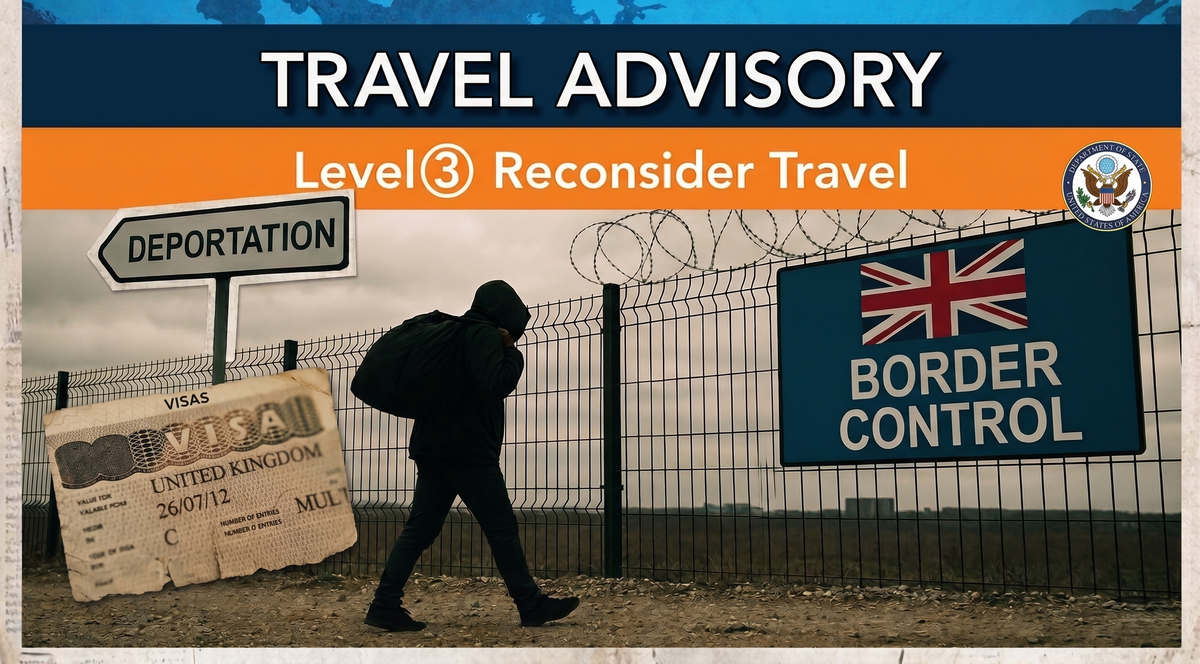
- US State Department reissued Level 3 "Reconsider Travel" advisory; Canada, Australia, Germany, and the UK FCDO updated travel guidance to reflect the SoE.
- UK visa-free entry was revoked by the PNM-era Home Office after a huge rise in asylum applications.
- Visa requirement prevented an estimated 4,541–6,174 asylum claims and saved the UK Home Office £278-377 million in support costs. 90–97% of T&T asylum applicants have been forcibly repatriated.
- Advance Passenger Information and Passenger Name Record Bill 2026 introduced to support diplomatic re-engagement.
- ETIAS for Schengen Area takes effect Q4 2026 and Trinidadian passport holders will need digital pre-screening.
- Amnesty International's 2026 report and Human Rights Watch flagged ongoing concerns about asylum-seeker pushbacks, the Syrian repatriation issue, and the boat strikes.
I want to speak directly to my readers in London, New York, and Toronto. The consequences of our domestic instability and reckless foreign policy have culminated in an international embarrassment that has fractured the diaspora and isolated our citizens on the global stage.
The collapse of our domestic security apparatus has not gone unnoticed by the international community. Following the declaration of the nationwide State of Emergency on March 2-3, 2026, the United States Department of State reissued a Level 3 "Reconsider Travel" advisory on April 13, 2026. The advisory cites the SoE, violent crime, and a heightened risk of terrorism. The US has also prohibited its government personnel from visiting areas like Laventille, Beetham, Sea Lots, Cocorite, and the interior of Queen's Park Savannah at any time.
The Government of Canada shares this apprehension. While the Canadian travel advisory has maintained an "Exercise a high degree of caution" stance as of March 31, 2026, it specifically highlights the extraordinary powers granted to Trinidad and Tobago security forces under the SoE to conduct warrantless searches and detain persons of interest. Canada has also issued regional advisories advising its citizens to "avoid non-essential travel" to several areas in Port of Spain due to high levels of violence and gang-related crime. The Australian government updated its advisory in April 2026 to "Exercise a high degree of caution", and the German Federal Foreign Office issued an urgent travel alert via its 'Sicher Reisen' app in December 2025, urging expatriates to register with local embassies and limit non-essential movement. The UK's Foreign, Commonwealth & Development Office updated its advice in March 2026 to reflect the additional powers of search and arrest granted under the SoE. It is an indignity to have a foreign app warn you that your own homeland is unsafe.
This isolation is compounded by mounting pressure from global human rights organisations. Amnesty International's 2026 annual report documented that our authorities "continued to push back people seeking asylum, in violation of international human rights law". The report highlighted lengthy and arbitrary detentions of asylum-seekers, unlawful deportations, and inhumane detention conditions. Human Rights Watch has condemned the State's failure to repatriate over 90 Trinidadian nationals, including at least 50 children, who have been arbitrarily detained in northeast Syria for alleged links to ISIS since 2019. HRW has also been a leading voice criticising Operation Southern Spear, which our government has endorsed. Civil society groups are preparing damning submissions for Trinidad and Tobago's upcoming UN Universal Periodic Review (UPR) scheduled for November 2026, with The Advocates for Human Rights pointing out that the government's repeated SoEs have "displaced constitutionally guaranteed rights and restricted freedom of expression, with broad regulations that give police powers to search, arrest, and detain without cause or warrant". The persistent absence of legal protections for the LGBTIQ+ community has also been flagged.
These human rights concerns are intimately connected to our ongoing passport crisis. The historical timeline matters here. On March 12, 2025, the United Kingdom Home Office abruptly and permanently revoked the visa-free travel privileges historically enjoyed by Trinidad and Tobago nationals. The current UNC government now owns the diplomatic burden of fixing this – but the humiliating restriction was actually implemented during the final days of the previous PNM administration. The ease of global mobility we took for granted as Commonwealth citizens vanished overnight.
The UK government justified this drastic measure by exposing a surge in asylum claims originating from our shores. Between 2015 and 2019, an annual average of 49 asylum applications were filed by our nationals. In 2024 alone, that figure was 439 – a near nine-fold increase. The application process is now arduous and expensive. To visit family in London, a Trinidadian must apply for a Standard Visitor Visa (£115 to £963), pay a mandatory £76.50 Visa Application Centre service charge in Port of Spain, provide extensive documentation, and submit biometric fingerprints. Citizens now require a Direct Airside Transit Visa (DATV) costing £39 just to transit through a UK airport.
The impact was immediate and brutally effective from the British perspective. The UK Home Office reported that the new visit visa requirement prevented between 4,541 and 6,174 potential asylum claims from Trinidad and Tobago, Jordan, Colombia, and Botswana up to December 2025. The policy shift saved the UK Home Office an estimated £278-377 million in accommodation and support costs (processing a single claim costs roughly £65,000). Current Foreign and CARICOM Affairs Minister Sean Sobers confirmed that between 90 and 97% of the more than 700 nationals who applied for asylum in the UK were forcibly repatriated.
Sobers has been actively lobbying the UK to reverse the rule, noting that new legislation could allow Port of Spain to share passenger data across CARICOM to ease British security concerns. This proposed solution took shape when the Advance Passenger Information and Passenger Name Record Bill 2026 was introduced in the House of Representatives on March 6. The Bill aims to "operationalise the CARICOM Advance Passenger Information System" by making provisions for the collection, transmission, sharing, and storage of passenger data for persons travelling to, departing from, and transiting through Trinidad and Tobago. Sobers argued that this legislation acts as a foundation to ensure Trinidad and Tobago is compliant with international standards. However, the UK has firmly stated that visas will remain until the asylum numbers fall.
Adding to this sense of isolation is the impending implementation of the European Travel Information and Authorisation System (ETIAS), slated for the last quarter of 2026. While not a traditional paper visa, ETIAS will require Trinidadian passport holders to undergo digital pre-screening against Europol and Interpol databases before being permitted to enter the Schengen Area.
Unencumbered global travel for the Trinbagonian citizen is over. While it was somewhat heartening to see the government honouring nationals abroad at the 2nd Biennial Diaspora Conference in San Fernando in July 2024, awards and dinners are a bandage on a gaping wound. The current administration faces an arduous diplomatic journey to restore the basic integrity of our national passport, a process that requires fundamentally fixing the systemic violence, economic stagnation, and human rights concerns at home. If our own citizens feel compelled to flee in numbers large enough to trigger international sanctions, the State has failed in its primary duty of care.