Part 3: The Working Class, Social Welfare & Nursing Crisis
The government secured public sector wage increases, expanded the Children's Life Fund, reopened the Couva Children's Hospital, and delivered 18,000 laptops to Form 1 pupils. Those wins are now overshadowed by an escalating dispute with nurses still on 2013 salary scales.
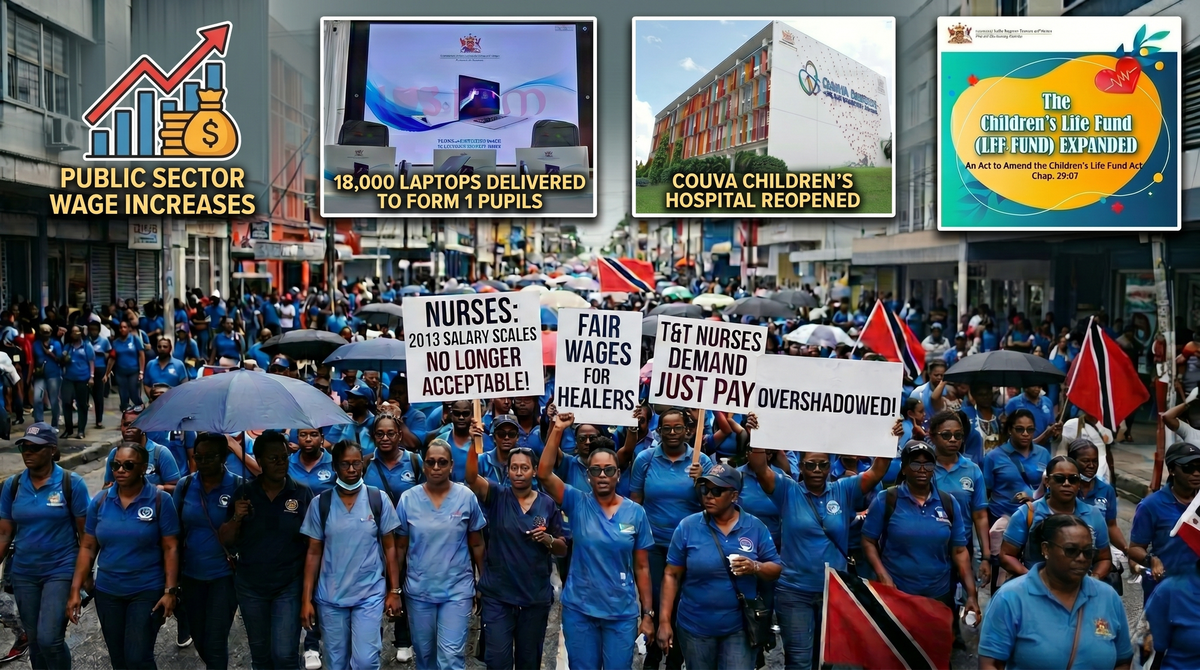
The Brief
- Wins: 10% wage increase for ~40,000 public sector workers; pension tax removed; ex gratia payments to two Paria families and survivor Christopher Boodram in January 2026.
- Children's Life Fund (Amendment) Act 2025 expanded coverage to "life-limiting illnesses".
- Couva Children's Hospital recommissioned; first paediatric surgeries November 28, 2025; over 500 surgeries to date.
- 18,000 laptops delivered to Form 1 pupils between November 27, 2025 and February 11, 2026; AI-assisted Mathematics and Language Arts digital textbooks launched April 2026.
- TTNNA escalation: nurses still on 2013 salary scales, halted extra-duty work, march on Port of Spain, NCRHA Chairman Dr Tim Gopeesingh's "racket" allegations rejected, Total Day of Nursing Care launched.
- Health Minister Dr Lackram Bodoe's "no crisis" framing has provoked the union; recruitment of over 100 Indian midwives criticised as an insult to local trainees
If there is an area where the government can claim tangible, structural successes, it is in its renegotiation of the social contract with parts of the working class and the most vulnerable in our society. For years, the relationship between the State and the labour movement was toxic, defined by rigid austerity and protracted legal battles. The wins achieved in this arena are real. They are also at risk of being completely overshadowed by the crisis brewing within our public healthcare system.
First, the positives. True to its campaign commitments, the Persad-Bissessar administration successfully concluded negotiations with major public sector unions, granting a 10% wage increase to approximately 40,000 workers and settling long-standing arrears running into billions of dollars. The government also altered long-term pension trajectories by passing legislation to remove taxation entirely on private pensions – an exemption that took full effect on January 1 this year – delivering real financial dignity to senior citizens facing fixed-income inflationary pressures. Labour Minister Leroy Baptiste has piloted the Retrenchment and Severance Benefits (Amendment) Bill, 2026, which expands protections for retrenched workers and significantly raises the cost of retrenchment. The government has signalled its intention to pilot major labour law reforms aimed at modernising the industrial relations framework.
Equally commendable, and perhaps the most resonant policy of the year, was the legislative enhancement of paediatric healthcare. Through the Children's Life Fund (Amendment) Act, 2025, introduced on June 13, 2025 and assented to by Her Excellency the President on July 11, the government substantially broadened the scope of State-funded overseas medical treatment for our most vulnerable children. Since its inception in 2010, the fund had seen over $400 million injected into it, but rigid legal definitions meant dozens of children with debilitating conditions were denied because their illnesses were not classified as "life-threatening".
The new amendment replaced this restrictive phrasing, mandating coverage for "life-limiting illnesses" via a newly inserted Schedule 3. This vital change unlocked funding for children suffering from sickle cell disease; complex heart anomalies like Tetralogy of Fallot; severe aplastic anaemia; and rare paediatric cancers such as Wilms tumour, neuroblastoma, and retinoblastoma. The amendment also permits the Minister of Health to review decisions made by the Board of Management if an application is initially rejected, ensuring bureaucratic hurdles do not override medical necessity. The passage of the Bill was not without parliamentary friction – former Prime Minister Stuart Young warned that granting the Health Minister this "superpower" of review meant that "without proper oversight, how quickly corruption or other issues can creep in". Leader of Government Business Barry Padarath rejected these insinuations, asserting the government had "no personal interest" other than saving children's lives.
The Couva Children's Hospital, idle for the better part of a decade, was finally recommissioned. Same-day surgeries began on November 28, 2025, with 86 procedures completed by December 5. Over 500 surgeries have since been performed as part of efforts to clear the backlog at the various Regional Health Authorities – though TTT News reported in March 2026 that significant areas of the facility, including the neonatal intensive care unit and paediatric ICU, remained dormant. Full operationalisation will cost an estimated $78.2 million more.
The rollout of the modernised CDAP+ programme has expanded the distribution of medicines for mental health and autism, benefiting over 300,000 citizens. Social development continues outside of the formal State apparatus too. Grassroots initiatives like the widely praised Puppet Palace, led by award-winning puppeteer Dawsher Charles, have done good work using puppetry to teach life skills and give a voice to vulnerable, at-risk children. Civic engagement remains a powerful force in our communities.
The four-year wait for the families of the Paria diving tragedy ended in January 2026 with the delivery of $1 million ex gratia cheques to lone survivor Christopher Boodram and the families of two of the four divers who died in February 2022 – Rishi Nagassar and Fyzal Kurban. The families of Yusuf Henry and Kazim Ali Jr are still awaiting payment. To be fair, the Cabinet decision to make these payments was actually taken under the PNM in April 2025, weeks before the election; the UNC has executed it. Litigation continues against Paria Fuel Trading Company and Land and Marine Construction Services. As Boodram pointed out: "Is four years, and nobody lost their job. Nobody was jailed."
Education has produced one of the cleanest deliveries of the year. Following a Cabinet decision in August 2025 to designate TSTT as the supplier, the Ministry of Education distributed 18,000 laptops to Form 1 pupils between November 27, 2025 and February 11, 2026. Schools were upgraded with broadband running at 150 Mbps, scaling to 500 Mbps and eventually 1 gigabit. In April 2026, Minister Dowlath launched the first two AI-assisted digital textbooks – Mathematics and Language Arts – with four more (Science, IT, Social Studies, Spanish) due before September. The textbooks work offline, save parents an estimated TT$1,500 per child, and reduce the weight of book bags. This is a tangible deliverable. It echoes what Persad-Bissessar's first term achieved between 2010 and 2015, and it will benefit a generation of pupils.
The picture is less encouraging when you look at what is happening inside those classrooms. Education Minister Dr Michael Dowlath's own data shows national suspensions rose from 2,659 to 3,005 in Term One of the 2025/2026 year, with classroom incidents during instructional time rising from 401 to 544. The School-oriented Policing Programme, which deploys around 95 special reserve police officers across 50 highest-risk secondary schools, has reduced lunchtime and after-school suspensions, but classroom violence is up. The pressure has shifted, not disappeared. Putting officers in schools is a short-term plug. Real classroom management training, social workers, guidance counsellors, and de-escalation skills will do the long-term work.
The goodwill generated by these social investments is currently being eroded by an escalating dispute with the Trinidad and Tobago National Nurses Association (TTNNA). In early April 2026, our public health system began to teeter as the TTNNA officially directed its membership to down tools the moment their eight-hour shifts end, refusing to undertake any extra-duty work unless paid full overtime rates.
The catalyst was a series of explosive allegations levelled by North Central Regional Health Authority (NCRHA) Chairman Dr Tim Gopeesingh, who publicly alleged that a "racket" involving excessive overtime payments had been uncovered within the authority's "pool" system, an extra-duty arrangement heavily relied upon to plug chronic staffing gaps. According to Gopeesingh, some nurses were taking home between $60,000 and $80,000 over a three-month period, with millions of dollars allegedly haemorrhaging since 2023.
TTNNA President Idi Stuart dismissed the allegations as a political distraction, insisting that the payments were for legitimate, gruelling work performed under unimaginably stressful and understaffed conditions. "The reason for the overtime is the shortage of staff," Stuart stated, noting that nursing and midwifery personnel are still operating on 2013 salaries in 2026. He further pointed out the disrespect shown to highly trained, specialised nurses, noting that under the revised rates, "they will be paid the same as general ward nurses for extra duty. That is unheard of."
The situation deteriorated following a statement by Health Minister Dr Lackram Bodoe, who said there was "no crisis" in the health sector despite a major march by nurses on Port of Spain on March 24, 2026 – the largest workers' protest since the government took office. Hundreds gathered at Port of Spain General Hospital and marched to the Ministry of Health on Charlotte Street, supported by the Joint Trade Union Movement, the TTUTA, the Amalgamated Workers' Union, the Estate Police Association, and the Communications Workers' Union. The TTNNA rolled out a 15-point action plan, with Stuart declaring that the timeline to conclude wage negotiations is "non-negotiable", warning that unresolved wage grievances were a primary reason the PNM was voted out in April 2025.
Adding insult, reports surfaced in mid-April that the NCRHA was moving to recruit over 100 midwives from India to fill the gaps. Stuart criticised this as an "insult to our locally trained nursing and midwifery personnel", especially given that many qualified local nurses are sitting at home awaiting employment. With the TTNNA launching its "Total Day of Nursing Care" on April 28, the dispute shows no sign of resolving. The TTNNA has also reported the death of a senior doctor at the Eric Williams Medical Sciences Complex who collapsed after working an extended shift over the Easter long weekend – a casualty Stuart attributes to the impossible workload doctors are now bearing in the absence of nursing staff.
While the government expends political energy on probes into historical corporate dealings – like Public Utilities Minister Padarath's April 2026 demand for an investigation into the 2017 Amplia Communications acquisition by TSTT – the present reality is that the very people tasked with keeping our citizens alive are being alienated, accused of corruption, and pushed to the brink. A social safety net is useless if the hospitals lack the nurses required to run them.