Pipeline to Washington: The Strings Attached to the NGC Gas Deals
In ten days this month, BP has consolidated three major gas deals in Trinidad and Tobago, covering some 15 trillion cubic feet. Every one depends on OFAC in Washington continuing to permit it, and that permission has been withdrawn once already. The deals are real. The dependency is also fragile.

The Brief
- On August 6, BP agreed to acquire Woodside Energy's 70% interest in the Calypso deepwater gas project, taking BP to 100% ownership and operatorship of a 3.5 trillion cubic feet resource off Trinidad's southeast coast.
- On August 10, at a function during the visit of United States Deputy Secretary of State Christopher Landau, the Prime Minister announced BP had agreed to sell NGC a 20% stake in the Manakin block, giving NGC a matching position on both sides of the cross-border Cocuina-Manakin field.
- On August 14, a BP-led consortium including ADNOC subsidiary XRG and Qatar's UCC Holding secured the Phase 2 licence for the Loran field, the Venezuelan side of the Loran-Manatee reservoir. Shell holds Phase 1 and is already developing the Manatee side on Trinidad's territory, with first gas targeted for 2027.
- The three deals together bring roughly 15 trillion cubic feet of natural gas resources into active development or consolidation, with BP as sole operator or lead partner on all three.
- Every one of the three depends on OFAC licences that were revoked entirely in April 2025 and restored only after direct engagement between the Prime Minister and US Secretary of State Marco Rubio in October 2025.
- Former Energy Minister Stuart Young publicly credited the previous PNM administration this week with laying the foundation for the current agreements and dismissed the current Government's claims of success as "complete hogwash."
There are periods in the country's news cycle that will look, in 10 years, more consequential than they seemed at the time. The past 10 days are one of those.
Between August 6 and August 14, BP announced or landed three significant natural gas transactions affecting Trinidad and Tobago. The Calypso acquisition. The Cocuina-Manakin agreement. The Loran Phase 2 licence. Together, they represent progress on natural gas resources approaching 15 trillion cubic feet, all coordinated through a single operator, all announced during or immediately around the visit of a US Deputy Secretary of State, and all dependent on a US regulatory framework that was withdrawn less than 18 months ago and restored only through direct diplomatic engagement at the highest level.
This is important news. It is also news that has been reported in T&T mostly one deal at a time, and the combined picture has not yet been drawn together in the way the country deserves. That is what I want to look at in this piece.
What the 10 days actually delivered
Three deals, in sequence.
August 6. BP agreed to acquire Woodside Energy's 70% interest in Block TTDAA 14, home to the Calypso gas project. Calypso is a deepwater development some 220 kilometres offshore Trinidad in 2,100 metres of water, holding around 3.5 trillion cubic feet of natural gas. BP moves to 100% ownership and assumes operatorship. Woodside exits Trinidad and Tobago after decades of activity, including its historical interests in the Ruby and Angostura fields. The deal is expected to close by the end of 2026, subject to regulatory approvals.
August 10. At a function at the Diplomatic Centre during the official visit of Deputy Secretary of State Landau, the Prime Minister announced that BP had agreed to sell NGC a 20% stake in the Manakin block. Manakin is the Trinidad-side portion of the cross-border Cocuina-Manakin field, which holds about a trillion cubic feet of natural gas, roughly 66% of which lies on the Trinidad side. NGC already held a 20% stake in the Cocuina portion on the Venezuelan side under a Venezuelan licence granted in July 2024. The August 10 agreement gives NGC a matching 20% position across the whole field. Feedstock is targeted to flow 75% to Atlantic LNG and 25% to domestic use from 2027. Final Investment Decision is expected by the end of 2026.
August 14. A BP-led consortium including ADNOC's international arm XRG and Qatar's UCC Holding secured the Phase 2 licence for the Loran gas field in Venezuela's Plataforma Deltana. Phase 1 was signed with Shell earlier in the year. Loran is the Venezuelan portion of the Loran-Manatee reservoir, which holds around 10 trillion cubic feet of natural gas across both sides of the maritime border. Shell is already developing the Manatee side on Trinidad's territory, with first gas targeted for 2027. Loran Phase 2 alone holds 4 trillion cubic feet.
The three deals are not all identical. Calypso is a straightforward consolidation of a Trinidad-side deepwater project into BP's sole ownership. Cocuina-Manakin is an equity swap giving NGC a real balanced stake in a cross-border field. Loran Phase 2 is a Venezuelan-side licence to a multi-partner consortium, some of it non-US, with the T&T side already under Shell development. What connects them is that BP is either sole operator or lead partner on all three, they were announced within 10 days of each other, and every single one required the US Office of Foreign Assets Control (OFAC) to say yes.
The 10-year story behind 10 days
Before we get to what the deals tie the country to, it is worth acknowledging what they are the result of, because a fair position is that this is a truly bipartisan achievement.
The 2010 unitisation agreement for Loran-Manatee was signed under the People's Partnership government. The 2015 unitisation agreement for Cocuina-Manakin, similarly, was concluded during Persad-Bissessar's first term as Prime Minister.
The subsequent operational work was done under the Rowley PNM government. In December 2023, OFAC granted the Dragon licence to Shell and NGC. In May 2024, OFAC granted the Cocuina licence to BP and NGC to negotiate for the Venezuelan side. In July 2024, Venezuela issued its own 20-year licence. Shell took FID on Manatee in July 2024. Stuart Young, as Energy Minister and later as Prime Minister for a brief period in 2025, was the T&T face of much of this work.
In April 2025, in one of Young's first acts as Prime Minister, he announced that OFAC had revoked both the Dragon and Cocuina-Manakin licences. The country's cross-border gas future was, at that moment, dead.
In April 2025, the country held a general election, won by the UNC. Persad-Bissessar took office on May 1. In July, she publicly declared Dragon "dead." Then in October, she met Marco Rubio at the State Department, and within hours, the licences were restored. The Guardian's headline was "Dragon dance" - meaning the reversal, not the deal itself.
In the wake of the three announcements, Stuart Young has called the UNC's claims of success "complete hogwash." He credited the PNM administration with securing Cabinet approval for BP to take Repsol's 30% ownership of the field. He called NGC Chairman Gerald Ramdeen "incompetent." He accused the Government of "plagiarism" for taking credit for a project the PNM had set up.
Young's press conference was partisan intervention and this blog is not going to endorse either side of it. What is worth noting is what his comments actually confirm. Both parties, when in office, negotiated versions of these agreements. Both parties, when in office, found the negotiations required going to Washington and asking permission. Neither party has managed the country's cross-border gas future without US sign-off, and both are now fighting over who deserves the credit for finishing what the other started. That is a bipartisan fact about the country's constrained sovereignty, not a partisan critique of either administration.
What the deals actually secure
The economic upside of the deals is real.
NGC now holds an equity position on both sides of the Cocuina-Manakin field, meaning the country will share in the value that flows from the resource rather than just providing the geography. That is a material difference from the passive-hosting model I criticised in A New Kind of Refinery two weeks ago. The OFAC dependency I discuss below undercuts it a bit, but the equity component itself is a genuine departure from the pattern.
Calypso, once developed, will add significant new gas volumes to Atlantic LNG feedstock at a moment when the country's domestic gas production is in decline. Loran Phase 2, together with Phase 1 and Manatee, will bring approximately 7 trillion cubic feet of Venezuelan-processed gas into T&T infrastructure over the coming years. BP is committing capital, engaging additional international partners including ADNOC and UCC, and consolidating operational control in ways that should accelerate final investment decisions on all three projects.
The Prime Minister was accurate when she said the Cocuina-Manakin agreement "removes a major obstacle and allows BP to move towards a final investment decision." Ramdeen was accurate when he explained that the State company did not want to hold equity on the Venezuelan side without a corresponding position on the Trinidad side. bpTT CEO David Campbell was accurate when he described the Manakin agreement as "another significant milestone" in the country's gas development.
None of this should be acknowledged grudgingly. The 10 days have delivered real progress on a portfolio of assets that the country's gas future genuinely depends on.
The strings attached
But what also needs attention is what all three deals depend on.
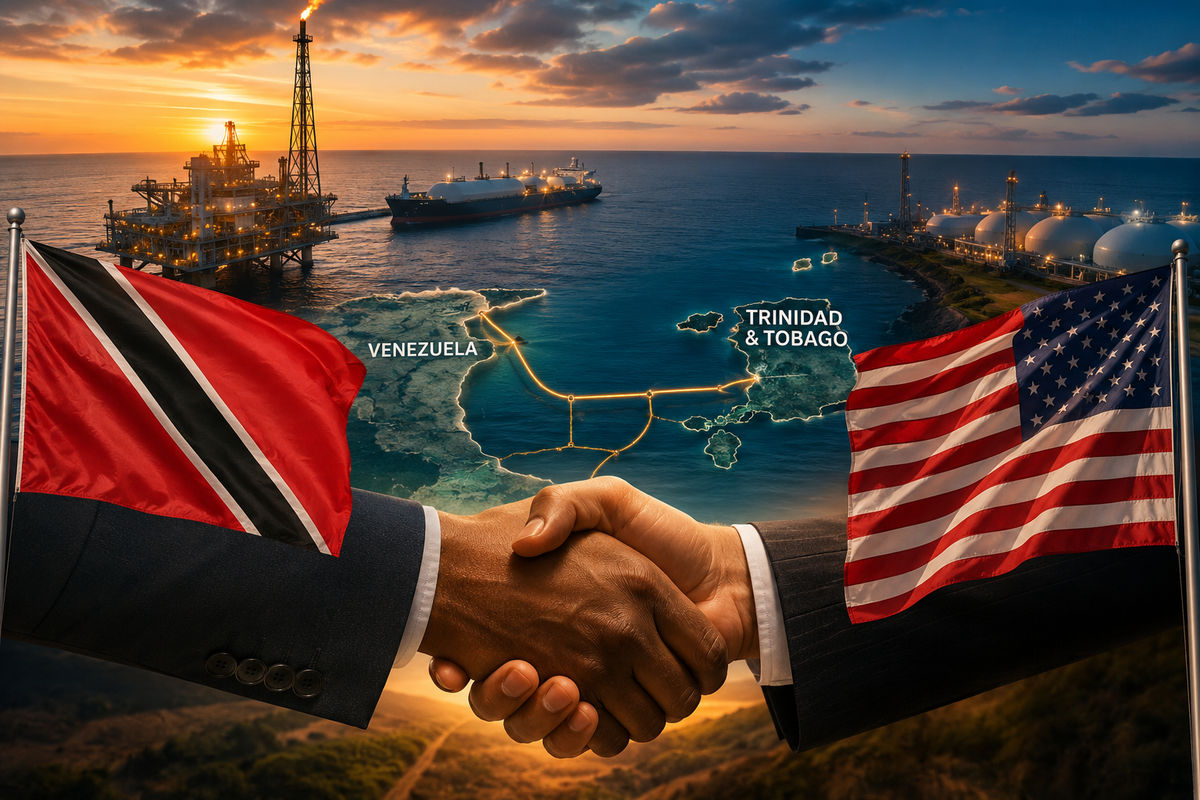
Every one of them exists because OFAC has issued or maintained licences permitting foreign energy companies to work with Venezuelan resources in spite of the wider US sanctions regime. Cocuina-Manakin operates under company-specific and general licences that BP and NGC required to negotiate and now to develop the field. Loran Phase 2 exists because OFAC's general licences allow BP, XRG and UCC to participate in Venezuelan hydrocarbon activity. Calypso, though located entirely in Trinidad waters, is part of the same regional gas complex whose Venezuelan-side developments are OFAC-dependent, and BP's consolidated portfolio strategy for the country depends on the whole picture working together.
These licences were revoked entirely in April 2025 and restored only after direct diplomatic engagement between the Prime Minister and the US Secretary of State. Nothing in the current framework prevents them from being revoked again. A different US Secretary of State, a shift in US-Venezuela policy, a change in the political mood in Washington, or a specific act of diplomatic displeasure could unwind any or all of the licences within weeks.
The country has now seen this happen once. It is worth remembering how quickly, and how completely, the whole architecture collapsed in April 2025, and how much depended on a single meeting five months later to bring it back. The three deals announced in the past 10 days sit on that foundation. They are only as strong as the foundation.
There is a related point worth making about how fragile cross-border arrangements can be even when they appear settled. The Loran-Manatee field was unitised in 2010. The unitisation was terminated by government-to-government agreement in 2019. What is now the standard framing - Loran as Venezuelan, Manatee as Trinidadian, each developed separately - is the result of that termination. Unitisation is not permanent. Bilateral cross-border agreements can be undone. The country would be right to note this when considering how confident to be about the current arrangements.
The concentration in one operator
There is a further observation worth making.
All three deals are BP-led or BP-consolidating. BP now owns 100% of Calypso. BP is the operator of Cocuina-Manakin with NGC as its minority partner. BP leads the consortium developing Loran Phase 2. BP already holds 45% of Atlantic LNG. BP's Ginger field is due to come online in 2027. Across the country's near-term gas future, one foreign company is now the operational thread running through most of the significant projects.
This is not necessarily a bad thing. BP has been in Trinidad and Tobago for decades. It has the technical depth, the operational track record, and the balance sheet to actually deliver these projects. The consolidation may well produce faster development, better capital discipline, and more reliable output than a fragmented set of operators would.
But the country's gas future is increasingly dependent on one foreign operator's ability to work in one specific geopolitical framework. If BP's global strategy shifts, or if the US-Venezuela policy environment shifts in ways that specifically constrain BP's Venezuelan activity, the country's exposure to that shift is now substantial. The concentration was smaller a month ago. It is significantly larger today.
Woodside was an Australian independent, exiting Trinidad after decades of activity. Its departure removes one of the small number of non-BP, non-Shell operators from the country's offshore gas landscape. That is a slow structural change worth registering, whatever its individual commercial merits.
The multi-partner reality
There is one respect in which the Loran Phase 2 deal partially diversifies the picture. ADNOC's XRG and Qatar's UCC Holding are not US firms. Their participation brings Gulf state capital into the T&T gas complex for the first time at meaningful scale, and it broadens the counterparty base beyond the traditional Anglo-American operators.
This is a positive development. It gives the country's gas future a slightly wider set of stakeholders and slightly more insulation from any single geopolitical shift. It also does not change the OFAC dependency. The deals still require US permission to work with Venezuela, regardless of whether the participating firms are American. XRG and UCC operating in Venezuelan waters remain subject to the same OFAC framework as BP or Shell. The counterparties are more diverse. The regulatory dependency is not.
The analyst caveat
Roushanne Seepersad-Bachan, an energy sector analyst, gave the Guardian what may be the most useful measured assessment of the Cocuina-Manakin announcement. She welcomed the deal as removing the commercial obstacle created by the earlier OFAC revocation. She then warned against viewing the project "as a solution to all of the sector's problems," framing it instead as "an important medium-term source of supply rather than a development capable of fully restoring the country's energy sector to peak operating levels."
That framing is worth extending to the full 10 days. Together, the three deals are important. They are also not sufficient on their own to reverse the country's structural gas production decline. First gas from Manakin and Manatee is targeted for 2027. Loran Phase 2 is behind that. Calypso is at an early stage and years from production. Even the most optimistic view of the combined output will not, on its own, restore the country's gas sector to the levels it enjoyed in the 2010s. Other decisions - about additional exploration, about production efficiency, about the shape of Atlantic LNG's future, about the country's wider industrial strategy - still need to be made.
What the country is owed
It is fair to say that the deals are real, that the achievement is real, that the diplomatic work by both administrations has been serious and sustained, and that the resulting portfolio genuinely does secure a meaningful slice of the country's gas future for the coming decade.
Every serious commentary should also say that the dependency the deals sit on is real. The OFAC licences that make them possible can be revoked. They have been revoked before. The single foreign operator now consolidating most of the country's near-term gas is one whose strategy is set in London and Houston, not in Port of Spain. The Venezuelan side of the equation is at the mercy of a wider US-Venezuela policy that has swung twice in the past three years and could swing again. The unitisation agreements at the heart of the cross-border framework are, as the 2019 Loran-Manatee termination demonstrated, revocable by governments.
The country needs both halves of that picture. What we have had for the past week is mostly the first half. I have tried here, in whatever small way, to put the second half alongside it.
These 10 days are worth marking. Something significant has been secured, at real diplomatic cost, by two governments working across a party line that is otherwise increasingly difficult to see. That is the good news. What comes after depends on decisions in a country that is not ours. That is the tougher news.
The pipeline runs both ways. The gas will, if everything holds, flow north from Venezuela from 2027. The permissions that allow it to flow will continue to run south from Washington for as long as the current framework holds. Both directions matter. Both deserve the country's attention. And the country should be honest with itself about which of the two it actually controls.