'A State of Emergency Cannot Eclipse the Rule of Law'
On Tuesday, Justice Frank Seepersad dismissed the Hadeeds' habeas corpus application. He also said, in the same ruling, that a State of Emergency cannot eclipse the rule of law. Both sentences now belong to the country, and both deserve careful reading.

The Brief
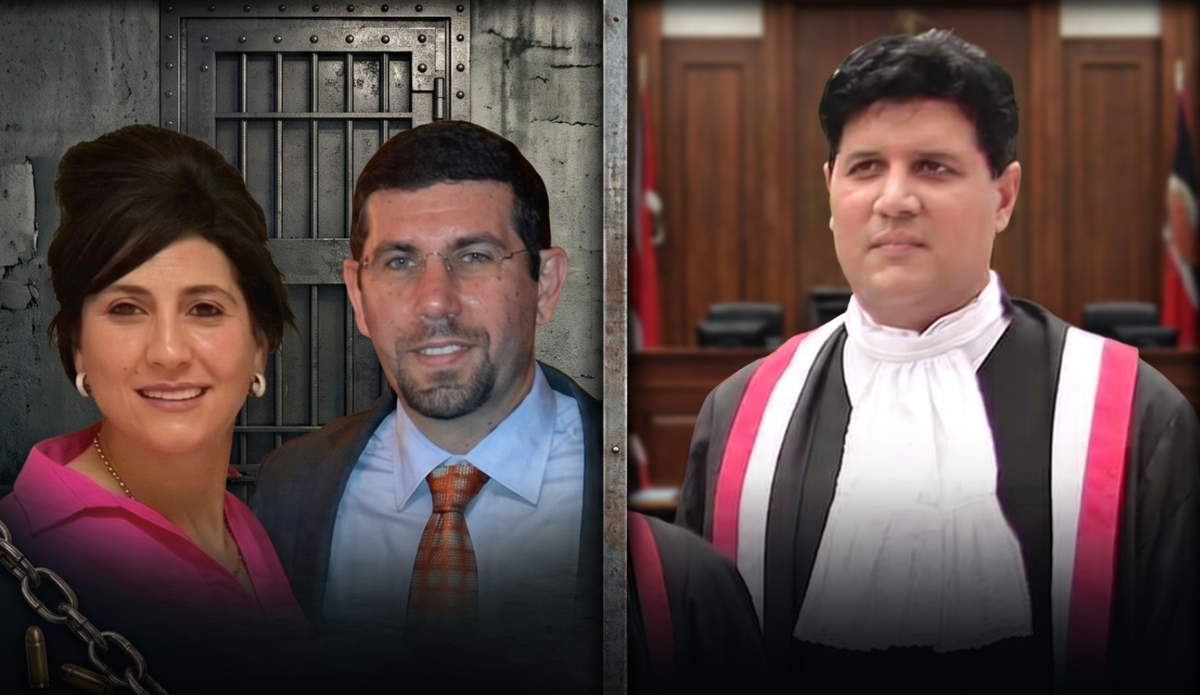
- On July 1, Justice Frank Seepersad dismissed the Hadeeds' habeas corpus application challenging the legality of their detention.
- In the same 24-page ruling, the judge affirmed that "a State of Emergency cannot eclipse the rule of law" and that the High Court's supervisory jurisdiction endures throughout an SoE.
- The judge also held that the courts must respect ministerial decisions on national security matters.
- The Hadeeds have been granted leave to file a judicial review claim, with a substantive hearing set for July 27.
- The case has been reassigned to a different judge at the Hadeeds' attorneys' request.
- Separately, the Police Commissioner revoked the appointments of 17 officers this week, part of a wider TTPS integrity move.
Last Sunday, I wrote about a week in which Trinidad and Tobago's most authoritative legal body had publicly questioned the architecture of State power, and in which the country's most prominent businessman had been detained under Preventative Detention Orders with no charges. That post, No charges. No hearings. No answers, argued that the pattern I have been documenting across the SoE, the 500-metre protest order, and the DPP's warning had now acquired both an institutional witness and a live example. It closed with a High Court hearing scheduled for the Monday morning after publication, and a promise that the country would soon see whether the bench would follow the bar.
The bench has now spoken. What Justice Frank Seepersad said in his 24-page judgment on Tuesday is neither a vindication of the argument I have been making nor a refutation of it. It is something more useful and more difficult. It is a ruling that acknowledges the constitutional principle at stake while declining to apply it to the case in front of him. The doctrine that emerges is now the country's. Both halves of it deserve to be read carefully.
The rule of law half
Let me start with the affirmation, because it is genuinely significant.
In his ruling, Justice Seepersad said plainly that "a State of Emergency cannot eclipse the rule of law". He said that "the supervisory jurisdiction of the High Court endures throughout a state of emergency". He said that even while dismissing the habeas corpus application before him, the courts would continue to guard against any abuse of emergency powers.
Those sentences matter. They matter because they are the strongest possible answer to the question I have been raising across Tell Us What Actually Happened in the Red House, 500 Metres from Democracy, Nine Days to Decide What Country We Are, and No charges. No hearings. No answers. The question has been whether the SoE architecture is subject to any check beyond a parliamentary vote and a ministerial signature. The judge has now said, on the record, in a written judgment that will be cited by lawyers for years to come, that it is. The High Court retains its supervisory role. Emergency powers do not put the executive beyond the reach of the courts.
That is a real thing to have secured, and for the country to have on the public record. The Bar spoke on June 26. The bench answered on July 1. Both said, in different ways, the same thing: State action under emergency powers is not exempt from judicial review, and citizens under detention retain the right to have the legality of that detention tested in an open court.
In the light of this, I have to be honest about my previous comments. In earlier posts I wrote about a State that was acting "without showing the working". The ruling published on Tuesday shows some of the working. The judge examined police station diary entries and found that the arresting officer had in fact told the Hadeeds at their home on the morning of June 24 that they were suspected of "acting, or being about to act in a manner prejudicial to public safety by conspiring with others to murder the Prime Minister, the Attorney General and other members of the Government". The judge held that this was sufficient to trigger the police officer's powers under Regulation 13 of the Emergency Powers Regulations. He also found that the initial 48-hour detention, together with the subsequent seven-day extension authorised by a senior police officer, complied with the regulations.
That finding refines my earlier argument, and I want to acknowledge it clearly. The State did tell the Hadeeds the basis of their detention. What the State did not tell the public, and still has not, is what the underlying intelligence consists of and how it was assessed. But the procedural point I was making, that the State was acting without communicating even the basic legal grounds to the detainees themselves, has been narrowed by the judge's finding. That is what a functioning judicial system is meant to do. It tests claims and refines them. My argument is not gone, but it is, admittedly, more limited than it was a week ago.
The deference half
Now the harder half, because there are two further sentences in the ruling that need to sit next to each other, and the second one does more practical work than the first.
Alongside the "SoE cannot eclipse the rule of law" affirmation, the judge also said this: "The judicial arm of government must respect the decisions of ministers of government on the question of whether the preventive detention of persons accused of being parties to alleged assassination plots constitutes a threat to national security". And in explaining why he was refusing interim relief for the Hadeeds, he said: "While the court appreciates the discomfort and distress which will inevitably result from any form of detention, it does hold the view that greater irreparable harm is likely to occur if the applicants/claimants are released and if the intelligence upon which the police and the minister have acted proves to be credible."
Read those sentences carefully. The first says the courts must defer to ministerial judgment on national security. The second says that even where a citizen has been detained under a PDO that they contend was unlawfully issued, the court will not order their release pending judicial review, because if the underlying intelligence turns out to be credible, the harm of releasing them would exceed the harm of holding them.
The two sentences describe, in combination, the operational doctrine the country now works under. In principle, the SoE cannot eclipse the rule of law. In practice, ministerial claims of national security are entitled to strong judicial deference, and citizens detained under those claims will remain detained until they succeed at substantive judicial review, or the SoE expires in September, whichever comes first.
To be fair, the reasoning Justice Seepersad gave is careful and consistent. The doctrine he applied is a version of the standard that operates in most Commonwealth jurisdictions when courts confront emergency powers claims: strong supervisory jurisdiction in principle, substantial deference to the executive on national security in practice. His ruling is neither eccentric nor extreme. It sits in the mainstream of the common-law tradition on this question.
But the country needs to be clear about what that doctrine means for anyone who might, in the coming months, find themselves on the receiving end of a Preventative Detention Order. It means that detention is not a holding step before charges. It is the whole ride, running until the SoE expires or the judicial review concludes. The judge has already indicated that even if the applicant is right about the law, release will not follow, because financial compensation will be considered an adequate remedy for the period of unlawful detention.
The PDO cases I have been documenting – Natalie Harford since April, and now the Hadeeds and Star Sabga in late June – all now sit inside this doctrine. Judicial review is available. Immediate release, in almost any conceivable set of circumstances, is not.
What has changed, and what has not
So here is what has moved and what has not.
What has changed. The rule of law has been affirmed as the standard against which State action under the SoE will be measured. The High Court has jurisdiction. The Bar can litigate. The bench will hear. This is not nothing. It is the constitutional floor that the LATT statement of June 26 asked the country to secure, and the court has now confirmed that floor exists.
What has not changed. The four PDO cases remain in effect. The Hadeeds remain in prison. Star Sabga remains in custody. Natalie Harford remains in custody, having now been held for three months without public charges. The protest order remains in force. The DPP's warning remains in place. The SoE runs until mid-September, and the Prime Minister has already signalled that further extension is possible.
What has newly emerged. A doctrine of executive-friendly deference on national security matters. If the pattern I have been documenting continues, it will continue inside a legal framework that gives the executive substantial latitude to act on classified intelligence, with judicial review available only after the fact, and with the practical remedy being financial rather than physical.
The country should notice what that framework produces at the level of ordinary lived experience. It produces an SoE in which a Cabinet minister can, on the strength of intelligence the public will not see, place named citizens in prison for the duration of the emergency. It produces a set of criminal-adjacent proceedings in which nobody is charged, in which no evidence is tested, in which the citizen's remedy is a compensation claim years after the fact. It produces a system in which the State's willingness to detain is functionally unchecked in real time, and in which the courts' role is to compensate rather than to release. That is now the system under which the country operates.
A word about the Police Commissioner
One thing has developed alongside the ruling that I also want to acknowledge.
On July 2, the Police Commissioner revoked the appointments of 17 officers. In a public statement, Allister Guevarro warned that any officer who "engages in criminality will face the full weight of lawful action". Former Commissioner Gary Griffith publicly backed the move. Approximately 290 officers are currently on suspension.
I have written across three posts about my concerns with Guevarro's conduct in office, and about the reasons why the Opposition's call for his removal has moved from premature to reasonable. Those concerns stand. But the dismissal of 17 officers this week is a move of real institutional integrity, and it deserves to be named as such. A Commissioner who is dismissing officers for misconduct on this scale is doing the work of internal accountability that his role requires. That does not resolve the questions about the protest order, or the questions about how the TTPS has handled the four PDO cases. Guevarro's conduct in the political-institutional dimension has been open to serious question. His conduct in the internal-integrity dimension is, on last week's evidence, delivering results. Both should be recorded.
What now?
The Hadeeds' substantive claim was filed on Friday, in the form of a hybrid judicial review and constitutional motion. It is broader than the ruling delivered on Tuesday. It challenges not only the PDOs themselves, but the extension of the SoE, the interpretation of the Emergency Powers Regulations, and over a dozen constitutional rights the Hadeeds contend have been breached.
The Government has responded by retaining British King's Counsel Sir James Eadie, First Treasury Counsel to the UK Government from 2009 to 2024, to represent the State, along with Robert Strang. Both were admitted to practice in Trinidad and Tobago by legal notices signed by the Attorney General last week, after consultation with the Chief Justice. Sir James is one of the most experienced public-law advocates in the Commonwealth. You don't appoint someone like that to defend an ordinary PDO. You do it because your doctrine itself is now on trial.
The substantive hearing is set for July 27. Between now and then, the Hadeeds and Sabga remain in prison. Natalie Harford remains in her fourth month of detention. The SoE continues. The protest order continues.
The Hadeeds' filing on Friday answers a question I was asking even as I began drafting this post. Their team, led by Senior Counsel Douglas Mendes, has chosen to challenge the deference-on-national-security doctrine directly, not merely the procedural handling of the individual PDO. This is now a case about the architecture, not a case about form. The country's constitutional trajectory rests on how the court answers it.
The other thing to watch is the wider set of judicial reviews and constitutional motions that the trade unions and other bodies have signalled they intend to file against the protest order and other elements of the SoE architecture. Those cases will now be heard against the backdrop of Tuesday's ruling. The doctrine will be tested. The bench has said its supervisory jurisdiction endures. The country now has to see whether that jurisdiction, in practice, secures anything more than the compensation-for-unlawful-detention remedy the judge has already indicated is available.
This is a moment worth noticing carefully. What has been secured on paper is genuine. What has been secured in the lives of the four citizens currently detained is limited. Both things are true. The gap between them is exactly the space the country has been asked to occupy, and to keep asking questions from.
The State has now shown some of the working. The rule of law has been affirmed. The bench has confirmed what the Bar demanded. What the country does with those affirmations, given that the citizens they were made about remain in prison, is the work of the coming weeks.