The Boat Home to Las Cuevas
Chad Joseph and Rishi Samaroo were killed by a US missile on October 14, 2025, returning home to Las Cuevas from Venezuela. Their families are suing the US in a Boston federal court. Their Prime Minister has said there is no evidence Trinidadians were killed. This is what happened.
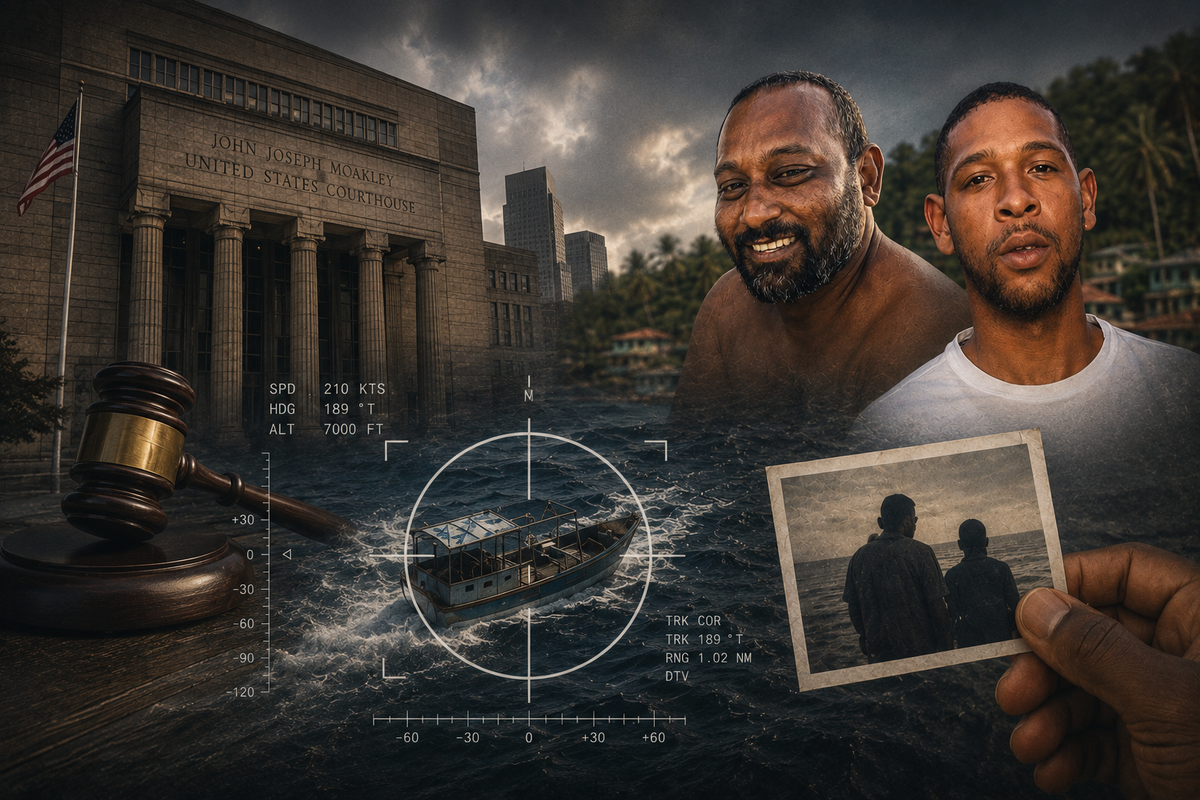
The Brief
- On October 14, 2025, a US military missile struck a small boat travelling from Venezuela to Trinidad in international waters. All six passengers were killed.
- Two of them were Chad Joseph, 26, and Rishi Samaroo, 41, both from the fishing village of Las Cuevas on Trinidad's north coast. Both were fathers of three.
- On January 27, 2026, Joseph's mother Lenore Burnley and Samaroo's sister Sallycar Korasingh filed a wrongful death lawsuit against the United States in the US District Court for the District of Massachusetts. The case is titled Burnley v. United States.
- The lawsuit is brought by the ACLU, the Center for Constitutional Rights, the ACLU of Massachusetts, and Professor Jonathan Hafetz of Seton Hall Law School.
- Since September 2, 2025, the US military has struck at least 44 boats and killed at least 148 people in its campaign in the southern Caribbean and eastern Pacific.
- Prime Minister Persad-Bissessar has publicly praised the US strikes, including saying that "the US military should kill them all violently." At the July 2026 CARICOM meeting, she said her government had no evidence that Trinidadians were among those killed.
Chad Joseph was 26 years old. He had three children. On October 14, 2025, he was on a boat heading home from Venezuela to Las Cuevas when a missile fired by the United States military killed him along with the five other people on board. One of them was Rishi Samaroo, 41, also from Las Cuevas, also a father of three. His mother had fallen ill and he was coming home to help take care of her.
Nine months later, in July of this year, the Prime Minister of Trinidad and Tobago told the CARICOM Heads of Government meeting in St Lucia that her government had "no evidence" that Trinidadians had been killed in the US strikes.
That gap is the subject of this post.
Who they were
The two men were from Las Cuevas, a fishing village on Trinidad's north coast. It is a place where the sea is close and where a lot of the men have always crossed to Venezuela for work. The distance to the Venezuelan coast is not much more than a hundred kilometres. Fishing, farming, construction – the work has always been there and Trinidadian men have always gone across for it.
Chad Joseph had gone over in April 2025. He was known as "Charpo" to his family and neighbours. His mother, Lenore Burnley, described him as "a loving and caring son who was always there for me, for his wife and children, and for our whole family." He had tried to come home earlier but that trip was cut short when the boat he was on developed engine trouble. He called his wife on October 12, 2025, to tell her he had found another ride home. Two days later, the boat was struck. He was travelling with another man from Las Cuevas, Rishi Samaroo, with whom he had been working on the same farm in Venezuela.
Samaroo's story is different in a specific respect. He had served 15 years in prison for his participation in a homicide, and had been released on parole in 2024. He moved to Las Cuevas, worked in construction, and travelled to Venezuela for further work. In August 2025, he told his family he was living on a farm there, caring for goats and cows and making cheese. He would send selfies with the animals to his sister Sallycar Korasingh. When their elderly mother fell ill, he decided to come home to help take care of her. He called Sallycar on October 12 to say he had found a boat, then sent her a photograph of himself wearing a life jacket. She never heard from him again.
The criminal history is public record and his family has been open about it: "Rishi was a hardworking man who paid his debt to society and was just trying to get back on his feet again and to make a decent living in Venezuela to help provide for his family," his sister said. "If the U.S. government believed Rishi had done anything wrong, it should have arrested, charged, and detained him, not murdered him." A citizen who has served time for a serious offence is still a citizen. Their killing by a foreign state without arrest, charge, trial or notification to their government is still a killing, and their family still has the right to have their government respond.
The lawsuit
On January 27, 2026, Lenore Burnley and Sallycar Korasingh filed the case Burnley v. United States in the US District Court for the District of Massachusetts. The 22-page complaint is brought under the Death on the High Seas Act and the Alien Tort Statute. The legal team includes the American Civil Liberties Union (with Brett Max Kaufman, Hina Shamsi and Ben Wizner among the lead attorneys), the Center for Constitutional Rights, the ACLU of Massachusetts, and Professor Jonathan Hafetz of Seton Hall Law School.
The complaint argues that the strike constituted an extrajudicial killing prohibited by international law and, even if the wider bombing campaign is treated as an armed conflict as the Trump administration claims, "would constitute a grave breach of the 1949 Geneva Conventions." The complaint's central claim is direct:
"These premeditated and intentional killings – carried out outside of the context of armed conflict and in circumstances where targeted individuals do not pose a concrete, specific, and immediate threat of harm – lack any plausible legal justification. Thus, they were simply murders."
This is the first wrongful death lawsuit filed against the Trump administration over the boat strikes. As of the filing date, the campaign had struck at least 36 boats and killed at least 125 people since September 2, 2025. By late February 2026, US Southern Command reported the total was 44 boats and 148 people killed. The campaign has continued since.
I am not going to debate the merits of the underlying US case. The matter is now before District Judge Leo T. Sorokin. The US government filed its Motion to Dismiss on June 5, 2026. The plaintiffs' Opposition followed on July 2. The government's Reply was filed by July 16. The case has been fully briefed on the motion to dismiss for over a month and is now under submission, awaiting the court's ruling. What is worth noting here is not the outcome of the litigation but the fact of it. The families of two Trinidadian citizens killed by a foreign state have been forced to seek accountability in the courts of the country that killed them, represented by a coalition of American civil liberties organisations. That is the mechanism the family has been left with. Why? Because it is not one their own government has offered them.
The country's response
On October 30, 2025, sixteen days after the strike, Foreign Minister Sean Sobers held a post-Cabinet news conference. Asked about the missing men, he said: "There is no evidence to suggest that what you are saying actually happened." Told that Samaroo's family said he had video-called them just before boarding the boat and had not been heard from since, he said: "All of that at this juncture is conjecture."
At the same press conference, the day before Venezuela's National Assembly voted to declare the Prime Minister persona non grata, Sobers was asked about the possibility of a US invasion of Venezuela and the panic that had spread through the population. He said: "I don't know what would have caused all this panic amongst the citizenry. All is well in Trinidad and Tobago."
The Prime Minister's own position on the wider campaign has been public and repeated since September 2025. When the first strike was announced, she said: "I, along with most of the country, am happy that the US naval deployment is having success in their mission. The pain and suffering the cartels have inflicted on our nation is immense. I have no sympathy for traffickers; the US military should kill them all violently."
Between that statement and the July 2026 CARICOM meeting, at least 148 people had been killed in the campaign. Some were Venezuelan. Some were Colombian. Two, according to the lawsuit filed in Boston, were Trinidadian citizens.
At the CARICOM meeting on July 6-7, 2026, in St Lucia, Persad-Bissessar was asked again about the Trinidadian nationals. She told the media briefing that her government had "no evidence" they had been killed. "All our investigations, our local law enforcement, everything, nothing has given us any evidence" that the individuals were T&T citizens.
Nine months after the strike, three weeks before her own State gas company signed the BP-Cocuina deal that requires the US government to keep permitting cross-border gas activity, and fourteen months into an administration that has consistently praised the US bombing campaign, the country's official position remained that there was "no evidence" its own citizens had been killed by its most important diplomatic partner.
So when Joseph's mother buried a coffin without a body in October 2025, her own country's government told her no evidence supported her family's account. When Korasingh went to the international press with the photograph her brother had sent her, the country's Foreign Minister called it "conjecture." When the ACLU and the Center for Constitutional Rights filed suit in Boston in January 2026, they did so without the co-operation, or even the acknowledgement, of the Trinidad and Tobago administration.
The boundaries of this argument
This is not an argument about drug trafficking. I do not know whether the boat the US struck on October 14, 2025 was carrying drugs. Neither does the Trinidadian public. Neither, on any evidence made publicly available, does the US government. Trump has claimed the men were "narcoterrorists" affiliated with "a Designated Terrorist Organization" transiting a "known DTO route." He has provided no evidence for those claims. The families have provided a different account, supported by phone records, photographs, and testimony from village neighbours in Las Cuevas. The court in Boston will decide which account the evidence supports.
It is not a post about US military policy. The wider legality of the boat strikes campaign is a matter for US constitutional law, international humanitarian law, and the US courts. Even Defense Secretary Pete Hegseth's own lawyers have reportedly questioned it. The Boston lawsuit is one of many that will now test it. That is proper.
I am also not attacking anyone's grief. Both families have said publicly they are trusting God to carry them through. Both have said they are seeking truth and closure rather than vengeance. That grace is not something this post seeks to complicate.
This post is about what a country's government owes its own citizens when they die abroad in circumstances where a foreign state has claimed responsibility. What accountability is required, what investigation is required, what acknowledgement is required. And what happens to a country's relationship with its own diaspora when the answer is repeatedly "no evidence."
The wider frame
The context in which Joseph and Samaroo were killed is something I have been writing about across pieces on the SoE architecture, the BP-Cocuina gas deals, and the constitutional cases still winding through the T&T courts. The country has, under the current administration, made a strategic decision to align closely with the United States on foreign policy. The airport access. The radar installation in Tobago. The public celebration of the strikes. The formal designation of Venezuela's cross-border activity as adversarial. The signature at the US Embassy on Independence Day. The gas deals whose viability depends on OFAC continuing to say yes.
Every one of those choices is defensible on its own policy terms. The country has security concerns. The gas fields are real. The US is an important partner. Honest commentators cannot pretend those things are not true.
But every one of those choices also has costs, and the death of two Trinidadian nationals is one of them. The wider bombing campaign that killed Joseph and Samaroo is the same campaign the Prime Minister has celebrated. The government that has told the world Trinidad and Tobago has no evidence of its own citizens being killed is the same government that has sent its most senior lawyers to London to defend Preventative Detention Orders against wealthy citizens alleged to have plotted against it. The State's investigative capacity has been demonstrably applied to some questions. It has not been applied to this one.
This is one of the more direct tests of what the country's alignment costs. It is one thing to praise a foreign military campaign. It is a different thing to find, in the wreckage of that campaign, the names of your own citizens, and to still be unable to say so.
The State's obligation
The State's obligation to a citizen killed abroad is not complicated. The State should investigate. The State should acknowledge. The State should press the killing government for information. The State should provide consular support to the family. The State should support, where appropriate, legal action seeking accountability. The State should, at minimum, avoid publicly dismissing the family's account as "conjecture" and the family's grief as unrelated to any Trinidadian citizen.
None of those things has happened for Chad Joseph and Rishi Samaroo. What has happened instead is a fourteen-month official silence, broken only by the Foreign Minister calling the family's account "conjecture" and the Prime Minister telling CARICOM there was no evidence.
That is a fact about the country's relationship with its own citizens abroad. It is also a fact about the country's relationship with the wider US alignment strategy. The two are connected. The country cannot keep saying it has no evidence while also praising the campaign that produced the deaths.
The lawsuit in Boston will proceed at its own pace. Whether it succeeds or fails will depend on American statutes and American judges. The wider bombing campaign will continue until Congress or the US courts stop it. The gas deals will proceed as long as OFAC continues to permit them.
What Chad Joseph's children will have is a mother who told the country she was hurting and was told her account was conjecture. What Rishi Samaroo's mother will have is a son who was coming home to help take care of her and was killed by a foreign state on the way. What Las Cuevas will have is two more names for a village that has lost too many of them.
And what the country will have to reckon with, in the years to come, is what it means to have watched all of this happen and to have said, on the record, that there was no evidence.
There is now. It is filed at the US District Court for the District of Massachusetts, in a case titled Burnley v. United States. The evidence has been sought. The evidence has been found. Just not by the country whose citizens were killed.