When Small Islands Tell Their Own Stories
The 39th Tobago Heritage Festival opened on Thursday. Fifteen days, eighteen villages, a wedding from 1798, a riot from 1876, cocoa dancing to a tambrin band. Small islands still tell their own stories, and it is worth celebrating that.

The Brief
- The 39th annual Tobago Heritage Festival opened on July 16 and runs until August 1.
- This year's theme is "Leh we tell de whole story."
- Eighteen events are scheduled across the fortnight, hosted by different villages.
- Signature productions include the Ole Time Wedding in Moriah, Dancing the Cocoa at Charlotteville's Natural Treasures Day, the Belmanna Riots re-enactment in Roxborough, and Folk Tales and Superstitions in Golden Lane and Les Coteaux.
- The festival was founded in 1987 by anthropologist Dr J.D. Elder, then Secretary of Culture in the Tobago House of Assembly. It has run every year since.
- It closes on Emancipation Day, August 1.
Every once in a while the calendar reminds you why you love where you come from.
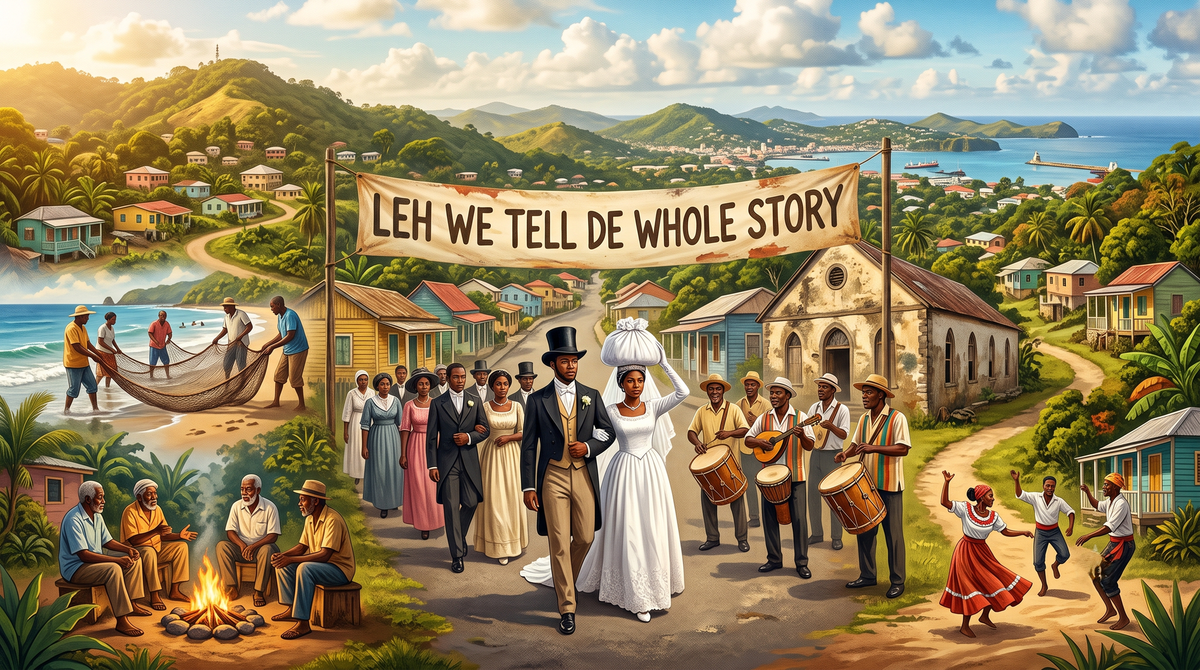
Since Thursday, and until the first day of August, one of the most distinctive cultural events anywhere in the region has been playing out across an island of sixty thousand people. For fifteen days, the 39th Tobago Heritage Festival, will see eighteen villages across Tobago hosting their own productions of the folk practices that have been part of their life since well before independence. This year's theme, painted on banners across Scarborough since the launch in May, is a single line in our own dialect: Leh we tell de whole story. Some languages get left at the door. This one is painted on the front of the room.
Telling the whole story is exactly what Tobago is doing, and it is one of the things this country does better than almost anywhere else.
The festival is not one big event in a single location. It is eighteen small events across the island, each hosted by a different community, each drawn from that community's specific history. On the last Sunday in July, the village of Moriah will re-enact an 18th-century wedding procession through its own streets, complete with the groom in a stovepipe hat and tailcoat, the bride in a long white trousseau balanced on her head, and the whole village walking in slow ceremony behind them to the sound of a tambrin band. This is the Ole Time Wedding, and it takes place at the old Moravian church. It is not a costume party. It is a formal, unhurried, community-produced re-enactment of what a wedding actually looked like in post-emancipation Tobago, performed by people whose grandparents performed it, in the same church, on the same road. Any Trini who has ever complained that we do not preserve enough of what we have needs to check out the Moriah wedding for a moment. Because we do.
In Charlotteville, on the northern tip of the island, Natural Treasures Day includes the ritual known as Dancing the Cocoa, in which villagers dance barefoot on cocoa beans laid out to dry, to a tambrin rhythm, as the beans polish under their feet. The dance began in the marketplace. Polished beans fetched a higher price. What has survived the marketplace is the rhythm, and the fact that a whole village still knows how to do it. That is worth celebrating.
In Roxborough, on the north-east coast, the village puts on a re-enactment of the Belmanna Riots of 1876, when Tobagonian workers rose up against the colonial administration after the killing of an African-descended labourer by Corporal Belmanna of the constabulary. The riot became one of the pivotal moments in the island's political history and helped precipitate the collapse of the ward system that had governed Tobago for a generation. And every year, the village re-performs it, in front of its own children, and calls it heritage. Not lace and church music. Open rebellion. Tobago has always been more complicated than the tourist brochures allow, and the island has always been honest about that.
There is a speech band tradition that runs across several villages, in which performers recite ornate, sometimes bawdy Victorian-era verse in competitive groups. There are Folk Tales and Superstitions nights in Golden Lane and Les Coteaux, in which stories that would otherwise sit only in living memory are told out loud, to whoever comes. There is a Salaka Feast with African-descended ritual roots. There is a Miss Heritage Personality Contest. There is actual, competitive goat racing at Buccoo. There is a Games We Used to Play afternoon in which children play the games their grandparents played.
The scale is small. The seriousness is not.
The Tobago Heritage Festival is one of the most impressive pieces of cultural work any small country produces anywhere. In a region where cultural production tends to be either state-heavy carnival at scale or individual-artist export, the Heritage Festival is the third option. It is community-produced, folk-based, distributed, non-commercial, and stubborn. It has run every year for 39 years, hosted by villages of a few thousand people each, drawing on knowledge that has been passed down inside those villages for generations. It does not depend on tourists to work. It does not chase the beach-carnival template. It does not homogenise. It refuses, year after year, to make itself easier to consume.
That refusal is the point. What Tobago is doing this fortnight is what a lot of the wider Caribbean has quietly stopped doing, or is doing in more diluted forms. Small-scale, community-owned cultural production that treats folk memory as a living thing rather than a tourism prop is not the norm in the region any more. It used to be. And Tobago has held the line.
There are places in the English-speaking Caribbean where the equivalent traditions have been shrinking for a generation. There are others where they have been captured by state agencies and turned into showcase pieces for national days. There are others still where the folk knowledge simply died out with the people who held it. The reason Tobago's traditions did not die out is that Dr J.D. Elder – an anthropologist and then Secretary of Culture in the Tobago House of Assembly – built a festival in 1987 that was designed from the beginning to keep them alive. That founding decision, and the four decades of careful stewardship by the Tobago Festivals Commission and the villages themselves that have followed it, is exactly the kind of institutional work small countries usually only get credit for after they have lost the thing they were supposed to be protecting.
Tobago has not lost it. Tobago is still doing it. And this weekend, and the next weekend, and the weekend after that, the villages are proving it again.
For those of us reading from far away, this fortnight is one of the reliable homing signals of the year. Every Tobagonian I know has a small map in their head of what is happening in which village on which night between mid-July and the beginning of August. The Ole Time Wedding falls on a specific Sunday. Belmanna is a Roxborough thing. Charlotteville is Charlotteville. The Bunji Garlin and Fay-Ann Lyons of another generation grew up watching these things, and the current generation of Tobagonian kids is being raised on them the same way.
I wish I were there to see it all in person. I have watched Ole Time Wedding footage on YouTube more times than I would like to admit. I have been to Buccoo goat races once, almost thirty years ago, and can still remember exactly how the crowd sounded when the leader stumbled at the last turn. But there is no substitute for being on the road in Moriah on a Sunday afternoon while the tambrin band strikes up, and I know it. This one is not a piece from the ground. It is a piece written from a living room in London, by someone who is grateful for what he can watch online and honest about what he is missing.
Lord Kitchener has been on my mind while writing this. In 1969 he recorded "Ode to Tobago" on his King of the Road album, and it was, and remains, one of the great calypso love letters to the island. Kitch was a Trinidadian who wrote in the voice of an invitation – come, leh we go – to see Fort George, see the reef at Buccoo, see the beauty running coast to coast. Sixty years on, that song still holds the exact tone in which the mainland speaks about Tobago at its best. Grateful, unhurried, aware of its luck.
If Kitchener wrote from outside the island, Eric Roach wrote from inside it. Roach was born in Mount Pleasant in 1915 – poor family, army service, teaching, journalism – and is widely regarded, in Laurence Breiner's phrase, as the most significant Caribbean poet in English between Claude McKay and Derek Walcott. His poems – "Homestead", "In Mango Shade", "March Trades", "The Flowering Rock", "I Am the Archipelago" – wrote the island from within it, at a moment when the question of who writes the Caribbean's story was itself a live one. He died in 1974. What he left behind is a body of work that describes, in the island's own voice, the fortnight the Heritage Festival now performs. When Roxborough re-enacts the Belmanna Riots each year, it is doing in community theatre what Roach did in verse.
The WhatsApp groups will fill with clips from Tobago over the next fortnight. That is a small annual mercy of diaspora life – the country reaches out and finds us, whether we deserve to be found or not. What comes through those groups is not the whole festival. It is not even close to the whole festival. But it is enough to remind us why we still keep the chats going, and why the country's cultural production is one of the reasons we do.
The festival closes on Emancipation Day, and no calendar accident could carry the point more clearly. The stories being told this fortnight in Moriah, Charlotteville, Roxborough, Golden Lane and Les Coteaux are the stories of what happened after emancipation, in the years and generations when Tobagonian villages had to work out for themselves what freedom would look like when the day-to-day arrangements of a colonial economy were still in place around them. The weddings, the harvest dances, the folk tales, the riots, the speech bands, the goat races. All of it is the record of a people making a life inside conditions that had not caught up with their legal freedom, and refusing to allow the conditions to define who they were.
That refusal is what the festival celebrates. And a country that has been publicly arguing with itself all year about what it wants to be is doing well to remember, this fortnight, that the argument is not the whole picture. Not everything the country produces is under strain. Some of what it does is one of the reasons the argument is worth having in the first place.
If you can get to Tobago before August 1, go. If you cannot, watch what the networks pass around, and pass it on. Either way, know that the island is telling its whole story this fortnight, and the story is one of the best ones this country has to tell.