The Court That T&T Built
On October 9, Washington imposed sanctions on the International Criminal Court that ANR Robinson, as Prime Minister of Trinidad and Tobago, spent fifteen years building. The country’s current Prime Minister, as she has done for months, said nothing.
The Brief
- On October 9, US Secretary of State Marco Rubio announced sanctions against the International Criminal Court as an institution, not just against its judges and prosecutors. His words: “Either the ICC will end its threats, or we will end the ICC.”
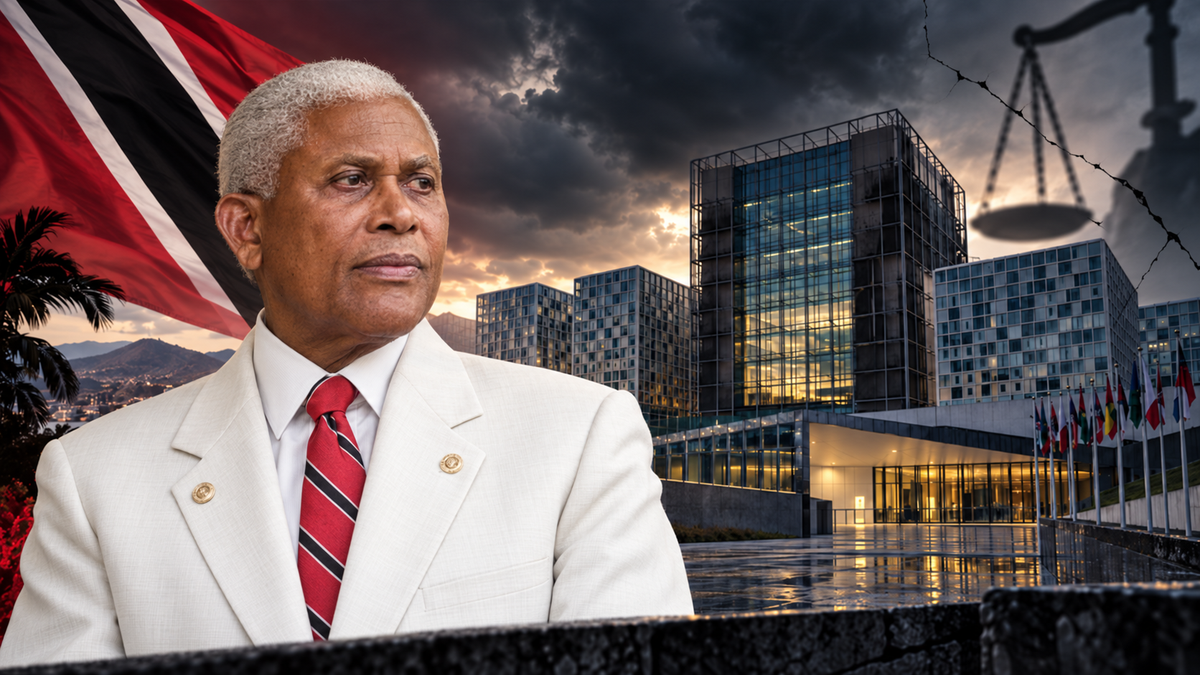
- The ICC’s own 2014 description of Trinidad and Tobago’s third Prime Minister and third President, ANR Robinson, is “grandfather of the International Criminal Court.” Robinson’s 1989 UN General Assembly resolution triggered the process that produced the Rome Statute and the Court.
- Trinidad and Tobago has a sitting ICC judge, Justice Althea Alexis-Windsor, whose term runs until March 2030. The country was one of the first three state parties to ratify the Kampala Amendments. The country’s second international airport is named ANR Robinson International Airport. That airport has been used by US military operations against Venezuela since late 2025.
- Prime Minister Persad-Bissessar did not address the ICC in her September 22 UN General Assembly speech. She declined to comment on US pressure against the Court when asked by Trinidad Guardian in July. She has not, as of this writing, said anything about the October 9 sanctions.
- The country that built the Court is now hosting the superpower dismantling it – in a facility named after the man who built it.
“Neither a free State nor a free world can long endure without adequate safeguards for the rule of law.” - ANR Robinson, October 1990
The late Trinidad and Tobago Prime Minister had presented the UN resolution that triggered the International Criminal Court process one year earlier. Three months earlier, during the Jamaat al-Muslimeen coup, he had been shot and beaten for refusing to surrender the authority of the state.
On October 9, 2026, the United States Secretary of State Marco Rubio stood at the podium and announced that his country was imposing sanctions on the International Criminal Court as an institution. Not individuals. Not prosecutors. Not judges on specific cases. The Court itself. His exact words: “Either the ICC will end its threats, or we will end the ICC.”
The Court that Rubio proposes to end is the Court that Trinidad and Tobago built.
The ICC’s own words on this are not open to interpretation. On Robinson’s death in April 2014, the Court issued a formal statement from The Hague. ICC President Judge Sang-Hyun Song: “He will be remembered by many as the grandfather of the International Criminal Court.” That is the official institutional view, written in the first week after Robinson died, by the President of the Court itself.
Trinidad and Tobago gave the world the ICC. The country’s current government, as of this writing, has said nothing about the United States of America announcing yesterday that it will dismantle it.
What Robinson built
Robinson did not stumble into the Court. He worked on it for the better part of three decades.
The foundation years ran from 1972, when he became a Director of the Foundation for the Establishment of an International Criminal Court, through to his election as Prime Minister in 1986. For more than fifteen years before he had any state power to deploy, he was already building the intellectual and institutional case for the Court as a serving officer of the Foundation. By the time he became Prime Minister, the question for him was no longer whether such a Court was desirable. The question was how to get it in front of the UN General Assembly in a form it would accept.
In June 1989, he did it. Trinidad and Tobago, with Robinson as Prime Minister, formally presented a new agenda item to the 44th UN General Assembly for the establishment of a permanent international criminal court. He had asked Benjamin Ferencz, a Nuremberg Prosecutor, and Robert Kurt Woetzel to help him draft the proposal. The original framing was practical: a Court with jurisdiction to tackle illegal trade, particularly drug trafficking and arms trafficking. The framing worked. In December 1989, in response to Trinidad and Tobago’s resolution, the General Assembly asked the UN’s International Law Commission to resume work on the Court. The decades-long machinery of the Rome Statute process started turning.
It took nine years to produce the Rome Statute in July 1998. It took another four years to bring the Court into existence on July 1, 2002. The scope widened enormously along the way – genocide, war crimes, crimes against humanity, and eventually the crime of aggression. Through all of it, Robinson stayed in the room. He never let go of the project. The Coalition for the ICC’s assessment, issued on his death, is as blunt as such assessments ever are: “Without Robinson, I do not believe there would be a Rome Statute and an ICC.”
The Court exists because a Prime Minister of Trinidad and Tobago spent his adult life making it exist.
The country that stayed in the room
Robinson’s work did not end with him. Trinidad and Tobago kept being present at the Court long after Robinson left office in 1991.
The country was one of the first three state parties to ratify the 2010 Kampala Amendments on the crime of aggression. The ICC’s own 2012 press release announcing the ratification described Trinidad and Tobago as “an active supporter of the Court since before its creation.” Three Trinidadian judges have sat on the ICC bench. Anthony Carmona, before becoming Trinidad and Tobago’s fifth President, served from 2012-2013. Geoffrey Henderson succeeded him. Justice Althea Alexis-Windsor sits now. The ICC gave Robinson a formal tribute award in 2008.
Alexis-Windsor was elected in December 2020 and sworn in on March 11, 2021. She serves a nine-year term that runs until March 10, 2030. She is assigned to the Trial Division and currently sits on Pre-Trial Chamber III, Trial Chamber I, and Trial Chamber VII. Her nomination was endorsed by CARICOM as a group. Before the ICC, she worked at the International Criminal Tribunal for Rwanda from 2004 to 2013, prosecuting cases of genocide, war crimes, and crimes against humanity.
Justice Alexis-Windsor will spend the next four and a half years working in an institution that the government of her own country has decided, by its silence, not to defend from a superpower’s declared intention to dismantle it. She reports for work at a Court whose operations have, since yesterday, been subject to US financial sanctions. The 180-day general license the US Treasury issued alongside the sanctions is explicitly described in State Department material as a pressure window – time for member states to show “meaningful progress” on US concerns before the sanctions bite harder. The Trinidadian judge on the ICC bench will be doing her job inside that pressure window.
A judge of the Court cannot speak publicly on the political pressure directed at the institution. The country that nominated her can. The country that nominated her has not.
What Washington is dismantling
The October 9 announcement is not a one-off. It is the culminating step of a methodical, publicly declared, sixteen-month campaign.
The sequence: Executive Order 14203, signed on February 6, 2025, is the legal instrument. The first individual designated under it was ICC Prosecutor Karim Khan. On July 9, 2025, Rubio added further individual sanctions. On August 20, 2025, four more judges were added. In July 2026, Rubio made the strategic commitment public: he would dismantle the Court “brick by brick” through sanctions, visa bans, and pressure on countries to withdraw from the Rome Statute. On October 9, 2026, he moved from targeting individuals to targeting the Court itself.
The running count, as of yesterday: ICC prosecutors, nine ICC judges, three Palestinian human rights groups, UN Special Rapporteur Francesca Albanese, and now the Court as an institution. Seventeen persons sanctioned under EO 14203 to date, in addition to the Court itself. The sanctions block “all property and interests in property” the Court holds in the US and prohibit the “making of any contribution or provision of funds, goods, or services by, to, or for the benefit” of the Court. US firms providing services to the Court are now at legal risk.
The international response was fast, uniform, and – across the political spectrum of the countries involved – unambiguous.
The ICC’s October 9 statement called the sanctions an “unprecedented step” and closed with a line that will likely be remembered: “History will judge this moment.” Deputy Prosecutor Nazhat Shameem Khan: “The sanctions are intended to undermine the rule of law internationally and the work that an independent judicial institution is doing. Our work will continue across all our situations, our investigations and our prosecutions.”
UN Secretary-General António Guterres: “Deeply alarmed.” Called the sanctions “a serious blow to our collective pursuit of international criminal justice, of which the ICC is a key pillar.”
The European Union: Called the sanctions “deeply regrettable” and said it was “ready to take any necessary measures to enable the court to carry out its work.”
Eight close US allies, in a separate joint statement: the foreign ministers of the United Kingdom, Canada, Denmark, Germany, France, Italy, Japan and the Netherlands. “As staunch supporters of the ICC, we regret and strongly disagree with the United States’ announcement of sanctions against the Court. We remain united in our support for the ICC and are determined to engage in a constructive and inclusive dialogue with non-States Parties in preparation for the Assembly of States Parties in December 2026.”
Seventy-nine ICC member states, in a joint statement: “Such measures increase the risk of impunity for the most serious crimes and threaten to erode the international rule of law.”
Human Rights Watch: “An unprecedented assault on global justice and the rule of law.”
The announcement, by one of the sharper historical coincidences of this century, came hours after the Norwegian Nobel Committee awarded the 2026 Nobel Peace Prize to Navi Pillay, a former ICC judge recognised for her warnings about mounting political attacks on the Court. The Nobel went to a defender of the Court in the morning. The sanctions went to the Court in the afternoon.
Seventy-nine countries, the ICC itself, the United Nations Secretary-General, the European Union, and the awarders of the Nobel Peace Prize have all made their positions on the October 9 sanctions clear within twenty-four hours.
Port of Spain has not.
The silence of Port of Spain
This silence is not new. It has a pattern, and the pattern has been pointed out, in writing, by the Opposition in Trinidad and Tobago, in the week leading up to the Prime Minister’s September 22 UN General Assembly address.
Opposition Senator Dr Amery Browne, former Foreign and CARICOM Affairs Minister, writing on September 22: “Kamla Persad-Bissessar and the current UNC regime have been conspicuously silent on contemporary issues related to the International Criminal Court.” Browne noted that “up to April 2025, successive Trinidad and Tobago administrations had given staunch and public support to the Court and its work in pursuing people accused of genocide, crimes against humanity, war crimes and crimes of aggression.” He pointed to Robinson. He pointed to Justice Alexis-Windsor. He asked the Prime Minister to use her UN address to clarify where the country now stands.
The Prime Minister did not. Her September 22 UN General Assembly address covered illicit firearms and narcotics, security cooperation with Washington (she thanked Trump personally for “deepening security co-operation”), and the country’s 2027-2028 UN Security Council term. On the Court the country effectively founded, she said nothing.
Opposition Senator Faris Al-Rawi, on September 24: “I think the Prime Minister missed an opportunity to speak to the International Criminal Court, and that is a huge issue. If you are going to deal with matters around terrorism and state responses, you have to focus on the ICC and its position. As a founding member of the ICC, I thought that was something the Prime Minister could have examined more closely and certainly addressed.”
The Opposition is not the only voice on the record. In July, when the US first made its intentions on the Court clear, Movement for Social Justice leader David Abdulah urged the Government not to support the US initiative. Independent Senator Anthony Vieira said silence was not an acceptable response. Former Minister Winston Dookeran warned that weakening the Court would undermine international accountability. Those statements were made in July. Three months later, with the Court itself now under sanctions, the Government position remains what it was: there is no Government position.
The July 2026 Trinidad Guardian report is the sharpest of the series. The Prime Minister, Guardian Media reported, “declined to comment on the United States’ recent campaign to dismantle the International Criminal Court, even as she met with a high-level American delegation to discuss strengthening bilateral ties.” When Guardian Media put the question to her directly – asking for her reaction to reports that the US intended to pressure countries to withdraw support for the Court – her entire response was two words: “Not now.” She met the delegation anyway.
Professor Anthony Bryan, Emeritus of International Relations, responding to Guardian Media in the same piece: “T&T and other members should stay strong with the ICC. The State Department is way outside its orbit.” That is one of the clearer statements on the record from a Trinidadian academic voice. It is not the position the current Government has taken. The current Government has taken no position.
As of this writing, 48 hours after Rubio announced that his country will end the Court Trinidad and Tobago built, no statement has been issued by the Office of the Prime Minister, the Minister of Foreign Affairs, or the Attorney General. The country whose former Prime Minister the Court itself called its grandfather has, through two full news cycles, said precisely nothing.
The airport that bears his name
Tobago’s international airport is named ANR Robinson International Airport. It is one of two international airports in the country. It is named after the Prime Minister who built the ICC.
In October 2025, the US military installed a radar system at that airport. In the same period, the Persad-Bissessar government opened the country’s airports to US military aircraft transits as part of the Caribbean build-up against Venezuela. The USS Gravely docked in Port of Spain on October 26, 2025. Joint military exercises followed. The build-up has not stopped. It has deepened.
The airport named after the founder of the International Criminal Court is, right now, a logistics asset for the superpower that announced yesterday that it will end the International Criminal Court.
The physical geography makes the argument the Government will not make. Robinson’s name is on the building. Washington’s hardware is in the building. Washington’s position on the institution Robinson built is now a matter of declared policy. The Government that governs the airport bearing Robinson’s name has said nothing about any of it.
What Robinson would have known
Robinson was not a sentimentalist about international institutions. He built the ICC because he understood something specific about the position of smaller countries in a world where larger countries were not held to account. The 1972 foundation work, the 1989 UN resolution, the fifteen years of institutional patience through the Rome Statute negotiations – all of it rested on a reading of the international order in which safeguards for the rule of law were not luxuries but survival infrastructure for countries like Trinidad and Tobago.
His 1990 line about rights and the rule of law was not a flourish. It was his considered view, developed over decades, that a free state and a free world depended on the same architecture. Dismantle one and the other follows.
The parallel to our domestic constitutional moment is uncomfortable but exact. Two weeks ago, I wrote about President Kangaloo’s September 24 warning that rights surrendered in anxious times are not easily recovered. That was about the Special Operations Bill, now proclaimed into force. The international version of the same argument was Robinson’s. He made it thirty-six years before the SOB came into force, and he built an institution to carry the argument internationally so that the Caribbean would not have to make it alone.
His successors are, by their silence, assisting in dismantling what he built.
What remains
Justice Alexis-Windsor will go to work tomorrow. Her term runs until 2030. She will sit on her chambers in The Hague, under sanctions, representing a country whose Government has decided that silence is the appropriate posture while the United States promises to end the Court she serves.
The 79 member states that issued the joint statement did their work. The EU did its work. The UN Secretary-General did his. The Nobel Peace Prize committee did its, in advance, by awarding to a former ICC judge in the same hours Rubio was announcing the sanctions. The Court itself did its work by issuing a statement within hours.
The Government of Trinidad and Tobago, the country without which the Rome Statute and the Court would not exist, has done nothing. The Government whose territory holds an airport named for the man the ICC itself called its grandfather has not acknowledged the sanctions. The Government that nominated one of the Court’s sitting judges has said nothing. The Government whose predecessors nominated her, and who will leave her to work under these sanctions for the next four and a half years, has said nothing.
What Robinson would have said, we know. He left it on the record in 1990, three months after they shot him for defending the rule of law at home. The record of what his successors are saying now, on the dismantling of the institution he built, consists of one phrase repeated across multiple news cycles: declined to comment.
Someone else will have to defend it.