'Rights Surrendered in Anxious Times Are Not Easily Recovered'
The Special Operations Bill passed at 1:30 AM on Republic Day, on the Senate President's casting vote, against unanimous Independent and Opposition opposition. Later that day, President Kangaloo warned that "rights surrendered in anxious times are not always easily recovered."
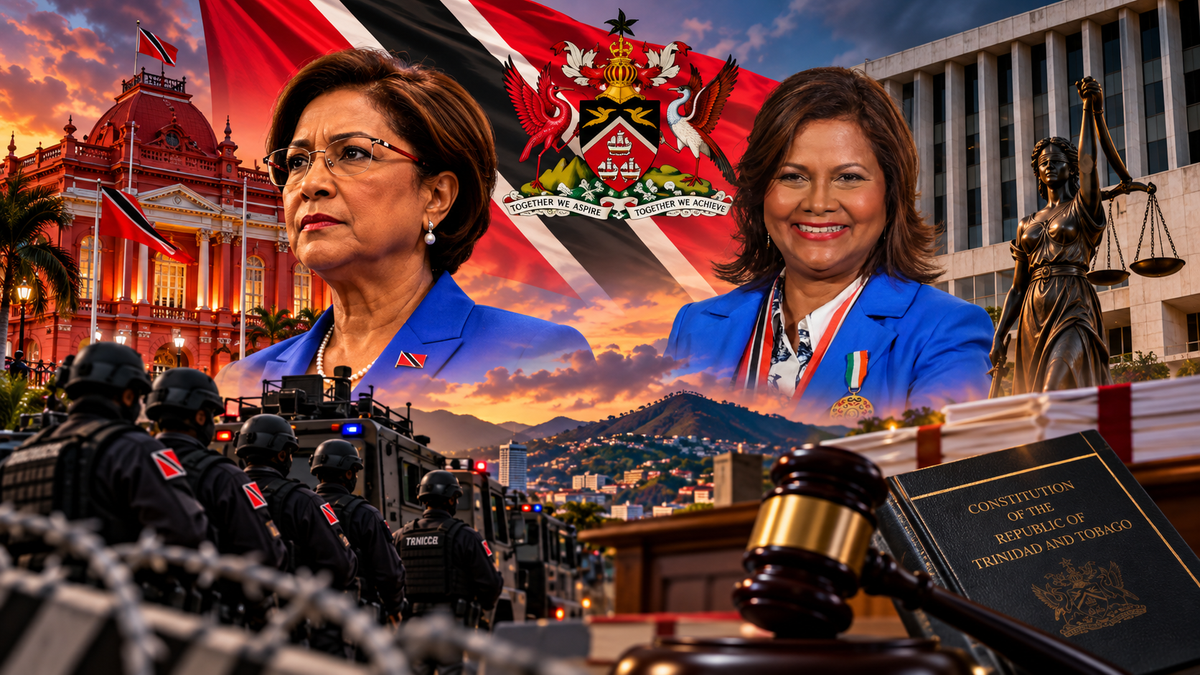
The Brief
- The Special Operations Bill, 2026 passed the Senate at approximately 1:30 AM on Republic Day (September 24) by a 16-15 vote, after the Senate President exercised his casting vote to break a 15-15 tie.
- All 15 Government senators voted in favour. All 9 Independent senators and all 6 Opposition senators voted against.
- The Bill is a rewrite of the failed ZOSO Bill. The constitutional override requiring a three-fifths majority has been removed, so only a simple majority was needed.
- Later that day, the President of Trinidad and Tobago warned that "exceptional powers must remain truly exceptional" and that "rights surrendered in anxious times are not always easily recovered."
- The Prime Minister has described the Independent senators as "scumbags," "satanic," "demons" and "Luciferian monsters" for voting against the Bill, and announced her Government would no longer accept amendments from the Independent bench.
- On September 21, before the Senate vote, the Prime Minister also publicly announced that special operations powers would not be applied in PNM-controlled areas, only in UNC-held constituencies and Tobago.
At around 1:30 AM on Thursday morning, September 24, the Senate passed the Special Operations Bill, 2026 by a 16-15 vote. All 15 Government senators voted in favour. All 9 Independent senators and all 6 Opposition senators voted against. The Bill was carried by the casting vote of the Senate President, Wade Mark, after the chamber deadlocked 15-15.
The date matters. September 24 is Republic Day. The 50th anniversary of the Republic. Later that same Thursday, President Christine Kangaloo issued her Republic Day address. It reads as a direct constitutional warning.
Ten days ago, I wrote about the third State of Emergency ending and asked what kind of constitutional order was being placed in front of the country. My argument was that emergency powers were becoming the operating condition of the country, and that it needed to be asked plainly whether it consented to that shift before it was answered by default.
What I did not anticipate was that the answer would come this quickly, this decisively, and in this form.
What was passed
The Special Operations Bill, 2026 is not the same ZOSO Bill that failed in the Senate in January. It is a rewrite. The Government removed the constitutional override that would have required a three-fifths majority, meaning the new Bill needed only a simple majority to pass. It also added a two-year sunset clause and reorganised the structure of the powers it creates.
What did not change is the substance of what the powers do.
The Bill divides Trinidad and Tobago into seven policing districts. Within those districts, the President may declare specific locations to be "closed areas" on the application of the Homeland Security Minister. Within closed areas, the State may impose curfews, cordons and checkpoints, close roads, and restrict movement into and out of designated zones. Residents may be required to obtain permits to enter or leave their homes and communities. Breach of the permit rules can bring a TT$50,000 fine and a year in prison. Warrantless searches are permitted in specified circumstances.
Unlike the previous Bill, which limited zones to 180 days and curfews to 72 hours, the new Bill sets no maximum for either. Once a closed area is declared, it remains a closed area until the State decides otherwise.
Attorney General John Jeremie acknowledged in Parliament that the Bill could interfere with rights including liberty, enjoyment of property, privacy and family life, and freedom of movement. He argued that any interference would be reasonable and proportionate.
How it was passed
With the chamber tied 15-15, Mark then exercised his casting vote in favour of the Bill. Two things about Mark's vote matter.
The first is that under standard parliamentary convention, a Presiding Officer's casting vote is used to preserve the status quo when the chamber cannot agree – to allow further debate, to send the Bill back for reconsideration, to keep an existing settlement in place rather than change it by a razor-thin margin. That principle is not a technicality. It reflects the constitutional design of the Senate President's office as a neutral chair rather than an extension of the Government bench.
Mark himself applied that principle three separate times in June 2025, on tied votes during the Children's Life Fund (Amendment) Bill. Former Deputy House Speaker Dr Fuad Khan noted this in a public letter this week and asked why the same principle was not applied to the Special Operations Bill. The public is entitled to know.
Former House Speaker Nizam Mohammed publicly warned this week that the precedent Mark has now set threatens to make the casting vote a standing feature of Government legislative arithmetic. "If it becomes accepted that whenever the Government finds itself at 15-15, the Senate President may simply provide the sixteenth vote required for passage, the casting vote ceases to be an exceptional constitutional mechanism exercised with restraint and becomes part of the Government's legislative arithmetic. That is precisely what must be guarded against."
The Government's own defence came from Senate Leader Darrell Allahar: "I do not think that the framers of the Constitution ever intended that an elected government should depend on the vote or abstention of even a single so-called Independent Senator to pass an ordinary bill. If that were so, a democratically elected government would not be able to govern and would be held to ransom by an unelected functionary chosen by the President."
That is a serious constitutional argument. It is also, on its face, an argument that the Independent bench should not exist in the form the Constitution created it. The Constitution requires a three-fifths majority for legislation that overrides fundamental rights precisely because the framers wanted Independent senators to be able to prevent such legislation from passing on a Government majority alone. Removing the constitutional override to reduce the threshold is a legal manoeuvre. Then arguing that Independent senators should not have been able to hold up such legislation in the first place is a wider position on how the Senate is meant to function. That position is not incidental to the Bill's passage. It is the constitutional theory the passage rested on.
What the Prime Minister has said
Prime Minister Kamla Persad-Bissessar has been on the record this week with several statements the country should read for itself.
Before the Senate vote, on September 21, she announced on social media that special operations under the new Bill would not be authorised in People's National Movement-controlled communities. Her exact words: "Since the Opposition MPs and supporters do not want Special Operations, I will only allow it in government-controlled areas."
That statement carries two problems, one immediate and one structural.
The immediate problem is that the Bill assigns the power to declare closed areas to the President, not to the Prime Minister. Her declaration that she "will only allow it in government-controlled areas" is either an announcement of political direction of a nominally executive-independent function, or a candid admission that Cabinet will decide where the powers are used regardless of what the Bill says on paper.
The structural problem is that a national security law cannot be applied on the basis of which party controls a constituency. Al-Rawi named the term for what Persad-Bissessar was proposing: ad hominem legislation. Legislation directed at a category of people. It is not how criminal law functions in a constitutional democracy. It is how criminal law is used somewhere else.
After the Senate vote, the Prime Minister described the Independent senators as "scumbags," "satanic" and "demons" for voting against the Bill. She said the Independent bench had been "relegated to uselessness in the Parliament yesterday, to only bray and then have no effect on the legislation. That will be their role going forward, to bray and be ignored. My Government will not buy votes from anyone."
She then announced that her Government would no longer accept amendments from the Independent bench. Any amendments. On any legislation.
By this morning, the position had been extended and tested against a fresh Bill. In an interview with the Sunday Express, the Prime Minister described the Independent Senators as "Luciferian monsters" and confirmed the Government would not accept a single amendment from the Independent bench on the Public Procurement and Disposal of Public Property (Amendment) Bill, due for second reading in the Senate on Monday. Two Cabinet ministers, David Lee and Barry Padarath, backed the position publicly at a China National Day function on Friday. The blanket rejection of Independent amendments is no longer a rhetorical commitment made in the immediate aftermath of the Special Operations vote. It is the operating rule for the next Bill in the queue.
That is the position of the Head of Government at the end of the last week of September 2026, on the record, following the passage of a Bill that gives the State expanded powers to detain, search and restrict the movement of citizens.
The President's response
Later on Republic Day, on the 50th anniversary of the Republic, President Kangaloo issued her address to the country. It really should be read in full by all citizens. The key passages read as follows:
"Our republican Constitution recognises and protects fundamental rights and freedoms. Those guarantees are not ornaments for tranquil times. They matter most when fear is greatest and the pressure to set them aside is strongest."
"Crime has caused profound grief and anxiety in homes and communities across our country. The State has an undeniable duty to protect life, maintain public order and ensure that citizens can live without fear. Yet a mature Republic must protect security, liberty and the sanctity of life together. Measures adopted in the public interest must remain necessary, proportionate, accountable and subject to the law."
"Exceptional powers must remain truly exceptional. We must be careful that fear does not persuade us, gradually and almost imperceptibly, that freedom is an obstacle to safety. Rights surrendered in anxious times are not always easily recovered."
"The strength of a constitutional democracy is measured not by whether it can exercise power, but by whether it can exercise power effectively without losing sight of the dignity and freedom of the people it exists to serve."
The weight of these words matters. This is not an academic. This is not a retired judge. This is the sitting Head of State, on the 50th anniversary of the Republic she was elected to represent, addressing a country whose Parliament had, in the early hours of that same morning, passed legislation of the kind she was warning against.
The Prime Minister once called this President "a low-level PNM functionary." The Bill Kangaloo will now be asked to sign into law makes her the deciding voice on where and when the State's closed-area powers are used. PNM Chairman Marvin Gonzales has called on her to seek independent legal advice before signing. What happens next in the President's Office is one of the questions the country now waits on.
Where this leaves us
In my September 16 piece, I predicted that the ZOSO Bill would fail in the Senate a second time. It did not. But it did not pass because the Government persuaded the Independent bench. It passed because the Government removed the three-fifths threshold and had the Senate President cast the tie-breaking vote against unanimous Independent and Opposition rejection. My prediction on the vote count was wrong. My wider argument on the trajectory the country was on has now been proven in the most concrete way possible.
The country was asked what kind of constitutional order it would accept. In ten days, the answer has been delivered. It is a constitutional order in which the substance of emergency powers is now on the ordinary statute book. In which a simple majority in the Senate, secured by the casting vote of a Presiding Officer, can override the unanimous opposition of the Independent bench. In which the Prime Minister publicly declares that the resulting powers will be applied on a partisan basis. And in which the response to the Independent bench doing its constitutional duty is the language of demonisation from the head of Government.
It is true that serious crimes have fallen. Murders have declined from 438 in 2024 to 262 in 2025 to 252 in 2026 for the year to September 10. Those numbers are real and I have said so in every SoE piece I have written this year. What I have also said, and I say again now, is that the country's answer to a crime crisis cannot be to redefine what constitutional order actually is. The State has argued that only these powers can deliver these numbers. The country has now been legislated into an experiment in whether that argument holds. But what is at stake in the experiment is not only the crime numbers. It is the Constitution itself.
What comes next
What the country does with the shift is the open question. On the Presidential side, the Special Operations Bill still needs Kangaloo's assent to become law. On the Opposition side, a constitutional challenge has been hinted at repeatedly but not yet filed. On the Independent bench, the constitutional role Vieira and Attzs named this week has to be defended or eroded, one Bill at a time. On the wider country's side, the question is whether ordinary citizens experience closed areas and permit systems as tolerable, and whether the crime numbers hold or reverse.
Al-Rawi has hinted repeatedly at a constitutional challenge to the Bill. Opposition Senator Amery Browne has called the Prime Minister "a clear and present danger" to the country's democracy. Independent Senator Anthony Vieira, one of the nine who voted no, said this week that Independent Senators "are neither Government nor Opposition representatives and are constitutionally required to assess legislation on its merits." Independent Senator Dr Marlene Attzs said the Independent bench was doing its job.
That is the record. It is the country's record now, whether the Bill is signed into law next week or challenged in court next month. What Trinidad and Tobago does with it from here is up to the country. What is no longer available to the country is the illusion that the constitutional order I wrote about ten days ago was hypothetical.
Rights surrendered in anxious times, the President said, are not always easily recovered. She is right. The country would be right to listen.