The Mighty Sparrow and the Voice We Have Lost
Slinger Francisco, the Mighty Sparrow, died in New York on September 27. Grenada-born, Trinidad-raised, Brooklyn-based for most of his final decades, he spent seventy-seven years making the Caribbean listen to itself. The voice that would have known what to make of the past political week is gone.
The Brief
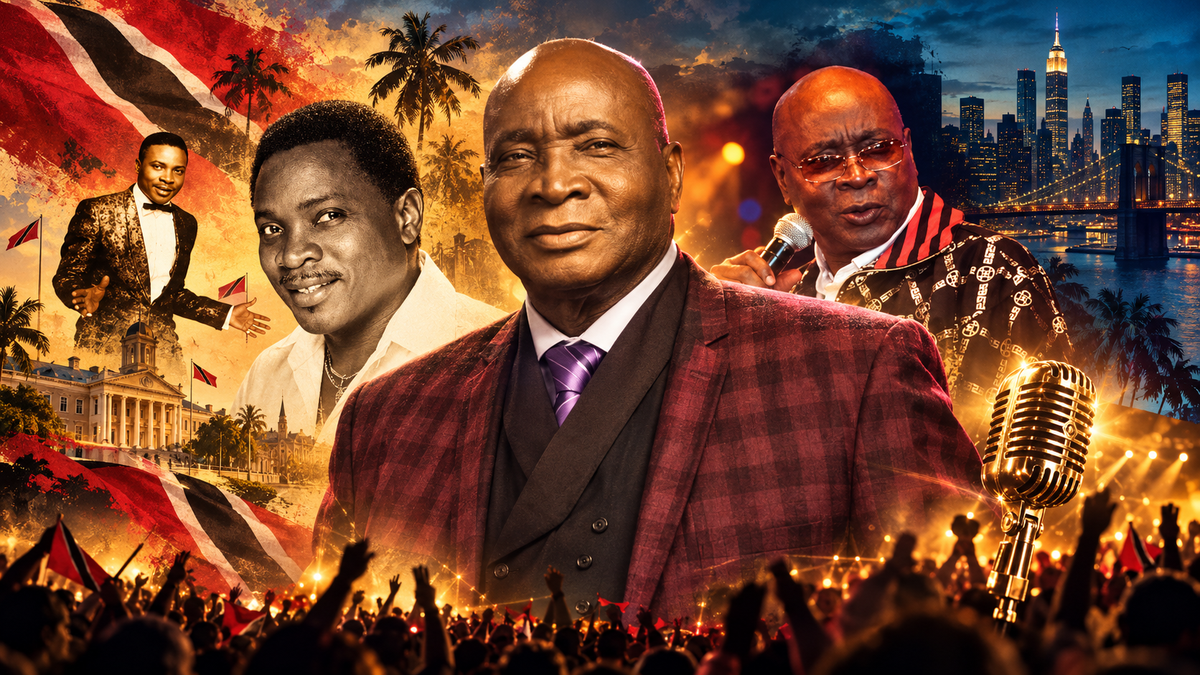
- Slinger Francisco, the Mighty Sparrow, died in New York on September 27, 2026, aged 91, after a brief illness. Born in Grand Roy, Grenada on July 9, 1935. Moved to Trinidad in 1937.
- Career from 1949 to 2026 – seventy-seven years. Eight Carnival Road March titles, eight Calypso Monarch titles, two Calypso King of Kings titles. Hundreds of recorded songs.
- Honours: ORTT, Chaconia Medal Gold, OBE, Order of the Caribbean Community (2001), honorary Doctor of Letters from UWI (1987), Nigerian traditional Chieftaincy (1977). Breakthrough: "Jean and Dinah" (1956).
- Trinidad and Tobago has announced an official State-assisted funeral and dedicated Calypso History Month 2026 to his memory. Grenada mourned him as a Grenadian son. Caribbean leaders paid tribute across the week.
- He died in the week the country's constitutional order was being rewritten by its Parliament and the language of politics was being pulled toward demonisation. The voice that would have known how to answer that is gone.
I saw The Mighty Sparrow perform live only once. It was November 2018, at the Barbican in London, at an event titled Windrush: A Celebration, part of that year's London Jazz Festival. He shared the bill with Calypso Rose and Brother Resistance, among others. He was 83. He walked onto the stage with a cane, in a three-piece burgundy windowpane check suit, waistcoat, white shirt, purple tie – dapper, stage-ready, every inch himself even seated. His voice was weaker and he performed mostly sitting down, but he still commanded the stage and his audience.
Among the songs he did that night were Congo Man and London Bridge is Falling Down. I thought at the time that it was a strange pairing. I think now it was deliberate – the arrival song and the departure song, played back to back for a London audience that had been both the destination and the betrayal. He sang Congo Man without apology. He had never apologised for it, and he was not about to start.
That is the Sparrow I keep seeing when I think about him, alongside the one being prepared for a State-assisted funeral in Port of Spain and commemorated in condolence books at fourteen municipal corporations. The one who sat on a stool at the Barbican at 83 and sang a song Trinidad radio had banned until 1989, because the song still said what he thought it said, and because he was not in the business of letting the country tell him what parts of his catalogue were acceptable.
He died on Sunday, September 27. The timing matters.
The week he died
The previous week was one of the most consequential political weeks the country has had in a decade. The Parliament rewrote the terms on which the State can detain, search and restrict the movement of citizens. The Prime Minister, that same week, called senators who voted against her legislation "scumbags," "satanic," "demons" and "Luciferian monsters." The country was in a political moment that had moved beyond the ordinary registers of parliamentary disagreement.
He was 91 and had been ill. His death was not a response to anything the country's politics was doing in September. But a country loses the people it loses in the weeks it is actually living through, not in the weeks they would have scripted for themselves. Trinidad and Tobago has lost, in a single week, the political framework of parliamentary restraint and the artist whose entire career was a demonstration of how to hold power to account in the language ordinary people actually speak.
Sparrow was not a politician and would have refused the label. He was a calypsonian. But what calypso did in his hands – what it did at its best, from Jean and Dinah in 1956 forward – was precisely to hold the political moment up to the language of the street and the fete, and to make the holding felt rather than argued.
Jean and Dinah is the song everyone names when they want to say he was political. On the surface the song is about Port of Spain sex workers losing their market after the American servicemen left Chaguaramas. Underneath it is a sovereignty song. It is about what happens to an economy and a social order organised around foreign military presence when the foreign presence packs up. In 1956 the country was six years away from independence and the song was telling it something about what independence would and would not deliver. The country did not need an op-ed about dependency. It had a calypso that worked.
Dan Is the Man in the Van did the same thing to the colonial education system. Capitalism Gone Mad, released during the oil-bust years, did it to the IMF era. Russian Satellite did it to the Cold War paranoia. Sparrow Dead, released in 1969 to mock the false rumours of his own ill-health, did it to the gossip economy of the country itself. Gunslingers did it to a political culture that had already begun to normalise criminal violence. Wanted Dead or Alive did it to the arrogance of State force. His catalogue is, among other things, a running commentary on the political life of the country across seven decades.
What the country lost last week is not calypso. The art form is intact and has new practitioners doing new work in new registers. What the country has lost is the voice that would have known how to put the current moment to music in the language that would have made the country listen. There is no one of Sparrow's generation left to do that work.
The Sparrow who was not a saint
Sparrow was a cultural giant. He was also human, and the commemorative accounts of this past week have, understandably, tidied him up a little. The obituary conventions are what they are. But the man was real and the catalogue is real, and both have to carry.
He was, in his early career, a loyal supporter of Eric Williams and the People's National Movement. The loyalty went beyond politics into territory that reads badly today. In at least one calypso of the period, he recommended that opponents of Williams's government should be hanged. That is what partisan calypso looked like at its ugliest and Sparrow wrote it. He later fell out with Williams, as the loyal often do. But the songs do not disappear.
He also wrote freely about women. Patricia Mohammed has argued, in work cited again last week, that the catalogue is more progressive on gender than its reputation suggests, and that Sparrow operated as a shape-shifter inside and outside the characters he created. The argument has merit, but it does not cover the whole territory. Some of the songs are misogynistic in their plain reading, some are indefensible, and the honest view holds both the complexity and the indefensibility. He wrote the songs he wrote.
The critic Robert Christgau called Congo Man "a provocative meditation on colonialism, sex and cannibalism." The Guardian, reviewing the Barbican performance, called it "a distinctly un-PC comedy song." Both descriptions are correct and both carry weight. The song trades in racial fantasy of a kind the Caribbean has had to argue about for sixty years. Even a British broadsheet reviewing the night in 2018 had to find a way to handle the song's content. That the question of what to do with Congo Man was not settled in his lifetime is itself a measure of what he put into the catalogue. Whether the choice to perform it in London in 2018 was the right call is a question I have not finished answering for myself.
Grand Roy, Port of Spain, Queens
He was born in Grand Roy, St John, Grenada. He arrived in Trinidad in 1937, aged two. He spent large portions of the second half of his life in Queens and in Brooklyn. He died in a New York hospital.
Sparrow was Trinidadian. He was also Grenadian. He was also, for decades, functionally a New Yorker, who flew into Port of Spain for Carnival season and flew back out, who maintained his primary audience among the Caribbean diaspora in Brooklyn, who recorded and performed in New York, who kept a Brooklyn production life alongside his Trinidad life. The country he represented at the ceremonial level was the country he spent more time visiting than inhabiting.
The description applies to a very large portion of the country's cultural output. Naipaul. Walcott, whose Trinidad was Trinidad from St Lucia. Jacqueline Chan, who left at sixteen and died in London in May. Many of the country's cultural ambassadors have, in significant part, lived somewhere else.
What the country gains from that is reach. What the country loses is the daily presence of its own cultural intelligence. Sparrow in Queens could still write Jean and Dinah because Jean and Dinah lived in him. The question for the next generation is whether a calypso that engages the current moment with the force Sparrow brought to Williams-era Trinidad can be written from Brooklyn, from Toronto, from London, from the places the diaspora has spread to. I believe it can. I am less sure the country has made the practical and institutional investments that would allow it to receive such a calypso when it is written.
Sparrow's death in New York is not an indictment of anyone. It is a fact about where his life had settled. It is also a fact about the shape of the country's cultural economy and the degree to which that economy is already a transnational one. What we have lost is one part of the story. Where we have been located all along is the other.
What the country can do when it chooses
Culture Minister Michelle Benjamin has announced an official State-assisted funeral. Calypso History Month, which began October 1, will be observed this year in Sparrow's memory. Condolence books have been opened at fourteen municipal corporations, at NAPA and SAPA, at the Shaw Park Cultural Complex in Tobago, and at the Culture Ministry's main office. The Senate marked his death with a minute of silence. The Prime Minister has issued a tribute. Grenada's Prime Minister has issued a tribute. Caricom has issued a condolence. The National Archives has posted an acknowledgment.
That is the country, at its official level, doing what the country can do when it decides a death merits the full apparatus of national mourning.
The country is capable of this. The country knows how to hold its own when it chooses to. The infrastructure of national honouring is sitting there, ready to be used, and when the country wants to use it, it does so.
The choice is the thing. The country has made that choice for Sparrow. It did not make a comparable choice when Jacqui Chan died in London in May, or when Claude Noel died in 2023 as a blind amputee in a public hospital with the Ministry admitting it had not known he needed a prosthetic leg, or when Hasely Crawford, still alive, is asking for his name to be taken off the national stadium because the country cannot organise six tickets for him at an event in his own arena.
The choice of who gets held and who gets forgotten is one the country will have to answer for in the weeks and months ahead.
What remains
The State funeral will happen. The month of Calypso History will unfold. Books will be published, if they are not already in press. The scholarship will deepen. The catalogue will be re-released, reissued, remastered, taught in schools, played at every fete for the next thirty years. The country will not forget him. That is the thing about Sparrow – the catalogue is too large and too loved for the country ever to forget him.
What the country has lost is not the memory. It is the voice.
The voice that could sit on a stool at the Barbican at 83 and command the stage without raising its own volume. The voice that could hear the political moment and know what calypso the moment deserved. The voice that could put a Prime Minister in a song and let the country decide for itself whether the song was praise or indictment. The voice that could, in the register ordinary people actually use with each other, hold the State to the account the State was not holding itself to.
That voice is harder to replace than any single song. It does not come along in every generation, and it is not clear whether the economic and institutional conditions that produced a Sparrow still exist in the country he represented.
The country that will bury him this month is not the country that produced him in 1956. He understood that. He chronicled the change for seven decades. He did not get to chronicle the final chapter.
Someone else will have to.