Petrotrin: What Comes Next?
On Thursday, the Government formally legislated the path back to a working Petrotrin refinery. The bill passed with no opposing votes. Whatever else is happening this month, this is a manifesto pledge becoming law. What the country needs to know now is what comes after the legislation.

The Brief
- Both houses of Parliament passed the Miscellaneous Provisions (Heritage Petroleum, Paria Fuel Trading and Guaracara Refining Vesting) (Amendment) Bill on June 18.
- The bill formally makes Heritage Petroleum and Paria Fuel Trading the legal successors to Petrotrin for the purposes of collective bargaining and the Industrial Relations Act.
- The Lower House vote was 26 in favour, no votes against, and 13 abstentions. The Senate passed it the same day.
- The bill is the legislative scaffolding for the Government's promised restart of the Guaracara refinery, closed by the PNM administration in 2018.
- Energy Minister Roodal Moonilal has been in talks with Indian Oil Corporation, Suriname's energy ministry, Guyana, Nigerian operators, and Italian engineering firm Tecnimont.
- Former Energy Minister Stuart Young has warned the restart could "sink" Trinidad and Tobago.
I want to begin with a statement that, of late, does not come naturally in this space, and that I am going to make myself write anyway, because this blog is meaningless if I cannot credit a government for doing the thing it said it would.
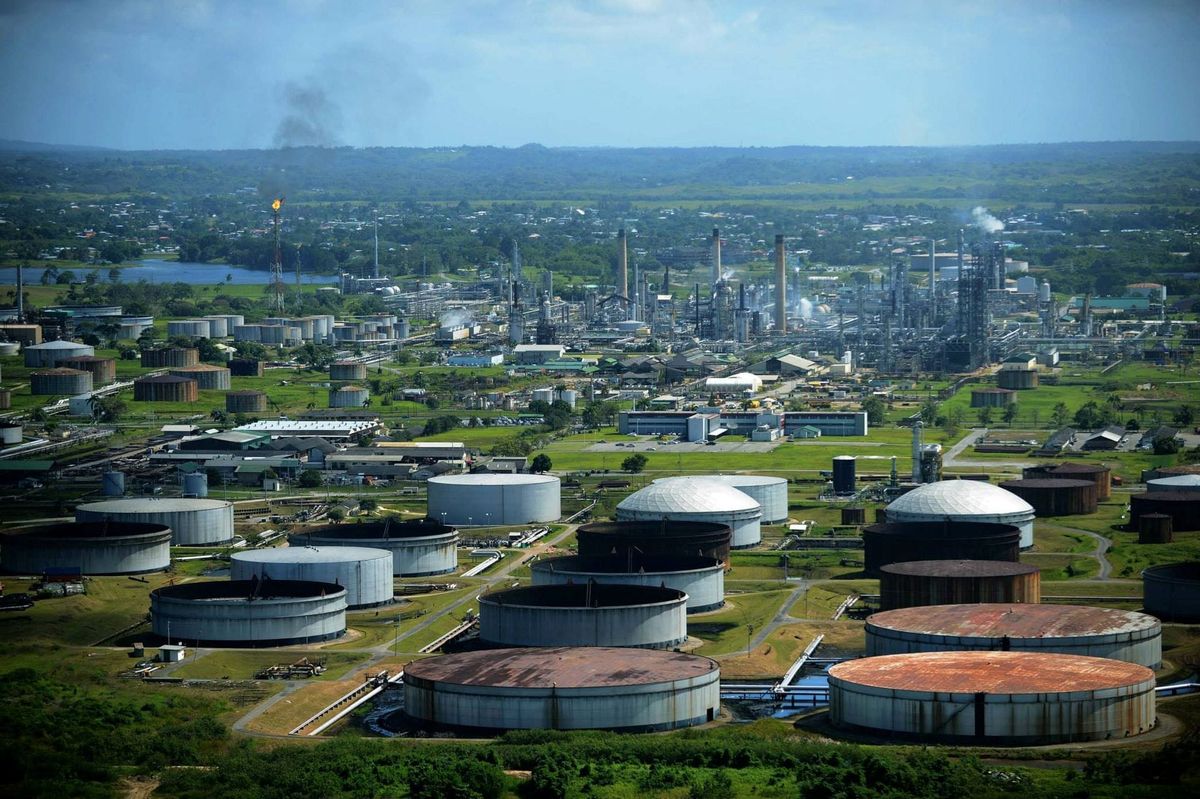
The United National Congress promised, before the election, that it would restart Petrotrin. On Thursday, the legislative scaffolding for that promise was put in place. The Miscellaneous Provisions (Heritage Petroleum, Paria Fuel Trading and Guaracara Refining Vesting) (Amendment) Bill, 2026, passed both houses the same day, with no opposing votes. The PNM abstained. The bill restores the collective bargaining rights and statutory framework that were lost in the 2018 restructuring under the previous government. It deems Heritage Petroleum and Paria Fuel Trading the legal successors to the old Petrotrin company for the purposes of the Industrial Relations Act. The cranes are not yet at Pointe-à-Pierre. But the legal road that gets the cranes there is, as of Thursday, open.
The Government has done what it said it would do. After three months of writing about the things this administration is doing badly, in matters of civil liberties and constitutional restraint, fairness calls for this post. Whatever happens next on Petrotrin, this was a moment of competent, deliberate, manifesto-aligned legislation, and it deserves to be recognised.
What I want to spend the rest of this post doing is asking the questions the next phase of this story is going to depend on. Because the legislation, while substantial, is the smallest part of what is about to happen, and the country is going to live with the consequences of decisions that have not yet been made.
What 2018 actually was
Before I go further, the 2018 decision deserves an honest hearing on both sides, because the country's reading of last week's bill depends on what it thinks happened eight years ago.
The Rowley administration closed the Petrotrin refinery in September 2018. The official rationale was that the company was carrying TT$12 billion in debt, needed TT$25 billion in repairs and upgrades, owed the Government TT$3 billion in taxes and royalties, and had become commercially unviable. Stuart Young, who has been the most consistent public defender of the decision, continues to argue that the restructuring was a financial necessity and that there was "no union busting whatsoever." The Selwyn Lashley-chaired report of June 2017 had found that the company provided around $43 billion in levies, royalties and taxes to government between 2007 and 2017, but had paid no dividends between 2011 and 2015. On the surface of the numbers, there is a real argument that the closure was a delayed reckoning rather than a political one.
The other version of the same week was that the closure cost roughly 5,000 jobs, dismembered a State company that had stood for nearly half a century, and broke the back of the country's largest blue-collar union. The Oilfields Workers Trade Union has not stopped fighting that decision since 2018. Ancel Roget, the OWTU's president general, burned photographs of Rowley and Young in protest as recently as last year. The closure was experienced as a betrayal in the southern oil belt, and the political memory of that betrayal is what got the UNC its mandate in those constituencies in April 2025.
Both readings are true. The closure was a financial decision and a political wound at the same time. Which of those two truths the country emphasises is a function of where it stands on the labour question, and that is its own form of honesty. I have my own view, which I will keep to myself for the moment, because the more useful thing for this post is to make clear that the bill passed on Thursday is the UNC's substantive answer to the labour-side reading of what happened. The bill restores the statutory framework that was dismantled. Whether you think the 2018 closure was right or wrong, the legislation passed this week is a coherent and serious response to its consequences.
What the bill does, and what it does not
The bill itself is narrower than the headlines have suggested. It does not, in itself, restart the refinery. It does not commit the country to any specific operating partner, financing structure, or refinery configuration. What it does is the legal plumbing. It establishes Heritage Petroleum and Paria Fuel Trading as the successors to Petrotrin for the purposes of all the collective agreements that existed before December 2018. It deems any worker whose employment was governed by those agreements to remain in the same statutory category, regardless of which successor entity now employs them. It clears a path for industrial relations within the new corporate structure to proceed as if 2018 had not happened.
This matters because without it, any restart of the refinery would have triggered a fresh round of recognition disputes, fresh collective bargaining, and fresh union certification, all of which would have taken months or years and given any operating partner an excuse to walk away. The bill removes that obstacle. It is, in legislative terms, the kind of preparatory step a serious government takes when it is genuinely about to do something.
But it does not, by itself, mean the refinery is restarting tomorrow. Several questions remain unanswered, and they are the ones that will determine whether last week was a milestone or a marker.
The operating partner question
The Government has been in talks with a range of international parties. Indian Oil Corporation, one of the largest energy companies in Asia. Suriname's state energy ministry, which operates a smaller refinery next door. Guyana, whose President Irfaan Ali reportedly facilitated introductions to Arab investors and local banking partners. Nigerian operators, drawing on West African refinery restart precedents. Italian engineering firm Tecnimont, whose subsidiary Tecnimont Services was awarded a US$50 million rehabilitation study contract in March 2026 to assess and prepare the facility. Even Marco Rubio, the US Secretary of State, reportedly offered US Department of Energy support when he met the Prime Minister at the CARICOM summit in St Kitts in February.
The breadth of this engagement is impressive. It is also, eight months in, slightly worrying for a different reason. The country has not yet been told who the actual operating partner will be. The Government has held discussions with companies on three continents. It has commissioned an Italian engineering study. It has accepted an interim report from the Refinery Restart Committee led by former energy minister Kevin Ramnarine. What it has not done is name the partner that will run the refinery when the lights come back on.
This is not a complaint. It is an observation that any decision of this scale, in a state with our recent track record on procurement, deserves daylight. The previous administration's preferred bidder, Oando PLC, was selected in March 2025 through a process that itself drew scrutiny. The UNC inherited that selection and has, sensibly, gone back to the market. But the market it has returned to is global, complicated, and largely happening in rooms the public is not in. At some point in the near future, the Government will name an operating partner, and the country will need to know how that decision was made, on what criteria, with what financial commitment, and with what protections against the kind of arrangements that have, in our region's recent history, cost states more than they gained.
The financing question
This is the larger of the two unknowns. The Petrotrin restart, by any credible estimate, will cost several billion US dollars. The original Rowley administration figure was that the company needed TT$25 billion in repairs and upgrades when it closed. Eight years of further deterioration are not going to have made that number smaller. Moonilal has spoken, in interviews with Caribbean and international press, about leveraging international private investment to reduce the burden on the taxpayer. That is the right instinct in principle. In practice, what it means depends on the structure of the deal.
There are three broad models the Government could use. A lease-and-operate arrangement, in which an international partner runs the refinery in exchange for a share of output, with the country retaining ownership. A joint venture, in which the state takes equity alongside the operator. A full privatisation, in which the country sells the refinery and walks away from the asset. Each of these has different consequences for the public purse, for foreign exchange, for energy security, and for the OWTU's long-term position. The country has not been told which model is on the table. The bill passed this week does not specify. The Cabinet has been deliberating since February without a public outcome.
Stuart Young's warning that a poorly structured restart could "sink the country" is partisan in its rhetoric but not in its substance. Trinidad and Tobago has a long history of state energy projects whose financial logic was sound on paper and ruinous in execution. The Petrotrin closure in 2018 was itself the consequence of decades of accumulated debt that the country had told itself, year by year, was manageable. The UNC's restart of the refinery cannot afford to repeat that pattern. The financing structure is where the entire project either works or destroys public finances for a generation, and the country has every right to see the workings before the contracts are signed.
The week the Petrotrin restart bill passed was also the week a 12-year-old girl was buried in Erin, and the Labour Day march in Fyzabad was overshadowed by the arrest of the leader of the Justice for Kaia Sealy movement. The country contains all of this at once. Government has to do everything, all the time, and the same Cabinet that legislated the bill on Thursday is also responsible for the security architecture, the labour disputes, and the wider political climate I have been writing about. Holding all of that in view at the same time is part of what reading commentary like this is supposed to be for. Crediting a real legislative success does not mean abandoning the questions that matter on the other tracks. It means engaging with the country as the complicated thing it actually is, on a Sunday, with the bill freshly passed and the next phase already in motion.
What we are about to find out
A few things will happen in the coming months that the country should pay attention to.
The Government will name an operating partner. Whether that partner is Indian Oil, a consortium led by Suriname, a Nigerian operator, or a hybrid arrangement, the choice will tell us something about whose interests are being prioritised. It will also tell us about the wider geopolitical posture this administration is taking. An Indian partner suggests one set of relationships. A US-facilitated arrangement, perhaps with Rubio's State Department in the background, suggests another. A regional consortium suggests a third. None of these is automatically better than the others. But the choice is not neutral.
The Government will publish, or fail to publish, the financing structure. If the Government commits to public disclosure of the financing arrangements before the contracts are signed, this story moves forward in the daylight the country deserves. If the Government does what governments of all parties have historically done in Trinidad and Tobago, and signs the deal behind closed doors with the details emerging only when something goes wrong, that will be a different kind of story, and this blog will address it.
The OWTU has already moved. Roget's union, which spent eight years fighting the 2018 closure, declared as far back as February that there is "absolutely no daylight" between its position and the Prime Minister's on the restart. That alignment is a significant political fact in its own right, because it gives the Government cover from the union that suffered most from the previous closure. The harder question is whether the alignment holds when the operating partner is named and the actual terms of the deal land on the OWTU's negotiating table. The union's institutional memory of the past three rounds of refinery-bid negotiations is long. Roget's support for the Government in February is not the same thing as the OWTU's support for whatever specific commercial structure emerges in late 2026.
The Opposition will move on from "this will sink the country" to a more specific critique, or it will not. Young's warning carries weight only if the PNM follows it with a credible alternative analysis. Abstaining on the bill was a careful procedural move. What the PNM does in the next three months on the financing question, the partner question, and the OWTU question will determine whether it is an opposition that is genuinely engaging with the policy or one that is waiting for the project to fail.
What this post is not
To be clear, this is not a victory lap for the UNC. The legislation passed this week was a procedural step in a much longer process, and the harder decisions are still to come. The Government deserves credit for the legislation. It does not yet deserve credit for the restart, which has not happened, or for the financing, which has not been disclosed, or for the operating partner, who has not been named.
It is not a retraction of anything I have written about this Government on the other tracks. The protest order, the DPP warning, the SoE extension, the rhetoric – none of that goes away because the Petrotrin bill passed. A government can do well in one area while doing badly in others. The honest commentator notices both. The dishonest one picks the story that fits the narrative.
It is not, finally, a piece about who is right about 2018. The closure happened. The country lived with the consequences. What matters now is not whether Rowley or Persad-Bissessar was correct eight years ago, but whether the restart that is now underway is structured to serve the country rather than serve the people who will sign the contracts.
That is the question worth asking on a Sunday in late June 2026, with the bill passed, the cranes not yet at Pointe-à-Pierre, and the harder decisions still ahead of us.