Tell Us What Really Happened in the Red House
The AG told Parliament a gang member triggered enhanced protection for MPs. The Police Commissioner backed him up. Parliamentary security, government senators and the Opposition say they never heard about it. For a claim that will be used to justify policy, the country needs more than "trust us."
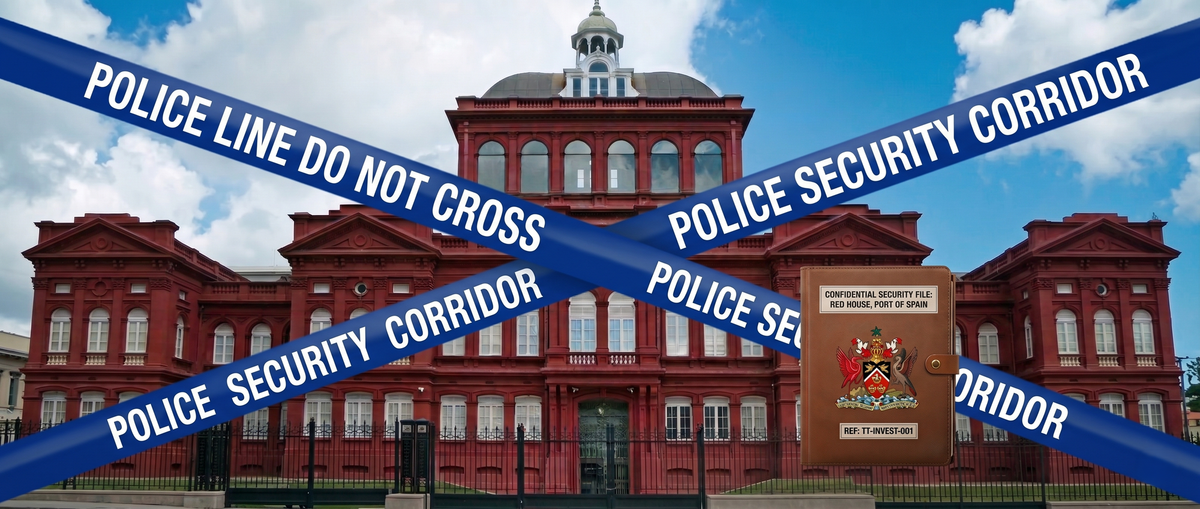
The Brief
- Attorney General John Jeremie told the House of Representatives on May 13 that a Belmont gang member sparked a "national security incident" on May 8, requiring enhanced protection for MPs and certain Government officials. Police Commissioner Allister Guevarro confirmed it on the record.
- TTPS security personnel assigned to Parliament, and intelligence officers within the service, say they only learned of the threat from the media after Jeremie's disclosure.
- PNM MPs say they were never briefed on Friday night. Several senators – including Government senators – also say they had no knowledge of any threat.
- Former Police Commissioner and former National Security Minister Gary Griffith says the AG should never have disclosed the threat publicly, calling on the current Commissioner to identify the protocol that justified the disclosure.
- On May 14, a separate and verifiable security matter unfolded at Piarco when a Ukrainian cargo aircraft landed with undeclared industrial explosives onboard. The TTPS framed the incident as evidence of the "heightened security posture under the ongoing State of Emergency."
- In July 2025, Jeremie made a near-identical claim about threats to ministers' lives to justify the original SoE.
- The current SoE, declared March 3 and extended on March 14, lapses in June. The ZOSO Bill is being reintroduced when the second session of Parliament opens.
- Opposition Chief Whip Marvin Gonzales is now calling for Jeremie and Guevarro to be fired, arguing the disclosure is "a great and grand deception" designed to lay the political ground for extending the SoE.
Wednesday afternoon in the Red House. Parole Bill debate. The Attorney General rises to defend Defence Minister Wayne Sturge from criticism over Sturge's comments linking the Belmont and Lady Young murders. And in the middle of that defence, with the Hansard recording, John Jeremie makes the disclosure:
"I'm authorised by the Commissioner of Police to say that last Friday, a member of one of those gangs in that community sparked a national security incident, such that all of us in this Parliament were protected to a higher degree and certain officials in the Government were given additional protection."
Police Commissioner Allister Guevarro, contacted by the media the same day, confirmed it. The TTPS, he said, "responded to a security-related matter last Friday, which required enhanced protective measures at Parliament and for a small number of Government officials." Given the nature of the matter, no operational details. Trust us, citizens. The system worked.
That is a serious set of claims, made on the record by the country's chief law officer and the country's chief police officer, in the Parliamentary chamber, under privilege. So before I go any further I want to say what I am not arguing. I am not arguing that nothing happened. I am not arguing that the AG and the Commissioner have invented a threat from whole cloth. That would be a heavy claim and I do not have the basis for it. What I am arguing is something narrower and, I think, more important.
If a national security incident occurred on May 8 of the sort the AG described, the country has every right to expect a paper trail. And the paper trail, as of today, is not there.
The Express and Guardian both reported that TTPS security personnel assigned to the Parliament, and intelligence officers within the police service, say they only learned of the alleged threat from the media after Jeremie's disclosure on the Wednesday. Speaking on condition of anonymity – which itself tells you something about the climate inside the service – they were never briefed, never asked to deploy additional protective measures, never told the people at the Parliament that there had been a threat against the people inside the Parliament. The very officers whose job it would have been to operationalise the response describe themselves as being in the dark.
The Opposition has said the same thing on the record. Stuart Young: he was not aware of any incident. Marvin Gonzales, the Chief Whip: present in the Parliament from 1.30pm until 7pm on the Friday, no briefing, no specific threats, no heightened security presence, nothing unusual at all. Opposition Leader Pennelope Beckles, who was in the chamber, says she was not informed. If a national security incident occurred that required enhanced protection for "all of us in this Parliament," in Jeremie's words, you would expect the Leader of the Opposition to be among the people told. She was not.
By the Friday morning, several senators – including senators on the Government's own benches – had also told reporters they had no knowledge of any threat. So at this point we have a circle of supposedly informed parties – parliamentary security, intelligence officers, the Leader of the Opposition, Government senators – none of whom seem to have been informed. The set of people who knew about the threat is now demonstrably smaller than the set of people who should have, even on the Government's own side of the chamber.
So we have two versions of that Friday night. The AG and the Commissioner say enhanced protection was put in place. The people who would have implemented that protection, and the people who would have been the subjects of it on the Opposition benches, say nothing happened that they noticed or were told about. There is a real gap there, and I do not think it can be papered over by saying that the security worked so well nobody noticed it. That is the position Phillip Alexander has staked out. With respect, it doesn't hold. Protective security in the Parliament involves the Marshal of the Parliament, the protective service officers, the Red House's own security supervisors. It is not invisible to them by design. It cannot be.
I keep coming back to one thing. In July 2025, the same Attorney General made what was effectively the same claim about threats against government ministers, in order to justify the State of Emergency the UNC had just declared three months into office. Three ministers were eventually named publicly – Wayne Sturge, Khadijah Ameen, Barry Padarath. The SoE was extended twice. It expired on January 31, 2026. The ZOSO Bill collapsed in the Senate three days earlier. A second SoE was declared on March 3 and extended on March 14. It lapses in June.
Now, six weeks before that SoE has to be renewed or replaced, the AG returns to the chamber and tells us that a gang member from Belmont – the same community at the centre of the recent killings – sparked a national security incident requiring enhanced protection for MPs. The PNM's reading is straightforward. As Gonzales puts it, this is the Government "setting the stage to play with the minds of the people of Trinidad and Tobago" to extend the SoE for another three months in June. He is calling for both Jeremie and Guevarro to be fired.
I am not ready to go where Gonzales is going. I do not have the evidence to. Calling for two of the most senior law enforcement figures in the country to be removed on the strength of a Hansard line and a 36-hour news cycle is the kind of move that ought to require more. But I am ready to say this: if the Government wants the country to accept that a serious threat was made, that enhanced protection was deployed, and that the security apparatus is responding to a category of gang threat that justifies extraordinary legislative powers, the country is owed something more than the AG's word and the Commissioner's confirmation. We are owed the operational paper trail. Not the source, not the method, not the names of officers. The paper trail. When was the threat assessment done? Who briefed the Marshal? What protective measures were authorised, by whom, and when? Why was the Leader of the Opposition not informed? Why did the parliamentary security service learn about the incident from a newspaper? These are not classified questions. They are governance questions.
While I have been writing this, a second security event has unfolded that I want to set alongside the first, because the contrast is the whole point. Late Thursday evening, a Ukrainian Antonov An-12BP cargo aircraft landed at Piarco for a refuelling stop, en route from the Bahamas to Cape Verde with a final destination of Libya. The crew declared the cargo as "nil." Immigration officers checking the paperwork on the ground found several tonnes of undeclared industrial explosives onboard. The aircraft was impounded, the crew of eight was detained, and a multi-agency investigation involving the TTPS, the Ministry of Defence, intelligence services and the Airports Authority ran for 24 hours before the plane was cleared to leave. No liability attached to pilot or crew. The system, in this case, worked exactly as it should.
Now look at the official framing. The TTPS statement on Friday opened with this line: "In keeping with the heightened security posture under the ongoing State of Emergency, routine checks identified irregularities requiring immediate precautionary action." Read that carefully. The work that caught the explosives was an immigration document check at the airline's general declaration. It is not SoE-enabled work. It is the regular, daily, unglamorous immigration and customs work that goes on at every border in every country, in every state of normal civil order. Bolting the SoE onto it as the framing device is a political act, not a security one. The country was protected, and it was protected by people doing the boring parts of their job correctly. We should be grateful to them, and we should be unimpressed by the press release.
This is why the Wednesday disclosure matters so much. Piarco gives us a comparison case. A real incident, a documented response, a chain of custody from immigration officer to Cabinet Minister that the press could actually trace. Within 24 hours, we had the airline, the flight number, the cargo manifest, the names of the agencies involved, the disposition of the crew. By contrast, on the Parliament threat we have the AG's word, the Commissioner's confirmation, and a parliamentary protective service that learned about its own operations from the morning paper. If the Government wants the public to take the second on the same footing as the first, the gap between the two paper trails has to close.
There is a wider point worth making, because I think it is the one diaspora readers in particular need to understand. National security claims are the single category of government statement that the public has the least ability to verify in real time. That is what makes them politically useful, and it is what makes them democratically dangerous. Trinidad and Tobago is not unique in this. The British government's dodgy dossier of 2003 sat at the heart of the most consequential foreign policy decision of a generation, and the public had no way to test the claims in it until years later. The American intelligence community's WMD assertions did the same work for the same purpose. National security claims do not arrive with footnotes. They arrive with consequences.
Justice Frank Seepersad made a quieter intervention at a Mother's Day dinner in Penal, calling on citizens to build "Zones of Support and Safety" inside their own homes and communities. A sitting High Court judge speaking that plainly, on the back of a week like this one, tells you something about where the country's centre of gravity actually is. Not "more law." Values.
Which is precisely why the standards have to be high. When an SoE is in force, when a parliamentary bill granting extraordinary powers has collapsed once and is being teed up again, and when the chief executive of the police service is publicly speaking the same script as the chief executive of the legal system, the country's epistemic floor cannot be "the AG said so." It has to be more.
I want to be fair to the Government on one point. Sturge has spent the last week saying out loud that the State has intelligence on who is behind the Belmont and Lady Young murders. The Homeland Security Minister has spoken about ZOSO designations. The PM has said the murder rate would have been higher without the SoE. It is at least conceivable that the cluster of public statements from senior ministers on a constituency that includes specifically named gang members has, in fact, drawn a threatening response. That is a coherent scenario. It is not an absurd one. But if it is the case, the Government's interest is in having it documented and corroborated, not in announcing it from the floor of the House on Wednesday afternoon during a Parole Bill debate, while the protective security service finds out from CNC3.
The Police Commissioner is in the most difficult position here, and I want to be honest about that too. Allister Guevarro inherited a TTPS that has been in operational crisis for years. He has been in post a relatively short time. He is being asked to back up the Attorney General publicly on a specific operational claim while, by all available reporting, his own intelligence and protective service personnel have been bypassed. That is not a position any commissioner wants to be in. The Opposition's call for his removal is, I think, premature, and risks treating him as a political appointee when his role exists precisely to be the opposite. But the demand that he account, publicly and on the record, for the basis of his Wednesday statement is reasonable. He has done the difficult thing already by confirming the AG. He now needs to do the next thing, which is to show the working.
Former Police Commissioner Gary Griffith has gone further. Griffith argued publicly on Thursday that the AG should never have disclosed the threat in Parliament at all, that there is "no protocol" requiring every threat to be made public, that the disclosure risks tipping off threat actors and damaging Trinidad and Tobago's international reputation. He challenged the current Commissioner to identify the specific protocol under which the public disclosure was made. Griffith is not a politically neutral voice – he has his own history with both major parties – but he is a credible operational voice, and his point is exactly the one I have been working toward. The standard for public disclosure of a threat is "neutralise it, secure the targets, then say only what is necessary." Wednesday's disclosure did not meet that standard.
And here is the thing the country has to keep returning to, because it is the throughline of the entire month of May. We are being asked, repeatedly, to accept critical information about our own circumstances on the say-so of officials. Heritage Petroleum spilled oil into the Gulf of Paria on May 1. We only learnt about it from the Venezuelan government on May 10. A national security incident occurred at Parliament on May 8. We only heard about it from the AG on May 13, after he was authorised by a Commissioner whose own security service apparently was not authorised in the same way. The Piarco incident on May 14 is the test case that proves the point – when a real incident happens, the documentation flows quickly because the people doing the work need to do the work. The Government had no choice but to confirm the facts of Piarco, because the facts of Piarco were happening in front of immigration officers, customs officers, the Airports Authority, the Defence Force and the foreign embassy of a Ukrainian crew. In both of the other cases, the public was downstream of the Government's preferred timing of disclosure, and in both cases the disclosure only came when the cost of silence became higher than the cost of telling us.
That pattern is not a partisan observation. It is a citizen one. The PNM has form on this too. Stuart Young, who is leading the criticism of the AG now, was the national security minister who presided over an information environment under the PNM that was not noticeably more transparent. I am not interested in tribal scorekeeping. I am interested in the standard.
The standard is this. If you are going to tell the country that something serious happened, and that the response to that serious thing will be more legislative power, more emergency powers, more rooms with fewer windows, then the country gets to ask for the receipt. Not for the source. Not for the method. For the receipt. The Hansard. The protective service log. The names of who knew, when. The reason the Leader of the Opposition was not in the loop on a threat that allegedly required enhanced protection for "all of us in this Parliament."
If those receipts exist, produce them. If they do not, that is its own answer.
For those of us reading from London, Toronto, Brooklyn and Miami, this is the kind of week that tests what we mean when we say we still belong to Trinidad and Tobago. It is not enough to be proud of Kes The Band on a Friday and silent on the Attorney General on a Wednesday. The same country produced both. The country we are remitting to and planning to return to is one where the rules of evidence in public life matter for our parents, our children, and the strangers in Belmont who are no longer with us. Tell us what actually happened in the Red House. Then we can decide what to do about it.