The Language We Leave at the Door
An opposition MP in Jamaica opened her speech on culture in the language most Jamaicans actually speak. The Speaker shut her down within seconds. It happened in Kingston, but every Trini who has ever code-switched at an immigration desk knows exactly what it felt like.

The Brief
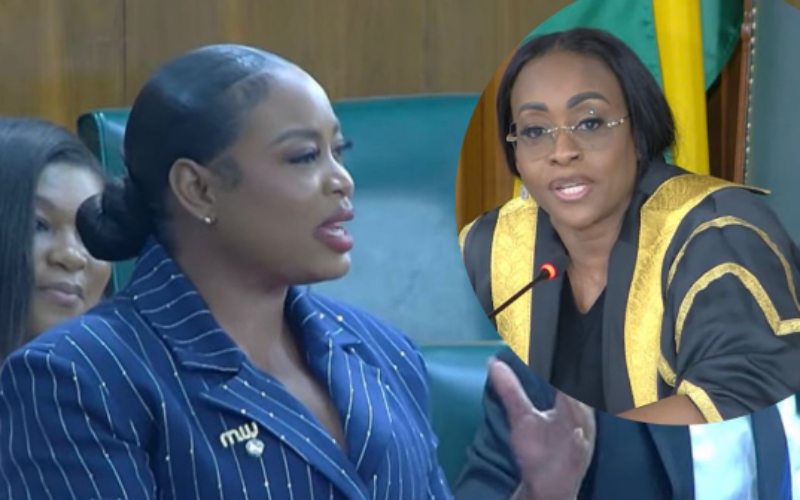
- On May 13, Jamaican opposition MP Nekeisha Burchell – the PNP spokesperson on Creative Industries, Culture and Information – opened her maiden Sectoral Debate presentation in Jamaican Patois. She got one sentence in before House Speaker Juliet Holness shut her down, citing Standing Orders requiring standard English.
- The debate Burchell was contributing to was about culture and the creative industries. The irony was not lost on anyone.
- Burchell pivoted gracefully, observing there was perhaps no more fitting way to open a speech on culture than in the language most Jamaicans speak, before continuing "in the Queen's English."
- The moment lit up Jamaican and Caribbean social media, reviving an old argument about colonialism, class and whose language counts as serious.
- It is not only a Jamaican argument. Trinidad and Tobago runs its Parliament on the same unwritten rule, and most of us live the same daily split between the language we think in and the language we are told to perform in.
There is a video going around that you have probably already seen if you keep half an eye on Caribbean social media. It is short. An opposition MP in Jamaica's House of Representatives, Nekeisha Burchell, stands to give her maiden Sectoral Debate contribution. Her portfolio is the Creative Industries, Culture and Information. She begins:
"Madam Speaker, mi git up dis afta noon fi mek mi fuss sectoral speech pon mi portfolia…"
She gets no further. Speaker Juliet Holness cuts across her. "Hold on, hold on, hold on. Standing Orders. And I think you are fully aware." A warning follows that if the Speaker has to stop her again, she will lose speaking time. The chamber dissolves into crosstalk. And Burchell, to her credit, recovers with more grace than the moment deserved. She notes, as the Observer reports, that there may be no more fitting way to begin a presentation on culture than to speak briefly in the language understood by the overwhelming majority of Jamaicans – "even if that language still struggles for full acceptance in some of our most formal, national spaces, including this very Parliament." Then she says, "So let me give you the Queen's English," and carries on.
I have watched it a few times now, and what stays with me is not the procedural rebuke. It is the phrase "let me give you the Queen's English". Said lightly, almost as a joke. But there is a whole history folded into that little surrender.
Now, before anyone in Port of Spain feels too comfortable watching Kingston have this row, let me be clear about something. This is our story too. We just have not had our viral thirty seconds yet.
Trinidad and Tobago's Parliament runs on the same unwritten understanding. Standard English in the chamber, in the Hansard, in the official record. And our relationship to our own Creole is exactly as conflicted as Jamaica's. We are a country that produces some of the most inventive language on earth – the calypso tent, the picong, the Carnival road, the entire literary inheritance from Sam Selvon to Earl Lovelace – almost none of which works in standard English. Selvon wrote The Lonely Londoners, the great novel of the Caribbean diaspora in Britain, in a modified Trini Creole because the story could not breathe in any other register. And yet the moment a Trini child steps into a classroom, a courtroom or a job interview, the instruction is the same one Burchell received: not here, not that, give us the proper version.
For those of us in the diaspora, this lands in a particular place. You know the move I am talking about. The phone call home where the accent comes back within ninety seconds. The flattening of your own voice at the London or Toronto or Miami immigration desk, the conscious decision to round the edges off your vowels so the officer does not ask you to repeat yourself. The two registers you keep running at once, switching between them so automatically you have stopped noticing you do it. We are a people who leave a language at the door, every day, and pick it back up on the way out. Burchell's thirty seconds in Gordon House is just that private negotiation made public, under a coat of arms, on the record.
So my instinct, like a lot of people's, was to side with her straight away. The symbolism is hard to argue with. In a country where, by most estimates, the overwhelming majority speak Patois as their daily language, telling the people's representative that the people's language is out of order in the people's House does look like the colonial hangover its critics say it is. The chamber in Kingston, like ours, was built to conduct the business of a Crown that is no longer ours to serve. Keeping its linguistic rules intact more than sixty years after independence is at least worth a hard question.
But I want to be fair to the other side, because the other side is not just stuffy traditionalists, and the most interesting criticism came from people who love the language.
The sharpest line I read all week was in a letter to the Jamaica Gleaner calling the moment a "stunt" by the educated class chasing cheap street cred. The writer's point was uncomfortable and, I think, partly true: many of the people rushing to defend Patois online are doing so in flawless standard English, and some of them are the very people who would decline to hire a young man who showed up to an interview speaking the way Burchell opened her speech. There is a real hypocrisy in romanticising a language in public while quietly penalising it in private, and the diaspora is not innocent of it either. How many of us have corrected our own children's "broken English" while sharing a dialect meme in the same hour? The honest version of that worry is not "Patois is lesser". It is "do not sell our children a romance that leaves them unequipped". On that much, the letter-writer and I agree.
There is a practical argument too, and it came from a serious source. The linguist Hubert Devonish, who has spent a career arguing for the dignity of Caribbean Creole, made the point that because Patois has historically been shut out of formal settings, it has never developed a fully standardised formal register – the agreed spellings and conventions you would actually need to keep a parliamentary record in it. That is not an argument against the language. It is an argument about the cost of the very exclusion Burchell was protesting. You cannot build a formal register for a language you forbid from formal rooms. The rule creates the deficiency it then points to as justification.
And there is one detail that stops this being a simple colonial morality tale. About six months before Burchell, a Jamaican government minister, Alando Terrelonge, was shut down in the same chamber for addressing Cuban visitors in Spanish – and the man who invoked the Standing Orders against him was a member of his own government. So the rule is not only ever used to suppress the language of the poor. It is, at least sometimes, applied with a kind of blunt consistency. That matters. It is the difference between a rule that is wrong and a rule that is merely old and outdated.
Where do I land? Somewhere in the middle, which will surprise nobody who reads this blog.
I do not think the answer is to throw out standard English as the working language of record, and I want to say why a little more strongly than the colonial-hangover framing usually allows. A parliament needs a common register that everyone, including the courts and the historians who will read the Hansard in fifty years, can rely on without ambiguity. That is not colonialism; that is just plumbing. But it goes further than the record. Standard English is not merely the master's language we are stuck with. It is one of the most valuable things a small country can hand its children. Why? Because it is the lingua franca of international trade, of diplomacy, of the rooms in London and Washington and Beijing where the terms that govern our economy are actually set. A Trini who can move fluently between the calypso tent and the negotiating table is not a person who has buried their true self. They are a person with two instruments instead of one, and the second instrument opens doors the first one cannot. We should teach standard English not apologetically, as a tax on being ourselves, but deliberately, as a tool we want every child to own. The code-switch is not only camouflage; at its best, it is competence – the ability to be understood by your grandmother in Laventille and by a buyer in Rotterdam in the same afternoon.
But I also do not think the answer is what happened in Gordon House, which was to treat the nation's mother tongue as an interruption to be silenced within seconds, in a debate about culture, by an institution that exists to serve the very people who speak it. There was a more generous ruling available. Let the member make her cultural point in the cultural language, on the record, and then proceed in the working register. The Standing Orders are made by the House and can be read by the House with more imagination than that.
Because here is the thing the diaspora understands in our bones. A language is not just a tool for transmitting information. It is the carrier of who we are when nobody is making us perform. When we tell our own people that the voice they use at home is unfit even to be heard in the rooms where decisions are made, we are not just enforcing a grammar. We are teaching them that the truest version of themselves should wait outside. The point is not that they should never learn the other register – they should, and it will serve them well. The point is that learning the second language should not require being made ashamed of the first.
Burchell will give the rest of her speeches in the Queen's English, as the rules require, and the record will note nothing unusual. But for thirty seconds she said the quiet thing out loud, in the language the quiet thing is usually felt in. Whether you think it was a stunt or a stand, it asked a question worth keeping alive throughout the Caribbean. Not whether we should master the world's working language – of course we should. The question is narrower and sharper than that: Whose House is it, really, if the people who own it cannot be heard in their own tongue even for thirty seconds, even in a debate about who they are?