The Nursing Dispute & False Economy of Austerity
T&T's nurses are now enforcing a 1:6 patient ratio – a policy the government approved but never implemented. The Health Minister says there is no health crisis. With nurses still on 2013 salaries and a brain drain in motion, the bill for years of austerity is coming due.

The Brief
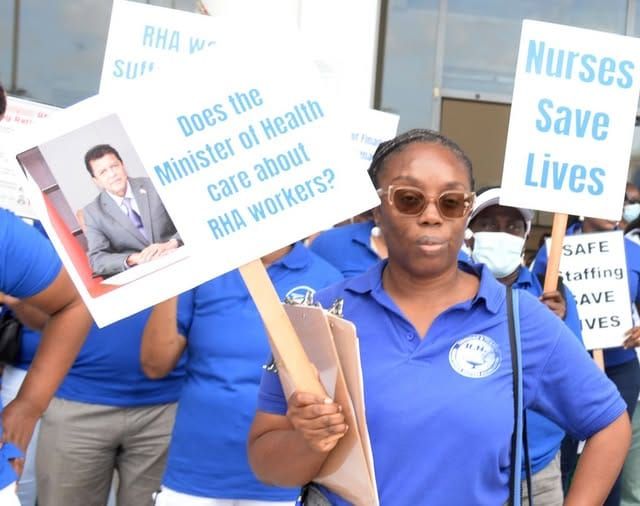
- Hundreds of nurses marched in Port of Spain on April 10, demanding an end to stagnant 2013 salary scales.
- The TTNNA voted on April 18 to escalate, and from yesterday – April 28, one year to the day after the UNC took office – nurses are enforcing a strict 1:6 nurse-to-patient ratio.
- The 1:6 policy is already approved and sitting on the Health Minister's desk, awaiting implementation.
- The RHAs cite a TT$3 million monthly overtime bill; nurses say it reflects chronic, dangerous understaffing.
- The government faces real fiscal pressures, but austerity-on-nurses is accelerating the brain drain to the UK, US and Canada.
If you want to understand how a country's economy is really functioning, look at the people running its essential services. Yesterday, April 28, the Trinidad and Tobago National Nursing Association (TTNNA) activated Phase 2 of an industrial campaign that began with hundreds of nurses marching through the capital on April 10. From yesterday, nurses across Trinidad's public hospitals are delivering "Total Patient Care" – one nurse providing the full set of care needs for each assigned patient – and will refuse to take on more than six patients at a time. The TTNNA voted at a special general meeting on April 18 to take this step, and deliberately picked yesterday – the one-year anniversary of the United National Congress government taking office. As political messaging goes, that is not subtle. Twenty-four hours in, neither Health Minister Lackram Bodoe nor NCRHA chairman Dr Tim Gopeesingh has responded publicly.
If you have relatives in the public health system, this development should concern you directly, and here is the part I want to sit with people. The 1:6 ratio is not the union's invention. According to TTNNA president Idi Stuart, the patient-to-staff ratio is already approved policy sitting on Health Minister Lackram Bodoe's desk, awaiting implementation. The TTNNA is, in effect, implementing the government's own policy because the minister will not. That distinction matters when patients can't get admitted, or get pulled from a bed: the union isn't enforcing a demand, it's enforcing a paper that the ministry already signed off on. The Nursing Council, for what it's worth, actually trains nurses for a 1:4 ratio. So 1:6 is already a compromise.
The action covers Trinidad only. The Tobago Regional Health Authority operates at roughly 1:5 to 1:7 already, and Health Secretary Faith Brebnor has confirmed the directive does not apply there. In Trinidad, particularly across the North Central Regional Health Authority, the situation is much worse. During the recent EWMSC sickout, Stuart reported NCRHA hospitals running with five nurses for 124 patients. That is a roster sheet that should have triggered an emergency response weeks ago.
The overtime contradiction
You cannot claim that nurses are overpaid while relying on them to work double shifts to plug the gaps you refuse to staff. That is the heart of the overtime row, and the government has not really answered it.
In fairness, the financial picture is awkward. NCRHA Chairman Dr Tim Gopeesingh says the "pool" extra-duty system has been costing roughly TT$3 million a month, with some nurses taking home up to TT$80,000 over a three-month period. The April 10 march was triggered when the NCRHA cut the hourly pool rate from TT$75 to TT$60, which the ministry described as a standardisation rather than a cut.
But we have to look at the other side of that ledger. Why are nurses working hundreds of extra hours in the first place? The answer is chronic understaffing. Wards short of permanent staff lean on the same group of people for double shifts, and the bill comes back as overtime. Stuart put it directly: NCRHA institutions, he said, "can't even operate unless they have pull." Treating the bill as the problem, rather than the staffing gap that produces it, gets you exactly the dispute now in progress. Gopeesingh himself has reported eliminating roughly TT$36 million in annual overtime expenditure as part of the NCRHA's reforms – but eliminating the bill while leaving the staffing gap untouched is a saving on paper, not in the wards. The TTNNA is now instructing members to refuse pool work entirely and demand statutory overtime, which will cost the RHAs more, not less, if the staffing is not fixed.
The 2013 trap and the brain drain
While the broader public service has moved up to 2019 salary scales after a recent 10% adjustment, RHA nurses are still on 2013 pay. Let that sink in. Thirteen years of grocery, fuel and rent inflation, absorbed personally by the people running the hospitals.
The macroeconomic context is real, and we have to acknowledge it. The IMF's Article IV report in February 2026 set out a sober picture: persistent budget deficits, an ageing population pushing healthcare demand up, and an ageing energy sector limiting future revenue. The treasury genuinely has limited room to manoeuvre.
But fiscal consolidation that drives your trained workforce out of the country is not consolidation. It is an unfunded subsidy to the NHS, the Canadian provinces and US health systems – and as someone who works in the UK, I can tell you the recruiters know exactly what they are doing. A newly qualified Band 5 nurse in England now starts on £32,073 from this April, under the NHS Agenda for Change pay scales. Trinidad pays to train its nurses, then watches recruiters pick them up at the gate. We are functioning as a free training academy for wealthier health systems. Compare 1965 to 1968: of 667 nurses qualified, 432 resigned for opportunities elsewhere. Sixty years on, the same pattern, with better recruiters.
The Minister's silence
Asked in Parliament on April 10 about the marches, Bodoe told the chamber there was "no health crisis" in the country. Opposition MP Colm Imbert reasonably asked what his definition of a health crisis was, given that hundreds of nurses were at that moment shutting down streets in the capital. There has been no substantive answer since. Back in November, Bodoe pledged that the 2026 Budget would fund the recruitment of around 400 additional nurses. Six months on, neither those recruits nor a pay settlement has arrived.
Silence is a strategy, but it is not a sustainable one. Beds will go unattended at the worst-staffed facilities. New admissions will be slowed or halted. Nursing managers who try to push staff above the ratio will receive legal letters from the union. None of that is a bluff.
Pockets of progress, missing the piece that matters
It is worth acknowledging that the public healthcare system is not entirely a story of institutional decay. Earlier this year, the Pan American Health Organization highlighted several innovations taking root in Trinidad and Tobago: solar-powered vaccine refrigerators that hold the cold chain through extended power outages, digitised perinatal records at Sangre Grande, and automated disinfection robots at Scarborough General. These are real upgrades, and they show the Ministry can improve its infrastructure when it chooses to.
But here is the fundamental problem. You can buy every solar fridge and disinfection robot in the world, and you can build modern, shiny hospital blocks. If there is no nursing workforce to run them, the system still fails. Healthcare is, at its core, a human-delivered service. Technology supports care; it does not replace the nurse at the bedside.
What needs to happen now
The Chief Personnel Officer and the RHAs need to put a serious offer on the table this week – not another press release about appreciation. Continuing to lean on the goodwill and exhaustion of nurses to absorb outdated pay and dangerous workloads has reached its limit. A fair settlement is not a luxury; it is an operating cost. A modernised, digitised healthcare system is useless if there is no one left in the wards to monitor the patients.