Nine Days to Decide What Country We Are
The State of Emergency lapses at midnight on June 17. In the meantime: a protest order, a DPP warning, thirteen unions threatening a constitutional challenge, and a Prime Minister who will not back down. Nine days to decide what we want this country to be.

The Brief
- On May 30, DPP Roger Gaspard SC warned the media, social media users and the public against publishing material that could prejudice the Kaia Sealy case.
- The warning came three days after the Police Commissioner signed the order banning protest within 500 metres of fifteen state institutions.
- Both restrictions land on the same case.
- The Opposition Leader is now publicly questioning whether the Commissioner is acting independently.
- A coalition of thirteen trade unions, led by TTUTA, has threatened a constitutional challenge.
- The Prime Minister has said she will not be backing down.
- The legal profession is publicly divided. Two senior counsel are arguing on opposite sides of the protest order.
- The State of Emergency lapses at midnight on June 17. A second extension requires a three-fifths majority in both Houses.
- The pattern is no longer one inferred. It is being named on the record.
The current State of Emergency lapses at midnight on June 17. That is nine days from this post. Whether Parliament extends it for another three months will tell us a great deal about which country we are choosing to be – and the architecture being built around the SoE in the meantime will tell us most of what we need to know about why.
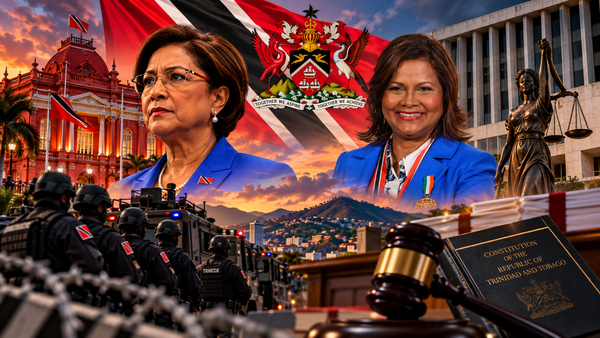
Last Sunday, in Five Hundred Metres from Democracy, I argued that the SoE, declared to fight gangs, had finally produced a receipt – and that the receipt was a tool for restricting the freedom of assembly rather than for fighting crime. The receipt was the order signed by Police Commissioner Allister Guevarro on May 27.
What I did not address in that post, because it was still settling, was a second intervention that landed two days earlier. On Friday May 30, the Director of Public Prosecutions issued a formal warning against publishing material that could prejudice the criminal case at the heart of all this. A few days on, with the wider response in, the two pieces fit together in a way that is harder to ignore.
Two restrictions in seven days. The first told the country where it cannot stand. The second told the country what it cannot say. The case sitting in the middle of both is the same one. Something is taking shape, and this post is about naming it.
The DPP's intervention
The DPP's warning is not, in isolation, the problem. The Office of the DPP exists in part to protect criminal proceedings from prejudicial coverage, and warnings of this kind have a real place in common-law systems. The rule of law depends on courts being the place where evidence is tested, not the comments section.
The question is timing and context. The Trinidad Express pushed back on the timing in an editorial titled "The DPP and the court of public opinion", noting that much of the prejudicial commentary the DPP now wants dampened was created by the TTPS's own peculiar handling of the May 19 to 21 charging announcement. The institutions that produced the public confusion are now warning the public against being confused out loud.
I want to add one more thing. The Media Association of Trinidad and Tobago backed the DPP while drawing a careful distinction between "professional journalists" who understand the legal principles of contempt and "comments circulating on social media platforms." It is a distinction I am going to challenge MATT on, as I think it quietly creates two tiers of speech – the "trained" voice and the citizen voice – with different protections at law. A constitutional democracy does not work that way. The right to comment on matters of public interest is not contingent on a press pass.
The case in the middle
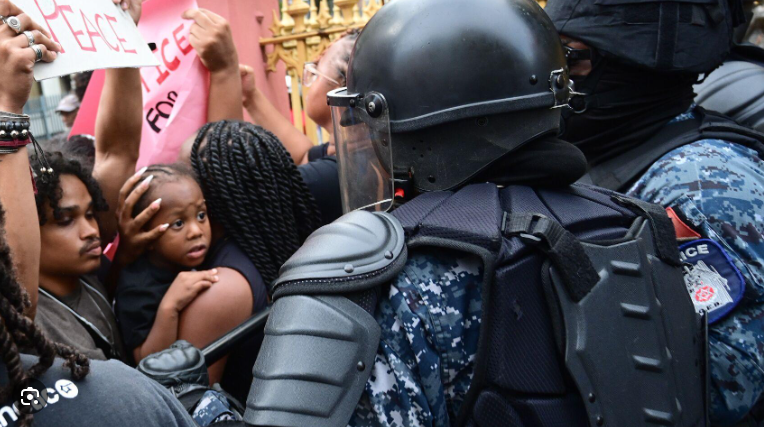
What the two restrictions share is not legal mechanism but political context. Both have arrived as public pressure on a single criminal case intensifies. The "19 Bullets, 19 Protests" campaign has continued through arrests, barricades and police dispersals. Trade unions have raised the labour-rights angle. Senior counsel from across the spectrum have raised the constitutional one. The case has become a focal point for a wider conversation about how the country holds its police accountable when they kill people.
The protest order means that conversation cannot now happen on the pavements outside the institutions involved. The DPP's warning means it cannot happen with the same volume in print or online. The combined effect, regardless of any individual official's intention, is to push the conversation into smaller rooms, quieter voices, and fewer eyes.
The Commissioner
Three weeks ago, in Tell Us What Actually Happened in the Red House, I held back from joining the Opposition's call for the Commissioner's removal. My argument then was that the evidence amounted to a single Hansard line and a 36-hour news cycle, and that removing the country's most senior law-enforcement officer required more than that. On Sunday, I wrote that if the Commissioner stood by the order, the Opposition's call for his removal would no longer be premature.
He has stood by it. The order is in active operating effect. The DPP's warning has now arrived on top of it. The condition has been met.
Opposition Leader Pennelope Beckles has escalated her language considerably since the protest order was signed. Is the Commissioner of Police acting independently? Who is guarding the guards? She has alleged the Prime Minister had prior knowledge of the order before it was signed. Those are strong claims. They are also claims being made publicly by the Leader of the Opposition.
I am not in a position to verify what the Prime Minister did or did not know before May 27. What I can say is that the demand Beckles is making – that the Commissioner publicly account for the basis on which the order was signed, and demonstrate independence from the political tier – is now a reasonable demand to make. With the DPP's warning added to the protest order, the case for accountability is harder to brush aside.
The lawyers
Larry Lalla SC, a Senior Counsel and a sitting PNM Senator, has publicly warned that the protest order could infringe constitutional protections, specifically the freedom of thought and expression and the freedom to express political views. That is a signal, to anyone listening, that there is a constitutional motion to be filed if the order is not withdrawn.
The legal profession is, importantly, publicly divided on the DPP's intervention. Israel Khan SC has endorsed Gaspard's warning, calling the DPP an entirely independent constitutional entity who must be free from external influence, including from street protests outside his office. Lalla has gone the other way on the protest order. Both are Senior Counsel. Both are speaking publicly. The legal community is, as it should be, in real-time disagreement. The point is not that one of them must be wrong. The point is that questions of this constitutional weight are being argued at the highest level of the Bar, which is why the public is owed the right to participate in the argument.
The country has recent precedent here. In August 2025, the Court of Appeal ruled that the destruction of the Highway Reroute Movement's protest camp by the army in 2012 breached the constitutional rights of seven HRM members. The freedom of peaceful protest is constitutionally protected, and the State cannot suppress it without a high bar of justification. The protest order signed on May 27 has not crossed that bar in any of the public documents the State has produced. There has been no White Paper, no parliamentary debate, no published threat assessment, no sunset clause beyond the SoE itself.
The unions
When I wrote last week that the order's labour-rights implications should bring trade unions of every political persuasion to the same table within twenty-four hours, I was being slightly optimistic about the timeline. In the event, it took a little over a week. On Tuesday, a coalition of thirteen trade unions calling themselves the Progressive Independent Trade Unions held a joint press conference at TTUTA's headquarters. TTUTA president Crystal Ashe tore up a copy of Legal Notice No. 40 of 2026 in front of the cameras. The coalition has obtained legal advice and is preparing a constitutional challenge. TTUTA, the Communication Workers' Union, the Trinidad and Tobago National Nurses Association, the Seamen and Waterfront Workers' Trade Union, the Trinidad and Tobago Airline Pilots Association, the Bank and Insurance General Workers' Union, the Prison Officers' Association and several others are now formally aligned. These are not statements that align tribally with one political party or another. They align around the working person's right to assemble outside the workplace at the heart of a dispute. That right, as the order is currently written, no longer exists for most of the country's major employers in the public and security sectors.
The Prime Minister's response to the unions' threat was to refuse to back down. "Citizens are free to protest, free to shut down the country or free to turn up to work on any day," she said. "In our society, citizens are allowed to pursue their individual choices within the law. At the end of each month, every individual has to pay their bills, and therefore they should make choices that best suit them." Read that carefully. The head of government is telling unionised workers that the price of exercising a constitutional right is their pay. The original "grifters" framing has now matured into a work-or-protest binary, with the State's enforcement architecture behind it. That is a position any democracy should be cautious about normalising, regardless of who holds office.
The pattern
I will say what I think plainly. I do not believe the timing of the two restrictions is a coincidence. I do not believe the Commissioner of Police, in the same week the DPP issued his warning, would have signed an order with that scope and that targeting unless the political tier above him was content for it to happen. I do not believe the Prime Minister's rhetoric since – the "publicity farming," the "victim gimmickry," the inverted "hands up, don't shoot at the police" line – was unrelated to the institutional moves underneath. The political register, the policing register and the prosecutorial register are all pulling in the same direction at the same time, on the same case. That is not coincidence. That is policy.
The fair version of the Government's case is that each institution is acting within its own remit and the convergence is completely incidental. I have given that version a hearing across two posts now. It does not explain why all three things happened in the same week, on the same case, with no parliamentary debate, no public threat assessment, no separation in time between the political register and the prosecutorial one. A coincidence of three actions converging on a single citizen-led protest movement is the kind of thing that, in any democracy, ought to invite questions the Government has so far shown no interest in answering.
What now?
In Five Hundred Metres from Democracy, I asked what the SoE was actually for. The week since has sharpened my answer. The SoE has become a constitutional shock absorber, and what it is absorbing is the political cost of a single accountability question. The protest order keeps the question off the pavements. The DPP's warning keeps it out of print and off our screens. The Prime Minister's rhetoric tells everyone still asking that they are grifters and publicity farmers.
It is not a complicated machine, when you stand back and look at it. It is a simple one, and a familiar one. Other democracies have built it, used it, regretted it. Most are now actively dismantling the parts they recognised too late. We are in the building phase. We have the chance to recognise it now, while the parts are still being bolted on.
Parliament's decision on June 17 is one part of the answer. The other part is what the public asks of these institutions in the nine days between this post and that vote. A three-fifths majority in both Houses is required for the SoE to be extended. The Prime Minister has signalled she will seek that vote if the National Security Council recommends it. There is a version of these nine days where the country sleepwalks through them and wakes up on June 18 to find the protest order extended by default. There is another version where editorials sharpen, where lawful debate finds its way into the rooms where the vote will be cast, and where the public asks the institutions involved to account for themselves before Parliament decides.
For Trinis abroad, this is the moment to keep watching. The diaspora's most important contribution to the country's democracy is its insistence that the country can be better than its worst week. The State has now told us where we cannot stand and what we cannot say. The thing it cannot tell us is what to think. That, for now, is still ours.