Five Hundred Metres From Democracy
Fifteen no-protest zones, signed by the Police Commissioner the same day riot police arrested a grieving best friend at a vigil. We have been asking for weeks what the State of Emergency was actually for. This week we got the answer in writing.

The Brief
- Police Commissioner Allister Guevarro signed a legal notice on May 27, creating 15 no-protest zones across the country.
- Each zone extends 500 metres from the listed site. The list includes Parliament, the PM's Office, every police station, every prison, every army base, both airports, the Port Authority and the DPP's office.
- The order was made under existing State of Emergency powers. It was not debated in Parliament.
- The same day, riot police dispersed a "Justice for Kaia Sealy" protest outside the DPP. Three people were arrested.
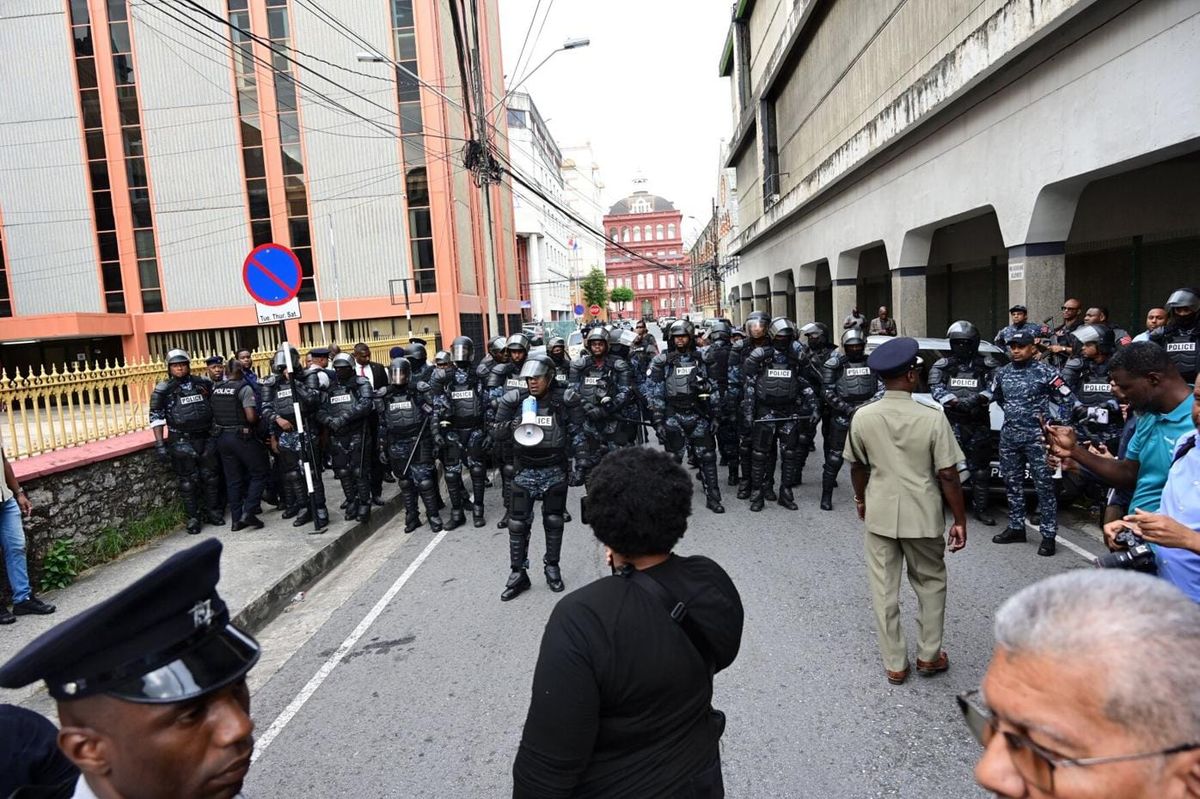
- A second protest at the Forensic Science Centre on May 29 was barricaded and pushed across the street.
- NATUC has condemned the order. It also raises serious concern for lawful industrial action, since every workplace at the heart of a major public-sector dispute is now a no-protest zone.
- The Prime Minister called the protesters "grifters" engaged in "publicity farming" and "victim gimmickry," and suggested they should chant "Hands up! Don't shoot at the police!"
Let me start with the chronology, because the chronology is the argument.
On the morning of Wednesday May 27, supporters of Kaia Sealy gathered outside the Office of the Director of Public Prosecutions in Port of Spain. The protest was part of a citizen-led campaign called "19 Bullets, 19 Protests," organised by Alyssa Phillip in memory of Joshua Samaroo, who was shot and killed by police in St Augustine on January 20. Sealy, who was with Samaroo on the night of the shooting and was struck several times herself, has since been charged with manslaughter in his death and several firearm offences, with four additional charges added the day before the protest. She is in the United States receiving medical treatment. Phillip had given the police 48 hours' notice of the protest under Section 109 of the Summary Offences Act, which is the legal requirement for a peaceful standstill demonstration.
Riot police arrived. Phillip was arrested at the corner of Sackville and Richmond Streets, along with her mother and another person. The vigil was dispersed.
Later that same day, Police Commissioner Allister Guevarro signed Legal Notice No. 40 of 2026. The notice creates fifteen categories of "no-protest zones" extending 500 metres from each listed location. The DPP's office is on the list. So is Parliament. So is the Office of the President. So is the Office of the Prime Minister. So is the Diplomatic Centre, the Office of the Attorney General, the Ministry of Finance, the Ministry of Defence, the Ministry of Homeland Security. So is the headquarters of the police service – and every single police station nationwide. The headquarters of the prison service – and every single prison and detention centre. The headquarters of the Defence Force – and every single army base and barracks. The Piarco and ANR Robinson airports. The Port Authority. The receipt for the Sealy protest had been written by the close of business on the same day. We just didn't know it yet.
Two days later, on Friday May 29, supporters tried again at the Forensic Science Centre on Barbados Road. A heavy police presence descended on the area. Barricades went up. The public, supporters and journalists were pushed to the opposite side of the street, prevented from standing on the same side of the road as the centre. The order is now in operating effect. The protest has not been banned outright. It has been pushed into the gutter, which is the modern version of being banned.
For three months now, since the second State of Emergency was declared in March, I, along with others, have been asking a version of the same question. What is the SoE actually for? The Government's case has been that it is a crime-fighting tool, necessary to disrupt gang networks, protect officials under threat, and prevent coordinated violence. I believe I have given that case a fair hearing on this blog. I gave the Attorney General a fair hearing when he disclosed the supposed Parliament threat on the floor of the House. I gave the Prime Minister's argument that the murder rate would be higher without the SoE the fairest hearing I could. I held back from joining the Opposition's call for the Commissioner's head, on the basis that I did not yet have the evidence to warrant it.
I owe my readers an update on that last position, and here it is. The receipt has now arrived.
On Wednesday, the man whose removal I declined to call for signed a legal notice that, under powers granted by an SoE declared to fight gangs, prohibits public protest within 500 metres of every police station in the country. Not on the day of a riot. Not in response to a specific threat. As a standing rule, until the SoE lapses in June or is renewed. The man who told us in his April media conference that the country was suffering from a fear of crime rather than crime itself has used powers granted to address crime to instead address the public's right to be visible outside the institutions that are supposed to serve them. That is not a small thing. It is, frankly, the largest peacetime curtailment of the freedom of assembly in Trinidad and Tobago that I can remember, and it happened on a Wednesday, with no debate, no White Paper, no parliamentary vote, no sunset clause beyond whatever happens in June.
As always, I want to be fair to the Government's case, because it has a real version worth engaging with.
The strongest version of the Government's argument is real. Protests at sensitive security facilities can be infiltrated, disruptive, or used as cover for hostile action. Other democracies do have similar rules. Section 109 of the Summary Offences Act has always required giving advanced notice. There is a perfectly defensible category of restriction here. The Piarco aircraft incident on May 14 reminded us that the country's airports and ports are genuine national-security infrastructure, and that protective measures around them are not paranoia. A reasonable person can accept that some buffer around some sites, at some times, may be sensible.
The problem is, none of that is what was signed on Wednesday.
What was signed on May 27 is a 500-metre exclusion zone around fifteen categories of building, including every police station and every prison in the country, declared by police executive order, not by Parliament, in the middle of a State of Emergency, on the day of a citizen protest the police were busy dispersing. It is the kind of order you would draft if you wanted to make sure that whatever happens next with the SoE, or with the Sealy case, or with any future industrial dispute or public grievance, the public will not be able to gather in any of the places where the gathering would actually be seen. Five hundred metres in central Port of Spain is not a buffer. It is most of the city centre. Five hundred metres around every police station nationwide is a no-protest zone that reaches into every village in the country. Five hundred metres around the DPP's office is the distance between the protest and any journalist trying to photograph it.
The Deputy Commissioner of Police's public defence of the order, when pressed by reporters, was this sentence, verbatim: "When these decisions are made, it is made in the best interest of Trinidad and Tobago." That is an answer that should worry anyone, of any political persuasion. It is the answer of an institution that no longer feels it owes the public its reasoning. Trust us. We know best. The fact that the answer comes from a service whose own intelligence officers, three weeks ago, learned about an apparent national security incident from the morning newspaper does not improve the climate.
The political register has been worse. On May 28, the day after the order was signed and the protest was dispersed, the Prime Minister was asked to respond to the protesters. Her answer was to call them "grifters" engaged in "publicity farming" and "victim gimmickry." She told them they were free to "mash up the place" if they wished and face the consequences. She asked, rhetorically, where they had been when more than 5,000 people had been murdered by criminals over the past decade. And then she said something I had to read twice to be sure I had read it correctly. She suggested the chant she would prefer they used in future: "Hands up! Don't shoot at the police!"
I want to be clear about what is wrong with that sentence, because the wrongness is not only what it sounds like. The phrase "hands up, don't shoot" is not generic protest language. It is the specific chant that emerged from Ferguson, Missouri, in 2014, after the killing of Michael Brown by a police officer. It became, over the following decade, the global shorthand for citizens demanding accountability when government agents kill an unarmed person. Every Trini in Brooklyn, Atlanta, Toronto or London knows where that phrase comes from and what it means. To twist it like this – suggesting the protesters chant the version that protects the police from the people, rather than the people from the police – is not just a joke. It is a deliberate inversion of a global civil rights symbol, by the head of Government, in response to citizens grieving a man shot dead by police. The Prime Minister is a former Attorney General and a Senior Counsel. She knows what those words mean. Choosing them was the point.
Mickela Panday of the Patriotic Front got the tone right in her response on Friday. She did not match the heat. She asked, simply, for the Prime Minister to "lower the temperature" instead of dismissing public concern as theatre. That is the request the country needs to keep making, of any government, of any party, in any week. There is room in the criminal process for Kaia Sealy's case to be tested. There is room in the legislative process for protest restrictions to be debated honestly. There is no room, in either, for the country's leader to refer to a grieving best friend at a vigil as a grifter.
I want to be clear that this post is not a defence of the underlying Sealy case or a brief for any particular protest movement. I do not know what happened on the night of January 20 in St Augustine. The criminal process will determine that, and the four additional firearm-related charges laid against Sealy on May 26 mean the State has its own version of events it intends to put to a court. That is the proper place. What is at issue here is not whether Kaia Sealy is innocent or guilty. What is at issue is whether the people who believe she has been treated unfairly – her best friend, her family, her supporters, anyone who feels strongly about a police shooting that left two people on a road and one dead – are allowed to stand on a public pavement and say so within sight of the office that is prosecuting her. On Wednesday, the answer became no.
The National Trade Union Centre's response named the second danger that has gone almost entirely unnoticed in the political conversation so far. The order does not exempt lawful industrial action. Every prison in the country is now a no-protest zone. Every police station. Every army base. Every airport. The Port Authority. If there is a Public Services Association dispute, a Prison Officers' Association dispute, a Fire Service Association dispute, an airline workers' dispute, a port workers' dispute – the order, as written, prohibits a peaceful assembly outside the workplace at the heart of the dispute. That is a labour-rights issue that ought to bring trade unions of every political persuasion to the same table, and NATUC was right to flag it within twenty-four hours.
There is a wider point about how rights die in small republics. They do not, usually, die in a single dramatic moment. They die through small, technical orders signed on busy days by officials who are not the ones who will have to answer for them in ten years, under emergency powers granted for an entirely different purpose. The State of Emergency was sold to the country as a tool against gangs. It is being used, on its own latest legal notice, as a tool against the public. The two uses are not the same use, and the country deserves some accountability. If the Government wishes to argue that protest restrictions around sensitive sites are necessary in normal times, let it make that argument in Parliament, in primary legislation, with proper debate, sunset clauses, and parliamentary oversight. There is a defensible version of that argument, and I would engage with it on its merits. What is not defensible is using emergency powers, granted for one purpose, to do permanent constitutional work for another. It is the legal equivalent of buying groceries with the rent money. Whatever you came home with, it was not what the money was for.
If you are reading this from abroad, this is the week to pay attention. The diaspora is often accused, fairly enough, of caring more about Carnival than about constitutions. The standing accusation is that we celebrate the country's culture and abandon it the moment that culture's freedoms are under pressure. This is the week to disprove that. Write to your MP back home if you still have one. Talk about it in your WhatsApp groups. Share NATUC's statement. Notice, and say you have noticed.
Three weeks ago I asked, in this space, for the Government to show the country the receipt for the threat the Attorney General had announced in the Red House. The Government never produced that receipt. What it produced instead, on Wednesday, was a different receipt entirely. A receipt for what the State of Emergency was actually for. Fifteen buildings, 500 metres, no debate, no sunset, no apology, and the Prime Minister calling the people on the wrong end of it grifters. The State, as the saying goes, is what the State does. On May 27, the State did this.
We were asking the wrong question. The State of Emergency was never about the gangs.