Outside the Zone of Peace
Trinidad and Tobago has long traded on a diplomatic weight in excess of its size. Between July and November, six consecutive votes, abstentions and absences have begun to spend that weight down. What is unclear is what the country is getting in return, and whether anyone has worked out the trade.
The Brief
- Between July 7 and November 4, Trinidad and Tobago broke with CARICOM or its own standing positions on six consecutive foreign policy tests: two Cuba votes, the extension of the UN Human Rights Commissioner, a UN climate advisory opinion, the Rubio sanctions on the ICC, and the Prime Minister's no-show at the Commonwealth summit in Antigua
- On October 28, T&T became the first CARICOM country in the 34-year history of the resolution to vote NO on the annual UN demand for an end to the US embargo on Cuba. Jamaica, Guyana and Haiti abstained
- Minister of Foreign and CARICOM Affairs Sean Sobers led the T&T delegation to the CHOGM and opened bilateral talks with Ghana on a joint CARICOM-African Union reparatory justice mechanism. T&T has historically funded around 20 percent of CARICOM's operating budget
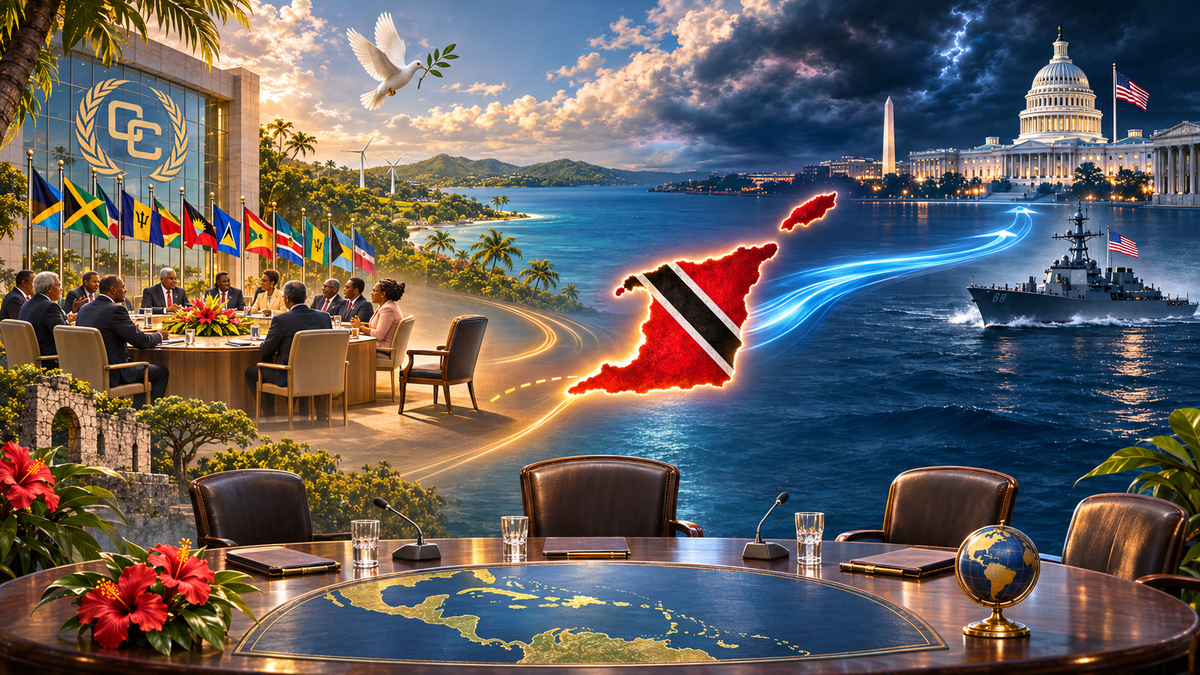
- T&T has historically operated on a diplomatic weight greater than its size: Robinson building the ICC, Manning hosting the 2009 Summit of the Americas, and the country's long adherence to the 2014 CELAC Declaration of the Caribbean as a Zone of Peace. That weight is what has been spent across these six tests
- T&T takes a non-permanent seat on the UN Security Council on January 1, 2027. The question is what the country is getting in return for the weight it is giving up
Trinidad and Tobago has for decades traded on a moral and diplomatic weight in Caribbean and global forums that was in excess of its size. The late ANR Robinson is the clearest case. He pushed, from Port of Spain, for an international court that eventually tried people the United States and Russia both wanted to protect. Patrick Manning hosted the Fifth Summit of the Americas in 2009 and used it to pull the United States back into regional conversation after years of neglect. The country sits where the oil runs out into the South and the Commonwealth meets the Hemisphere, and that position has been the basis of its foreign policy weight. The country was also, by regional declaration since 2014, part of a Caribbean Zone of Peace, which committed its signatories against hosting foreign militaries in the region and against aligning with great powers against their own neighbours. T&T carried that posture into every CARICOM chamber and every UN vote for more than a decade.
That weight is being spent right now, in votes and absences the country has not been invited to discuss, in a direction the Government has not accounted for. I have been turning that over all week, since the Prime Minister missed CHOGM 2026 last Tuesday. Six consecutive foreign policy breaks in five months is a pattern. The Government has not told us what it is, or what the country is giving up to be on it.
On July 7, at the UN General Assembly, T&T abstained on a procedural vote tied to the US embargo on Cuba. Grenada abstained alongside us. Guyana and Antigua did not vote. That abstention was itself a break with T&T's record of supporting the annual UN resolution against the embargo, which goes back without interruption to 1992. T&T is also one of four Caribbean countries that broke with Washington in 1974 to establish diplomatic relations with Havana, which is a founding act of post-independence Caribbean foreign policy. The July abstention was the first move away from that posture.
The second move came in October. On October 28, on the annual General Assembly resolution calling on the United States to end the embargo, T&T voted NO. The resolution passed 130-17. T&T sat with the United States, Israel, and 14 others. Jamaica, Guyana and Haiti abstained, breaking from the regional bloc but declining to vote with Washington. T&T is, as far as I can find, the first CARICOM country in the 34-year history of the resolution to cast a NO vote. The Prime Minister defended the vote by saying her government will not support a "military dictatorship" in Cuba. The Cuban government has not changed its character between 2025 and now. T&T's vote has. Minister Sobers had earlier told the Guardian that it would be hypocritical to support ending the embargo and that the embargo is "a bilateral situation" between Washington and Havana. The hypocrisy claim fails on the record: 33 years of T&T voting with the overwhelming UN majority against the embargo was never hypocritical. The bilateral claim fails on the law: the official UN position, and the standing CARICOM position, is that the embargo's extraterritorial reach affects third countries, including T&T.
Between the two Cuba votes, in mid-October, T&T joined nine other countries in voting against the extension of UN High Commissioner for Human Rights Volker Türk. T&T's stated reason, procedural concerns about the appointment process, mirrored one of Washington's objections. Türk received the extension anyway, with 144 votes. My former colleague Sunity Maharaj was the first to connect the Türk vote to the July Cuba abstention, in her Express column The Ghost of ANR, and she was right to do it. It was the second time in a month T&T had sided with the minority Washington was leading.
Then the climate vote. On a UN General Assembly resolution tied to an ICJ advisory opinion on states' obligations in respect of climate change, T&T did not vote. Former Foreign Minister Amery Browne put it plainly: T&T did not vote yes, did not vote no, did not vote to abstain, and did not even participate. For a small island state whose citizens live with the physical consequences of a climate crisis they did not create, not showing up to the climate vote is a particular kind of silence.
Then the ICC. On October 9, US Secretary of State Marco Rubio announced sanctions on the court as an institution. The court is the one Robinson, more than anyone else, is responsible for creating. Three weeks ago, I argued the Government's silence on the Rubio sanctions was itself a position. Nothing has changed since. The Prime Minister declined to comment when Guardian Media asked her directly, saying only "not now," while meeting the American delegation that had come to press the point. Justice Althea Alexis-Windsor, the Trinidadian judge the country nominated to the ICC bench, continues her work in The Hague, undefended by the Government that put her there.
Then CHOGM. The 28th Commonwealth Heads of Government Meeting was held in Antigua from November 1 to 4. The CARICOM Reparations Commission had, in advance, called it the reparations CHOGM. King Charles attended. New UK Prime Minister Andy Burnham arrived open to a formal apology for slavery, if not to financial reparations. The Prime Minister of Trinidad and Tobago did not attend. The reason given was illness. Minister Sobers represented the country.
Illness can affect anyone and it is bad faith to pretend otherwise. The absence does sit inside a pattern, though. The Government missed the July 2025 Jamaica CARICOM summit, the Prime Minister's first opportunity to appear as a returning head of government. It missed the meetings concerning the reappointment of Secretary-General Carla Barnett, whose reappointment T&T has publicly announced it will not recognise after August. It missed the Africa-CARICOM Summit, where the Opposition called T&T's representation by two mid-ranking officials a further insult. In December 2025, the Prime Minister called CARICOM "not a reliable partner", drawing a public rebuke from the host of this CHOGM, Antigua's Gaston Browne. A reparations CHOGM in Antigua was always going to be the room where that December exchange had to be addressed. And T&T has historically funded around 20 per cent of CARICOM's operating budget, which makes the pattern of absence something more than a diplomatic snub. It is a country one-fifth of whose bills the bloc depends on, telling the bloc, repeatedly, that it does not want to be in the room.
Sobers did substantive work at the summit. He held bilateral talks with Ghana's Foreign Minister Samuel Okudzeto Ablakwa on the margins about a joint CARICOM-African Union mechanism for reparatory justice. T&T is set to take the CARICOM chairmanship from January 2028. The country was represented, and represented seriously, on at least one of the questions the summit was convened to address. The argument of this piece is not that T&T has disengaged from the region. It is that the Government has not set out the doctrine that explains why it is present on reparations and absent, or silent, on almost everything else.
So: two Cuba votes, Türk, the climate no-show, the ICC silence, and the CHOGM absence. Six in five months. Each defensible on its own terms. The six add up to a direction: closer to Washington, looser with Havana, quieter on The Hague, further from CARICOM, and outside the Caribbean Zone of Peace the country spent a decade helping to define. What is the policy behind that direction?
There may well be a reasonable case for it. In March, the Prime Minister met the Commander of US Southern Command and described the relationship as strategic. In September, she welcomed the warship USS Gravely to Port of Spain. She described her US visit this year as a "strategic victory". There is a theory of the US relationship behind these moves, and the six votes are consistent with it. Security cooperation on Venezuela and on transnational crime is one plausible candidate for what T&T is being offered in return. Dragon gas is another. But neither has been offered to the country as part of a settled foreign policy doctrine, and neither has been laid out for the country to weigh.
The weight was built by people like Robinson and Manning over decades, in small rooms, through patient work. It is not the kind of thing that can be rebuilt by press release once it is gone. The Zone of Peace was a negotiated regional posture, not a slogan. It let small Caribbean states speak with a shared voice on questions where none of them could speak with great-power volume alone. The Prime Minister has rejected it in public, calling the Caribbean position "zone of peace fakery" and saying Trinidad and Tobago "wants no part of that alignment". That is the clearest statement we have been given of any part of the new doctrine, but it only tells us what the country is leaving, but not where it is going.
In January, T&T takes its non-permanent seat on the UN Security Council for the 2027-2028 term. The seat was won in June by years of Trinidadian diplomacy and the weight the country still had going into the vote. In that chamber, T&T will be asked to vote on Venezuela, Palestine, Iran, Sudan, and the enforcement of international criminal law. If the direction of the last five months continues, T&T will sit with the United States, Israel and the United Kingdom more often than its CARICOM colleagues outside the chamber will be comfortable with. The Government is free to disprove the prediction. So far it has given us no reason to think it will.
Sunity, writing in October, asked whether the ghost of ANR Robinson would be called upon to serve. It is a fair question, and it has a follow-up. What is the Government giving up Robinson's inheritance in exchange for, and when will the country be told the answer?
The six tests are the public evidence of a position that has not been publicly explained. The position may well be defensible, but the country deserves to hear the defence.