The Pointe-à-Pierre Paradox
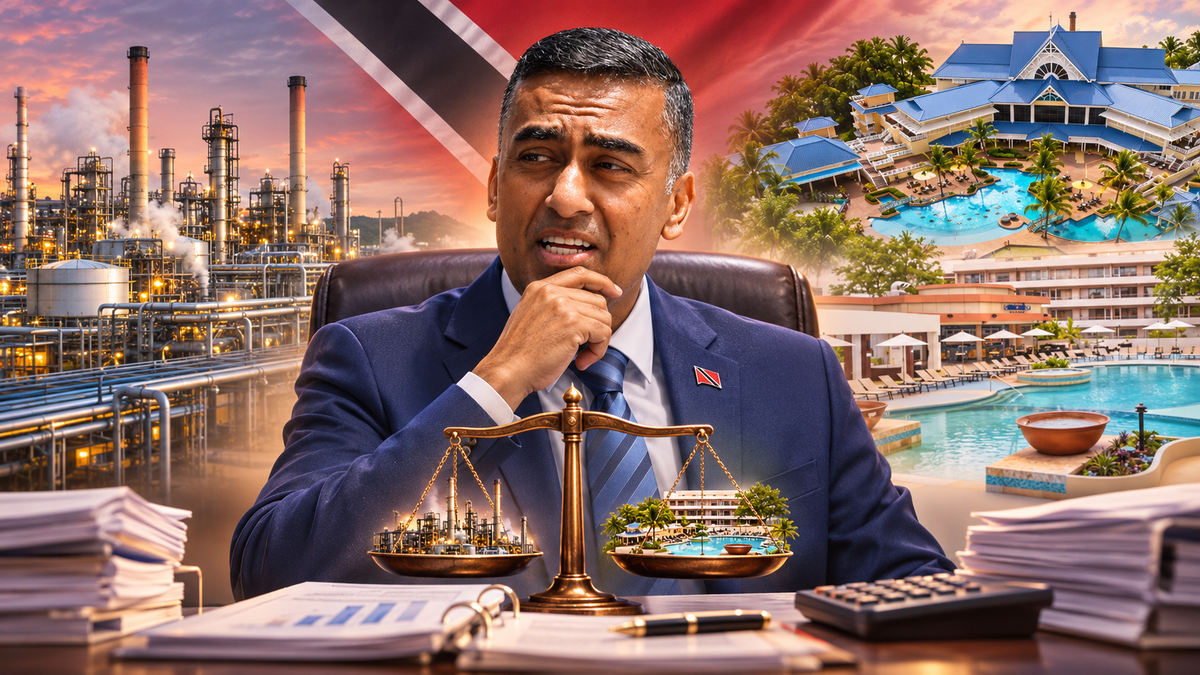
Trinidad and Tobago's 2027 Budget sells off the State’s hotels while reopening its oil refinery. The Prime Minister told the House that “no government should be running hotels”. The Finance Minister told the same House that “we will restart the refinery”. One of those positions is going to give way.

The Brief
- Finance Minister Davendranath Tancoo presented the 2027 Budget on October 12, 2026, with projected spending of TT$63.368 billion and revenue of TT$59.729 billion.
- In the Budget speech, Tancoo confirmed the government will press ahead with a phased restart of the Guaracara (formerly Petrotrin) refinery at Pointe-à-Pierre, closed in November 2018 under the Rowley administration.
- During the Budget debate, the Prime Minister defended planned divestment of loss-making State enterprises, including the Magdalena Grand hotel in Tobago (which she said has accumulated losses of $240 million), the Hilton (which has reportedly asked for approximately $400 million in upgrades), and the State-owned pharmaceutical company Caridoc. She said “no government should be running hotels”.
- The restart of a petroleum refinery is defensible as strategic nationalisation. The divestment of hotels is defensible as fiscal discipline. The two are not in conflict as economics.
- They are in conflict as a public argument. The government is behaving like a strategic nationaliser and arguing like a divester, and it has not reconciled the two.
Two sentences in the 2027 Budget belong next to each other. The UNC has placed them in different speeches.
The first is from Finance Minister Davendranath Tancoo in the Budget presentation on October 12, 2026: “We will restart the refinery.” He was referring to the Guaracara refinery at Pointe-à-Pierre, which the Rowley administration closed in November 2018.
The second is from the Prime Minister during the Budget debate in the days that followed: “No government should be running hotels.” She was defending plans to divest the Magdalena Grand in Tobago (which she said has accumulated losses of $240 million), the Hilton in Port of Spain (which has reportedly asked for approximately $400 million in upgrades), and the State-owned pharmaceutical company Caridoc.
A State-owned petroleum refinery is a different kind of thing from a State-owned hotel. Energy sits in a long tradition of strategic nationalisation, with real public-interest justifications: energy security, sovereign control of a core sector, employment stabilisation in a resource-dependent economy, foreign-exchange capture, and downstream linkage to petrochemicals. Hotels sit in no such tradition. The two are not economically equivalent.
The paradox is not in the economics. The paradox is in the rhetoric. The UNC is behaving like a strategic nationaliser, and arguing like a divester, and treating the two as if they do not need to be reconciled.
The divestments are the clearer half of the picture. The PM named three State entities for divestment: the Magdalena Grand, the Hilton, and Caridoc. She also made a broader argument that loss-making State enterprises should be sold because the taxpayer should not keep funding them. There is a case for this. The Magdalena Grand’s $240 million in accumulated losses is money the State could have put into hospitals and schools. A $400 million upgrade request from the Hilton is a lot of money for a hotel. Caridoc has its own history. Whether the sales themselves will deliver value, or whether the assets will go cheaply to well-connected buyers, is a separate question that will not be answered by the Budget speech. The language the government has chosen is the language of divestment. The State should not run businesses that lose money. That is a free-market framing, and the PM has used it clearly.
The refinery is where the government’s actions are telling a different story.
The Guaracara refinery at Pointe-à-Pierre was closed in November 2018 under the Rowley administration, following accumulated losses that the then-government put at TT$8 billion between 2013 and 2018 and debts of around TT$12 billion. The closure affected approximately 2,600 permanent and 1,200 non-permanent jobs. It became a political wound that never fully healed in central and south Trinidad, and it was a central UNC campaign commitment in 2025. The restart was named in party materials and in the PM’s early statements after her May 1, 2025 swearing-in.
The work since then has moved. Energy Minister Dr Roodal Moonilal established a Refinery Restart Committee under former energy minister Kevin Ramnarine, which delivered an interim report concluding that restart was “technically, commercially and financially viable”. The government has engaged in formal talks with Indian Oil Corporation, with TotalEnergies also mentioned at the margins, and Guyana’s President Irfaan Ali has helped broker introductions to Arab financiers. Just over two weeks ago, Minister Moonilal appointed Gowtam Maharaj (a former Petrotrin refinery manager with 28 years at the company, and currently chairman of the Penal/Debe Regional Corporation) as chairman of a new Guaracara Refining Company board. The OWTU welcomed the appointment publicly as “another Labour Movement recommendation to a State board”.
The structure does not include a private partner to take majority ownership of the refinery and bear the operating risk. The arrangement Minister Moonilal has described keeps the asset in State hands and brings in international firms as technical and commercial assistance. The equity stays public. The debt, if the restart falters, stays public too.
That is strategic nationalisation. It is a reasonable thing for a government to do with an energy asset, and a long list of oil-producing economies have done it, including Mexico with Pemex and Norway with Equinor. If the UNC’s position is that Trinidad and Tobago needs a sovereign refining capacity for reasons of fuel security, foreign exchange, and petrochemical linkage, that is a defensible position. The problem is that this is not the position the government has publicly argued.
Instead, the government has given three other kinds of answer, none of which does the full job.
The honest answer, which it has avoided, is the strategic one. State ownership of core energy infrastructure is in the public interest in ways that State ownership of hotels is not. If the government said this plainly, in those terms, the inconsistency between the Tancoo sentence and the Persad-Bissessar sentence dissolves. The two would be understood as applications of different principles to different categories of asset. The reason the government has not said this plainly is political. A strategic nationalisation argument requires defending State ownership on principle, which is uncomfortable territory for a government that has just told the country no government should be running hotels. The two arguments can coexist, but only if the government is willing to say that different sectors warrant different treatment, and to say why.
The historical answer is that the Rowley administration closed Petrotrin, and reversing that closure is politically important to the UNC base in central and south Trinidad. This is probably true as a reading of motivation. It is also an acknowledgement that the restart is driven by the previous election rather than by any principle the Budget articulates. That is normal in politics. What is less normal is to see it coexisting in a single budget cycle with the strongest statement in favour of divestment that a sitting Trinidadian prime minister has made in years, without the two being brought together.
The pragmatic answer is that the hotels can be sold because there are buyers. The refinery cannot easily be sold, because the previous administration tried and failed to sell it. The Patriotic Energies and Technologies bid under the OWTU in 2019 collapsed. A later process under then-Minister Stuart Young in 2024 produced what Young himself described from the floor of Parliament as a “fake and fraudulent” US$1.5 billion offer letter. If the refinery cannot be sold, the choice narrows to leaving it to rust at TT$5.6 million a month in holding costs, or restarting it under State operation. From that angle, restart is the least-bad available option. The pragmatic answer explains the policy, but it does not do the argumentative work. “We could not sell it so we are running it” is not a doctrine.
What we have, then, is a government that is doing something defensible (strategic nationalisation of a core energy asset) while publicly justifying it with language that comes from somewhere else (fiscal discipline, taxpayers should not fund losses, State should not run businesses). The gap between the two matters for three reasons.
The first is political. If the restart succeeds, the UNC will have delivered a strategic nationalisation it never named. If the restart fails, the UNC will have burned public money on something it never justified. Either way, the voters will have been handed a result without having been given the argument that produced it, which breeds the kind of cynicism Trinidad and Tobago does not need any more of.
The second is operational. A government that cannot articulate why it is doing something has a harder time doing it well. The Petrotrin restart will involve genuinely difficult decisions over the next twelve to eighteen months about financing structures, operating partners, workforce composition, and the role of OWTU. Each of those decisions is easier to defend if there is a public doctrine in place about why the State is running this refinery. There is not yet one.
The third is precedential. If the State can renationalise a refinery without articulating the doctrine, it can also sell off other assets without articulating the doctrine, and nobody will be able to tell afterwards whether the decisions have been coherent or ad hoc. The Budget is where governments usually tell citizens what they believe about the State’s role in the economy. The 2027 Budget does not quite do that.
My take is that the UNC does not have a settled position on this question yet. It has a set of political commitments inherited from the campaign (reopen the refinery, protect pensions, restore public sector pay) and a set of fiscal pressures that have come upon it in office. The PM’s own figures put inherited debt refinancing at $21 billion already borrowed, with another $70 billion falling due over the next five years, while the IMF projects modest 0.8% growth in 2026 before an uncertain acceleration. The campaign commitments push the government towards selective State activism. The fiscal pressures push it towards divestment. The absence of a stated doctrine means the government can do both without owning the contradiction. That is politically convenient. It is also where the trouble starts.
The 2027 Budget asks us to accept that the State should divest its hotels, and to accept that the State should restart its refinery. Both can be defended, on different grounds. The grounds, however, are what the government has yet to tell us.