Tiny Desk, Big Stage: What Kes Just Did for All of Us
Kes The Band's NPR Tiny Desk concert was not just a good gig. It was the kind of soft power we usually only talk about when we are losing it. Pair it with the laptops and prosthetics from India last week, and you start to see what punching above our weight actually looks like.
The Brief
- Kes The Band debuted on NPR's Tiny Desk Concert series on May 8 – the second soca set on the desk in 18 months, after Machel Montano's January 2025 appearance. Tiny Desk reaches roughly 44 million viewers a month.
- The set ran from "Hello" through "Wotless" and closed on "Savannah Grass," dedicated by Kees and Jon Dieffenthaller to their late father George "Bunny" Dieffenthaller and their late sister Danielle.
- India's External Affairs Minister Subrahmanyam Jaishankar concluded a two-day official visit during which 2,000 laptops were handed to pupils across seven school districts, and a National Prosthetics Programme was launched in Penal.
- For a republic of 1.4 million people, both stories sit in the same conversation – how a small country uses what it has, culturally and diplomatically, to claim a seat at tables it was never supposed to sit at.
- The diaspora is part of how that work travels. We don't get to sit out the celebrations any more than we get to sit out the criticisms.
Every once in a while the news cycle gives you a week with two faces. We have been talking, rightly, about Belmont, about the killings, about the security questions that keep coming back without proper answers. But I want to spend this post on the other face. Not because the heavier story has gone away, but because the light moments matter, and we should learn to claim them when they come.
Kes The Band, our soca ambassadors-in-chief, debuted on NPR's Tiny Desk Concert series last Friday morning. If you are reading this in Trinidad and that name doesn't ring a bell, let me explain. NPR – America's National Public Radio – runs a concert series filmed at a small wooden desk in the cluttered corner of an office at NPR Music headquarters in Washington, DC. Tyler the Creator has played the desk. Adele. Lizzo. Stromae. T-Pain's session has been viewed over 100 million times. The series reaches roughly 44 million viewers a month across its channels, and a single appearance can change an artist's American profile in an afternoon.
Caribbean acts have only recently begun to feature in serious numbers. Machel Montano brought soca to the desk in January 2025 with a career-spanning set that ran through "Famalay," "Like Ah Boss" and "Soca Kingdom." Kes's debut on Friday is the second soca Tiny Desk in eighteen months, and both performances were Trinidadian. That is not coincidence. It is the sound of a small republic punching its way into rooms it never used to be invited into.
Kes used the slot to do something I want to consider for a moment.
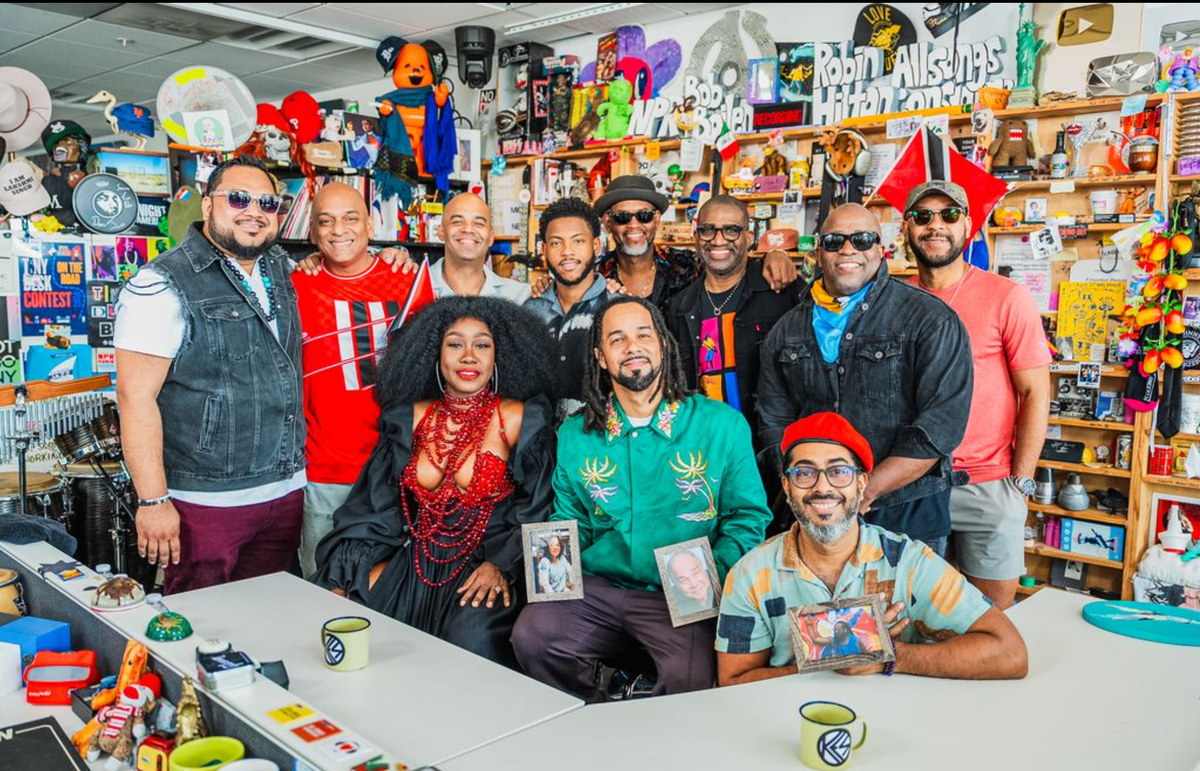
They opened with "Hello." Kees Dieffenthaller's first words to the room – "representing for soca music, happy music, love music" – set the frame for everything that followed. The set walked through "Rum & Coca-Cola," co-written by Michael "Tano" Montano (Machel's dad), then "Jolene," "Cocoa Tea," "Fallin'," and the breakout that made the band a global Carnival staple, "Wotless." There were waving flags and wining in the office. This was not a sanitised, world-music export version of who we are. This was Carnival, in Bob Boilen's old corner of the building, on a platform where the rest of America was forced to take it on its own terms.
They closed on "Savannah Grass," and this is the part of the set I keep going back to. The song is a love letter to the Queen's Park Savannah – the heartbeat of Port of Spain, formerly a sugar cane plantation, now the open green where so much of our cultural life happens. Kees and his brother Jon dedicated the performance to the memory of their father, George "Bunny" Dieffenthaller, credited as a co-writer, and to their late sister Danielle, a filmmaker whose photographs were placed on the desk during the set. Twenty years of Kes The Band, ending a global breakout performance with a tribute to family, to the Savannah, to the whole shape of who they came from. That is the soca tradition doing what it has always done – holding the joy and the grief in the same hand.
I watched the set from my living room in London on Friday evening, with my phone going off in the Trini WhatsApp groups. North London. Brixton. Birmingham. Brooklyn. Toronto. Montreal. Every pardner and old school friend was sharing the same clip back and forth. That is the moment that stays with me. The diaspora WhatsApp groups are where the real temperature of the country gets taken these days, and we have spent more weeks than I can count trading bad news. Last week, for an hour, we were trading something else.
This isn't an isolated moment either. The Tiny Desk premiere lands in the middle of the band's Roots, Rock, Soca tour, which has already moved through Paris and London – they played the O2 Academy Brixton on May 2 – and rolls through North America over the summer. There's a Toronto night at the RBC Amphitheatre on July 4. There's a date in Duluth, Georgia in August co-headlining with Beres Hammond. And last July, Kes became the first soca act to sell out two consecutive SummerStage nights at Central Park, both shows gone within hours, with a return to the venue reportedly on the books for this summer. For Trinis in any of those cities, the band is coming. Twenty years in, soca is travelling further than it has ever travelled.
Now let me bring a second story into the same room, because I think the two belong together.
While Kes was setting up at NPR, India's Minister of External Affairs, Subrahmanyam Jaishankar, was on a two-day official visit to Port of Spain. The Prime Minister addressed Parliament about the visit, and the headline outcomes were specific. Two thousand laptops were handed to pupils across seven school districts in a ceremony at the Rotunda of the Red House. A National Prosthetics Programme was launched in Penal. Several memoranda of understanding were exchanged, covering areas where India's scale and our specificity actually meet – agriculture, technology training, healthcare delivery.
I will say this carefully, because I want to keep my Year One audit of the government honest. Modi's India is not an uncomplicated partner. The democratic backsliding under his administration is well documented, and the diaspora has not been quiet about it. But engaging seriously with India does not mean signing off on every part of the relationship. What it does mean is recognising that a small republic does not get to choose its partners the way a large one does. We have to make the most of who is willing to sit across the table and offer something concrete, and 2,000 laptops in a pupil's hands is concrete. A prosthetics centre in Penal is concrete.
Now hold the two stories side by side and tell me what you see.
One is bottom-up. A band from Trinidad and Tobago, twenty years into its career, walked into one of the most influential rooms in American culture and made it ours for an hour. The other is top-down. A government that took office a year ago with promises on technology, healthcare and diversification used a State visit to land laptops in classrooms and prosthetics in a clinic. Both are about the same thing. What a country of 1.4 million people can do when it knows exactly what it has to offer, and to whom.
This is the part I think the diaspora needs to hear, and I am writing it as much to myself as to anyone else. We are good at remembering what is wrong with home. We have to be – distance and helplessness can curdle into either denial or anger, and most of us choose anger because it feels more honest. But anger is not the only honest response. The clip of Kes on Tiny Desk going around our group chats last weekend was honest too. The pupil holding a laptop in the Rotunda of the Red House was honest. The prosthetics centre in Penal is honest. We are allowed to celebrate these things. We are allowed to put them in the same sentence as our criticisms, not as cancellation but as completion.
I will not pretend the bigger picture has changed. The nursing dispute is unresolved. The Auditor General's qualified opinion stands. A 23-month-old is dead in Belmont, and the architecture that should have protected him is being argued about all over again. The pressure on ordinary households is what it is. But on a Friday in May, soca played at the Tiny Desk to a room of Americans who had probably never heard "Wotless" in their lives, and on a Monday in Penal, a small clinic took delivery of equipment that will let some Trinidadians walk who were not walking last week.
Brighter days remain a promise. Last week, for a few hours at a time, the promise blinked. It was good to see.