The First Closed Area
On November 10, President Christine Kangaloo signed the first closed area declaration under the Special Operations Act. The country she warned on Republic Day is now operating under the powers she warned against. Two constitutional challenges are live. The State has flown in three British KCs.
The Brief
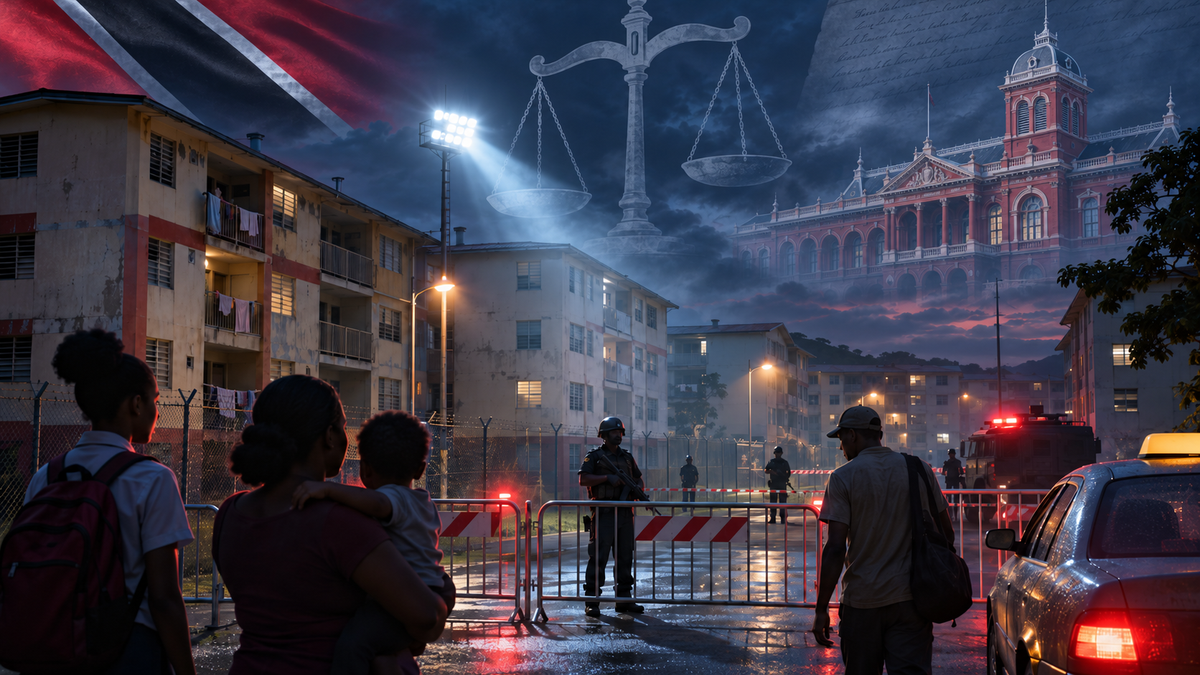
- On November 10, President Kangaloo declared the Maloney Buildings Housing Development a closed area under the Special Operations Act. A nightly curfew runs from 9pm to 5am. Permits are required for outdoor movement
- Two live constitutional challenges. Wendell Eversley, represented by Richard Rojas, filed on November 16 and is assigned to Justice Nirala Bansee-Sookhai. Opposition Leader Pennelope Beckles has sent a ten-page pre-action protocol letter with deadlines of 4pm Friday and 4pm Tuesday November 24
- The State has gazetted authorisation for three British KCs to defend both cases: Sir James Eadie KC, Robert Stephen Strang and Thomas Mountford (working with David Pannick KC). Pannick's reported rate is around £5,000 per hour
- Residents allege five firearms recovered on November 17 were planted. Commissioner Allister Guevarro has challenged them to produce the CCTV evidence they say exists. A Guardian journalist observed an empty 12-gauge ammunition box left behind at the recovery site
- The Catholic Commission for Social Justice has asked that residents be treated with dignity and whether the Special Operations Act can address root causes such as neglect, unemployment and lack of opportunity
- The Prime Minister says she is "not concerned at all" by the challenges and cites a 46.2% drop in murders and a 44.5% drop in robberies
On the 50th anniversary of the Republic, President Christine Kangaloo warned the country that "rights surrendered in anxious times are not always easily recovered". That was September 24. The Special Operations Bill had passed the Senate in the early hours of the same morning, on the casting vote of a Presiding Officer, against the unanimous opposition of the Independent and Opposition benches. The President was setting out where she could see this heading.
Six weeks later she signed the first order under the Act.
The Maloney Buildings Housing Development has been under lockdown since November 10. The President signed the Special Operations Order on the application of the Homeland Security Minister, following a Cabinet briefing on a Special Branch threat assessment. On November 9 a shooting and a stabbing in the development had hospitalised three people. A social media video of the shooting had gone viral. The intelligence assessed, in the President's own words, "a high likelihood that associates of the affected parties will engage in retaliatory violence." The community, her statement of reasons said, was "tense, volatile and highly susceptible to rapid escalation."
I take the assessment seriously and have no basis to question the underlying intelligence. The grief and fear in that development are real, and nothing I write here is meant to make them smaller. What I want to look at is what the order has produced in twelve days, what the law has produced in the courts, and the gap between the State's framing and what is happening on the ground.
Let's start with what Maloney is living through.
The curfew runs nightly from 9pm to 5am. Outdoor movement is barred without a special permit. Taxi drivers who serve the development operate under permit conditions restricting them to 5am to 7pm, so most have stopped by 7pm rather than risk being ticketed outside the window. The nearest they can wait for passengers is a grocery parking lot on Piarco Branch Road, about 900 metres from Maloney Gardens, which is a 10 to 15-minute walk. Kyle Graham, a driver quoted in the Guardian, expects the problem to worsen at Christmas. Pat Alexander, a lifelong resident, called it "just wrong" that people should be walking home in the dark because of a service cutoff nobody had explained to them. Aitch Donner, who lives inside the closed area and attends UWI St Augustine, said her classes end around 7pm and she doubts the operations are still beneficial to security. The businesses inside the development are reporting what some are calling their worst Christmas trading period.
None of that, on its own, settles whether the operation is lawful or necessary. It does tell us how its weight falls on people who had nothing to do with the November 9 incidents.
Then the firearms controversy. On November 17, police recovered five firearms and 39 live 12-gauge cartridges from a fig patch inside the closed area. Within hours, residents alleged on social media that the weapons had been planted to justify continuing the lockdown, and said CCTV footage would back up the claim. By November 19, Commissioner Allister Guevarro had posted a video message demanding the footage. "Twenty-four hours later, crickets," he said. He suggested residents making the allegations could be shielding gang members, and said the police had appointed investigators to examine the claims and were "prepared to subject the matter to scrutiny, because we have nothing to hide."
The Guardian's Jensen La Vende returned to the recovery site the following day and reported observing an empty 12-gauge ammunition box left behind at the scene. The box, he noted, does not prove the firearms were planted. It raises a question, no more, about whether the scene was thoroughly processed and whether the packaging was examined.
Both observations matter. The Commissioner is right that if there is CCTV footage, residents should produce it. La Vende's observation runs the other way. The State cannot process a crime scene, leave a piece of its own evidence packaging behind, and then insist the only question still open is what the residents saw. That is how allegations of planting take root. The State has to show its work.
On November 17, the Catholic Commission for Social Justice, an office of the Roman Catholic Archdiocese of Port of Spain, issued a statement asking that residents be met with "esteem, empathy and dignity." It said human dignity is "inalienable" and that the state must weigh public order against residents' rights. It asked whether the Special Operations Act can address the deeper drivers of what Maloney is going through: neglect, unemployment, lack of opportunity. It asked the public to think about what a large police deployment in a residential community means.
That is a modest set of asks from an institution that rarely gets into legislative detail. It is also the kind of statement the architecture of this law was built to make it easier to put aside. The Act gives the Executive the power to declare and the Police to enforce. The community living inside the declaration has no procedural standing to be heard. The Commission is the only institutional voice speaking for them that does not need to be in court to make itself heard.
Two constitutional cases are now live.
The first was filed on November 16 by Wendell Eversley, represented by Richard Rojas, and has been assigned to Justice Nirala Bansee-Sookhai. Eversley lives in Bon Air West, Arouca, which is outside the Maloney closed area. The claim is brought in the public interest on the basis that his own community could be designated next. The grounds are the ones the Independent senators raised in September. The Act needed a special majority because it infringes fundamental rights. The discretionary powers are too broad and lack safeguards. The Act gives the Prime Minister an effective veto over designating Heads of Special Operations, which puts the political executive into operational police management.
The second is being prepared by Opposition Leader Pennelope Beckles through her attorneys Hove and Associates. Her ten-page pre-action protocol letter, dated November 17, sets two deadlines: 4pm Friday for the Attorney General to confirm immediate safeguards, and 4pm Tuesday November 24 for the full response including the intelligence materials relied on for the Maloney order. Her challenge lists six grounds. Among them, that the restrictions are disproportionate, that the permit and curfew regime is not "prescribed by law," and that the Government has not shown why ordinary policing was insufficient, a condition Section 11(1)(b) of the Act requires the State to meet.
The State's reply has arrived in two parts.
The Attorney General's is procedural. "The State is not a party here to elective litigation. If a claim is filed against the State it will be defended." He expects the cases "will ultimately land in London." He has declined the Opposition's request for additional transparency about movement permits, saying operational decisions rest with the Commissioner and the Head of Special Operations. He has gazetted authorisations for three British King's Counsel. Sir James Eadie KC and Robert Stephen Strang to defend the Beckles challenge. Thomas Mountford, working with David Pannick KC, to defend Eversley. Pannick's reported rate is around £5,000 per hour, or roughly TT$44,650. The other authorisations do not disclose fees.
The Prime Minister's is political. Asked about the Eversley challenge, she said she is "not concerned at all". She accused the PNM of trying to derail the Government's crime-fighting effort and said the easiest route to ending Special Operations would be for the PNM to tell their "one percent drug mafia friends to stop flooding communities with cocaine, heroin, meth, marijuana and guns." She said the Government has cut the murder rate in half in 18 months and cited a 46.2 per cent drop in murders this year and a 44.5 per cent drop in robberies.
The murder drop is real. What has not been published is the attribution analysis that would tell us how much of the drop is traceable to the State of Emergency, to the Special Operations Act, to the closed-area powers in actual use, or to any of the dozen other factors in play. The Prime Minister is asserting that her new powers caused the drop. She has not shown the evidence. That link is the whole policy case for keeping the architecture in place.
Two months ago, in Rights Surrendered in Anxious Times, I wrote that the country was being legislated into an experiment in whether emergency-era powers on the ordinary statute book could deliver crime results without rewriting what constitutional order actually is. I said the answer to that experiment would come in the application rather than the drafting. Maloney is the application. It is the first closed area, the first curfew, the first permit regime, the first legal challenge, the first bill for three British KCs.
Twelve days in, this is what the application has told us.
The powers are being used. They were not reserved for an extreme case. They were triggered by a shooting and a stabbing in a particular estate.
The permit regime is not working for ordinary residents. Taxis stop by 7pm. Residents race home to beat the curfew. Businesses are losing their Christmas trade.
The State cannot answer basic procedural questions about its own operation, from the ammunition box to the transparency on permits to the attribution of the crime drop, without accusing the people asking of shielding gang members.
And the Government is prepared to spend public money at a rate of about TT$45,000 an hour to defend, in the court of the former colonial power, a law passed at 1:30am on Republic Day on the casting vote of a Presiding Officer, against the unanimous opposition of the Independent bench. That the Privy Council is the end of our appellate road is a feature of the constitutional architecture, not a complaint about it. But it invites a question about whether a Government that has otherwise been willing to criticise CARICOM for being insufficiently aligned with its priorities has taken any view on the cost of outsourcing its constitutional defence to the Bar of England and Wales at those rates.
The Catholic Commission asked whether the Act can address root causes. It is a fair question and the answer is no. A closed-area regime is a containment tool. It is not a jobs programme, a housing programme, an education programme, or a mental-health programme. It is a set of curfew, cordon and search powers applied to a community. Whether it is a proportionate response to a particular shooting is a question for the courts. Whether it is a sustainable response to a decades-long problem is a question for the country.
President Kangaloo, two months ago, said in the most careful language available to a head of state that rights surrendered in anxious times are not always easily recovered. On November 10 she signed the first order under the Act she was describing. On November 24 the Opposition's deadline for the Attorney General expires. By the time either of the constitutional challenges is heard in London, the operation in Maloney will have run long enough to tell the country something about what the architecture does.
The architecture is now in use. The country is watching what it does to Maloney. The courts will tell us, in time, what it does to the Constitution.