The Conversation We Are No Longer Having
The SoE was extended at 12.27am on Thursday. The Mid-year Review will hand out the salary money tomorrow. Between the two, the AG said the alternative to extending was Haiti, and the Public Utilities Minister called the nurses racist. This is not conversation. It is rhetoric in place of one.

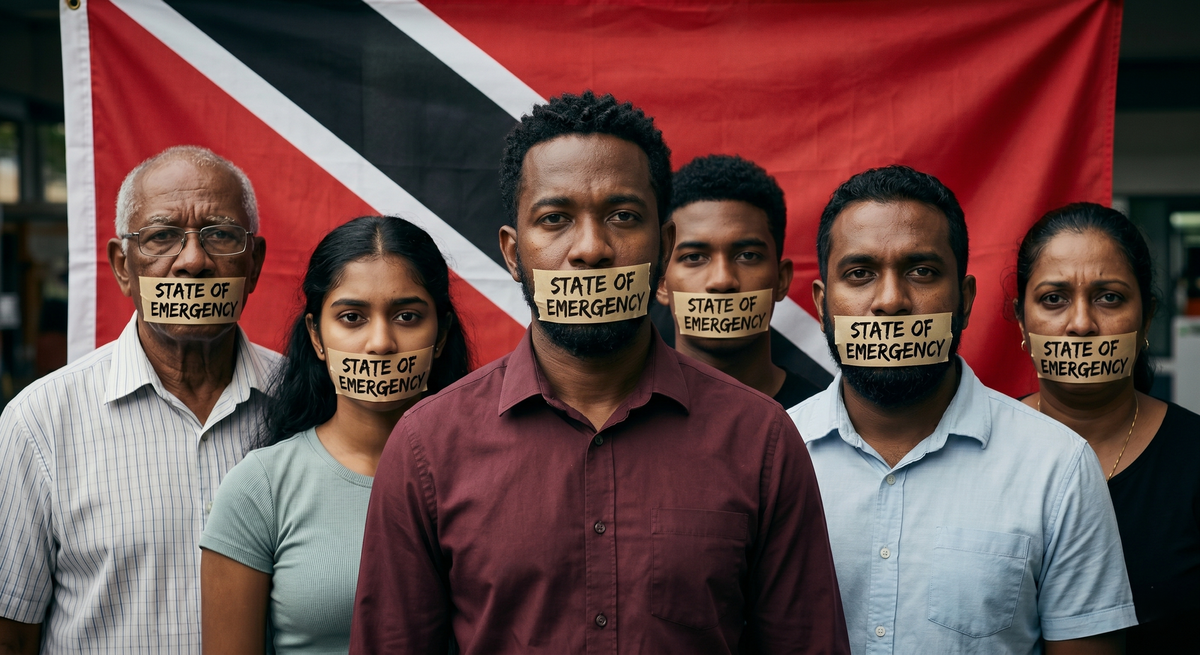
The Brief
- The State of Emergency was extended to September after a midnight vote in the House of Representatives on June 12.
- Attorney General John Jeremie closed the debate by saying the alternative to extending was for the country to follow Haiti.
- Opposition Leader Pennelope Beckles called it the normalisation of a State of Emergency and refused to treat it as a substitute for governance.
- The Mid-year Review on June 15 is set to add $2.93 billion to the Budget, of which $2.83 billion is earmarked for back pay and salary increases for 62,050 unionised workers.
- Public Utilities Minister Barry Padarath has accused the country's nurses of racism for considering protests outside ministers' homes.
- Political analyst Dr Bishnu Ragoonath has called the murder rate "still totally out of control." The TTPS has published a statistical analysis arguing the SoE has produced meaningful reductions.
- Opposition Chief Whip Marvin Gonzales has confirmed the PNM is preparing a formal constitutional challenge to the extension.
Let me start with three sentences, spoken in the same week, by three different people in three different rooms.
The first, from Attorney General John Jeremie on the floor of the House of Representatives at 12.27 in the morning on Thursday, closing the debate on extending the State of Emergency: "We were headed to a very dark place, but Haiti will not be citizens' fate under this UNC Government." The vote followed almost immediately. The SoE now runs until September.
The second, from Opposition Leader Pennelope Beckles a few minutes later. She refused to support what she called the normalisation of a State of Emergency, refused to treat it as a substitute for governance, and asked the question the chamber spent most of the night avoiding: "These SoEs are all about abuse of power and frightening the people into submission. What is this Government so afraid of?"
The third, from Public Utilities Minister Barry Padarath earlier in the week, responding to the Trinidad and Tobago National Nurses' Association's suggestion that nurses might protest outside ministers' homes if the 500-metre order continued to displace them from traditional protest sites: "These actions are being fuelled by a deep-rooted issue that many are speaking about in hushed tones but refuse to make public. It is an issue of hatred for the UNC, racism and prejudice."
Three sentences. Three different speakers. Three different rooms. The same underlying tone.
We are no longer being talked to. We are being talked at, talked about, talked over. The conversation that a democracy is supposed to be is not happening, and the past two weeks have made the absence harder to ignore than it was when I wrote about the 500-metre order, the DPP's warning, and the nine days running up to the vote. This post is about what is missing, named plainly, while we still have the vocabulary.
The vote and the Haiti analogy
At a midnight sitting of the House on Wednesday into Thursday, the SoE was extended for another three months. The motion required a simple majority and passed 26 to 12, with the two TPP MPs voting with the Government. The Senate followed by Friday. The architecture of restrictions that this blog has documented across two posts – the protest zones, the heightened protective powers, the DPP's warning to commentators – is now confirmed through September, and the Prime Minister has signalled she is willing to extend again beyond that.
The intellectual content of the Government's case for the extension reduced, in the closing speech, to a single comparison. Without the SoE, the country was on a path to becoming Haiti. That was the closing sentence of the closing speech of the closing debate.
The more I look at that analogy, the worse it gets. Haiti is the first Black republic in the Western Hemisphere. It is a country whose history has been shaped, more than most in the region, by the long consequences of external intervention, debt impositions and political destabilisation, much of which Haiti did not choose. Trinidad and Tobago is not in that condition. The country has serious crime, and a murder rate that should embarrass any government of any party. None of that is in dispute. But the gap between "we have a crime problem" and "we are about to be Haiti" is not a gap any Cabinet minister gets to close with a sentence on the floor of the House. It is closed, if at all, by evidence – of the kind the Government has, three times now, declined to produce. To use Haiti as the bogeyman in a sentence justifying our own suspension of civil liberties is to deploy our shared regional history badly. It treats a sovereign neighbour as a cautionary tale rather than as a country we are in solidarity with. It implies that what separates Trinidad and Tobago from Haiti is a State of Emergency rather than the longer arc of how we became the countries we are.
The Opposition Leader's response did the work the AG's speech declined to do. She matched the heat without matching the tactics. She did not invoke a foreign country as the alternative to her own position. She did not respond to "grubby PNM hands" with a counter-smear. She made the case directly: that this is the normalisation of a State of Emergency, that emergency powers are no substitute for governance, and that the country deserves an answer to her closing question rather than another midnight extension. That is the kind of intervention the chamber needed and only partially got. It is the line that should be quoted back in the chamber every time the SoE is up for renewal.
The money is real
There is one area where the Government deserves some credit.
The Mid-year Review on Monday will, if the Government delivers what it has already announced, do something substantial. Finance Minister Davendranath Tancoo has flagged $2.93 billion in supplemental funding, of which $2.83 billion is recurrent spending earmarked for back pay and salary increases for some 62,050 unionised workers – public servants, teachers, the defence force, city corporations, and others whose negotiations have finally concluded. The UNC promised, during the election campaign, that it would settle the long-overdue salary disputes that the previous government had not. On the headline number, it has delivered.
I have said in this blog, and will keep saying, that a fair commentator credits a government when it does the thing it said it would do. Settling a decade of stalled wage negotiations in a single budget cycle is, by the metrics of the manifesto, an achievement. The Public Services Association president called the Opposition liars over the comparative figures and, based on the actual money on the table, she has a stronger case than the PNM is willing to acknowledge.
What the Review did not do, on the evidence I have seen so far, is close out the nursing dispute. The TTNNA has been clear that nurses remain on 2013 pay scales in 2026. The supplemental funding may yet be the vehicle through which their settlement comes, and if Idi Stuart announces that, this blog will report it without hesitation. As of the time of writing, before the Review has actually been delivered, the country's most visible labour dispute – the nursing one, the one that has produced the most sustained street action of the Government's first year – remains unresolved. Whether the Review closes it out, or leaves it for another round of escalation, is the question Monday will answer. And the Padarath comments came in response to a TTNNA proposal that arose directly from the consequences of the protest order this blog has been documenting.
So the Government can settle long-running disputes when it chooses to. It has the financial bandwidth, the political will, and the parliamentary majority to do so. Whether the nurses are now in or out of that settlement is the question the next ten days will answer.
When the conversation closes
Which brings us back to Padarath.
He has now extended to the country's nurses the same move the Prime Minister used against the Sealy protesters: from policy disagreement to motivational suspicion. The nurses are the people who held up the public health system at 2013 salaries through the pandemic and beyond. According to a sitting Cabinet minister, the reason they might protest outside a Cabinet minister's home is not the 500-metre order that has closed off public spaces, and not the unresolved salary dispute. The reason is racism.
There is no point engaging with that position on its merits, because it has none. A government that responds to criticism by calling its critics racist has stopped having a conversation with its country. That is true regardless of which party is in office and which group is being so labelled. The PNM had its own versions of this technique. None of them were good for the country either.
What I will engage with is what this kind of framing produces. Three accountability questions in three months. The Belmont killings and the ZOSO Bill. The protest restrictions and the DPP's warning. The nursing dispute and the displaced protests. In every case, the Government's first response has been to question the motives of the people raising the concern. Grifters. Publicity farming. Hatred. Racism. The motives shift, the technique does not. When the technique becomes the default, the substance stops being something we discuss.
The political analyst Dr Bishnu Ragoonath has argued publicly that the murder rate "is still totally out of control" despite the SoE. The Government has its own counter on the public record. The TTPS released a statistical analysis three days ago concluding that all three of the country's recent SoEs have been associated with meaningful reductions in murders, and that the current SoE has produced the strongest reduction of the three.
Both claims deserve to be on the table. The Government's claim is grounded in time-series forecasting and division-level data, methodologies that are not trivial to dismiss. Ragoonath's claim is grounded in the lived perception of citizens and the wider observation that statistical reductions in murder are not the same thing as a country feeling safe. The Government's argument is the technocratic one. Ragoonath's is the experiential one. Both are saying something true, and the debate the country deserves is one in which both are taken seriously.
Also last week, regional security consultant Dr Garvin Heerah – who is not aligned with either party – told the Trinidad Express that any SoE extension needs to be "time-bound, goal-specific, and subject to independent accountability." On the standard he set, none of those three boxes has been ticked on the current extension. The Government has not specified what success would look like. It has not set a benchmark for non-renewal. It has not, beyond the TTPS analysis itself, provided independent oversight of what the SoE is achieving and what it is not.
The Attorney General's closing line about Haiti did not earn the data the TTPS analysis contains. If the SoE is producing genuine reductions in murder, the country needs to hear that argument made carefully, with the data, in daylight, on the floor of the House where MPs can question it. Not at 12.27 in the morning as a metaphor about a neighbour.
What is actually being asked of us
There is a phrase families use when something has been wrong for long enough that it has to be addressed at the kitchen table. We need to talk. It is what unions say when negotiations have broken down. It is what neighbours say when something needs sorting out before it gets worse. We need to talk. It is the foundational request of any community that has not yet given up on itself.
The Government, this week, has not been talking. It has been deciding, announcing, deflecting, and labelling. Each of those is a function of governing. None of them is conversation. And in the spaces where conversation used to happen – the parliamentary debate, the public-square protest, the editorial page, the DPP's office – the Government has installed either a restriction, a warning or a motivational accusation.
To be clear: this is not a PNM piece. The PNM, in office, did versions of all of this. Its current arguments would carry more weight if its own conduct in government had been more consistent. The point is not which party is doing the talking-at. The point is that we are no longer doing the talking-with, and the institutional grammar that makes the talking-with possible is being slowly dismantled, one Legal Notice and one ministerial press release at a time.
For Trinis abroad, this is the part of the conversation we are in a privileged position to insist on. The diaspora has the distance to see the country whole, without having to live inside any single week of it. We have the right – earned by remittances, by visits home, by the lives we have built that still have one foot in the country – to keep asking what kind of place we are choosing to be. We do not get to make the choice for those at home. But we get to be a voice that does not let the question close.
One thing has shifted while I have been writing. Opposition Chief Whip Marvin Gonzales has confirmed that the PNM is taking advice from senior counsel on a formal constitutional challenge to the SoE's extension. Whatever you think of the PNM, the legal route I have been flagging is no longer theoretical. The constitutional questions are about to be tested where they should have been tested all along – in court, in the open, with evidence on both sides. That is the conversation we are owed. If it has to begin in litigation rather than in dialogue, so be it.
There is a wider story behind all of this, about the country's foreign policy, our changing relationship with CARICOM, and the position we are taking on the United States and Venezuela. That conversation is coming soon in this space. The version of it that arrives today is the domestic one. Inside our own borders, in our own chamber, between our own institutions, the conversation we are supposed to be having with ourselves is the one we are no longer having.
If we want it back, we have to insist on it. Out loud. In every space where insisting is still legal.